How to Increase Hot Water Heater Capacity: 9 Effective Upgrades and Tips
To effectively increase your hot water heater capacity, consider these strategies: upsize the tank, install a high-recovery or hybrid heat pump unit, add a tankless on-demand booster, upgrade burners or elements, fit thermostatic mixing valves, use low-flow fixtures, and implement a demand-controlled recirculation pump. Ensure proper sizing, regular maintenance (such as flushing and checking the anode), and code-compliant installation to maximize efficiency. Additional sections will cover costs, sizing guidance, troubleshooting, and necessary permits for each option.
How to Quickly Determine If You Need More Hot Water Capacity
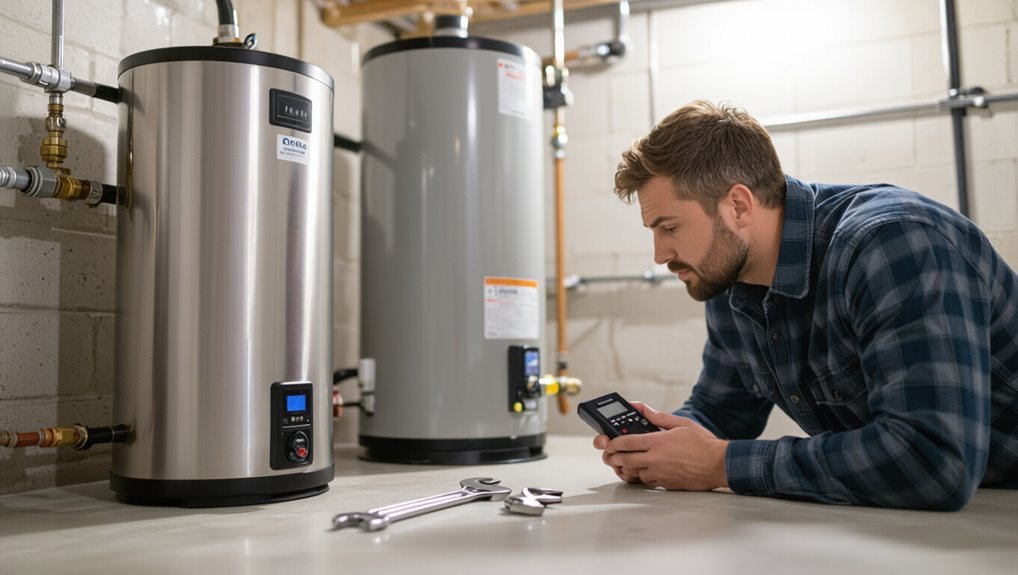
Signs such as running out of hot water during showers, long recovery times, or fluctuating temperatures indicate an undersized heater.
A quick assessment combines the unit’s first hour rating and recovery rate to estimate effective hot water capacity.
The decision to replace the tank or upgrade components depends on age, efficiency, and whether increased capacity or faster recovery is the primary need.
Common signs your water heater is undersized
How can a homeowner tell whether a water heater is too small for household needs? Common signs include rapid depletion of hot water during showers, simultaneous-use shortages (multiple fixtures running out), lukewarm recovery between uses, frequent thermostat cycling, and reliance on temperature boosts.
Recognizing these indicators informs decisions about how to increase hot water heater capacity through upgrades, replacing units, or adjusting usage patterns.
How to calculate current effective hot water capacity (first hour rating and recovery)
When evaluating whether a water heater meets household demand, the most useful metric is the unit’s effective hot water capacity—typically expressed as the first hour rating (FHR)—which combines the tank’s usable gallons with the heater’s recovery rate to show how much hot water is available during a typical hour of peak use.
Calculate FHR by adding usable tank volume (tank size minus cold water draw) to one hour’s recovery output; compare to peak-hour demand.
When replacing vs upgrading is the better option
Determining whether to replace a water heater entirely or upgrade its components depends on the gap between calculated demand (such as FHR) and actual household usage, the unit’s age and condition, and budget constraints.
If demand exceeds capacity and the unit is old or inefficient, replacement is advisable.
If the tank is sound and shortfalls stem from poor recovery or insulation, targeted upgrades suffice.
Nine Practical Upgrades and Modifications to Increase Hot Water Availability
The section outlines practical upgrades and modifications that reliably increase hot water availability for residential systems.
Recommendations range from straightforward tank swaps to integrating supplemental on-demand units and improving recovery efficiency. Each option balances cost, installation complexity, and expected performance gains.
- Increase tank size or replace with a larger tank
- Install a high-efficiency, higher-recovery tank-style water heater
- Add a tankless (on-demand) water heater as a supplemental system
- Convert to a hybrid heat pump water heater or install a demand-controlled recirculation pump
Increase tank size or replace with a larger tank
When considering an upgrade, homeowners should first match tank volume to household peak demand by counting simultaneous hot water uses and estimating flow rates.
The discussion weighs choosing a slightly larger tank to prevent shortages against higher upfront cost, increased standby heat loss, and space requirements.
Practical guidance includes simple sizing rules of thumb and trade-offs to help decide if upsizing or replacing is the better option.
How to choose the right tank volume for your household
How much hot water a household needs depends on the number of occupants, simultaneous usage patterns, and peak-demand activities; choosing the right tank volume requires matching those factors to the heater’s first-hour rating and recovery rate to avoid shortages.
Calculate typical peak-hour demand, add margin for guests or appliances, compare candidate tanks’ usable capacity, and consider future household changes when selecting volume.
Pros and cons of upsizing a storage tank
Although upsizing a storage tank requires more space and a higher upfront cost, it offers a straightforward way to increase on-demand hot water by raising stored usable capacity and reducing the frequency of cold-water dips during peak use.
Benefits include simplicity, predictable performance, and compatibility with existing systems.
Drawbacks are greater energy standby losses, increased installation complexity, and potentially higher maintenance and replacement expenses.
Install a high-efficiency, higher-recovery tank-style water heater
A high-efficiency, higher-recovery tank-style water heater is defined by its recovery rate—the volume of hot water it can restore to set temperature per hour—which directly affects how quickly the tank supplies additional hot water during heavy use.
Choosing a unit with a faster recovery reduces the chance of running out of hot water but may require more fuel input or advanced heat exchangers.
Comparing energy use and operating costs between higher-recovery models and standard units helps determine whether the increased performance justifies the long-term expense.
What recovery rate means and why it matters
Recovery rate refers to how quickly a water heater reheats incoming cold water after the stored hot water has been drawn.
It directly determines how long a tank can continue to supply near-design-temperature water during successive uses. A higher recovery shortens wait times between showers and reduces temperature drop during peak demand.
Recovery depends on burner/element capacity, heat exchanger design, and fuel type; it guides upgrade decisions.
Energy implications and operating cost comparison
Understanding how quickly a heater restores temperature naturally leads to examining the energy and cost trade-offs of choosing a high-efficiency, higher-recovery tank-style unit.
Higher recovery reduces standby cooling and shortens reheating cycles, lowering fuel or electricity consumption per usable gallon. Initial purchase and installation costs rise, but lifecycle operating savings—especially in cold climates or high-demand households—often justify the premium.
Add a tankless (on-demand) water heater as a supplemental system
Adding a tankless on-demand unit as a supplement allows targeted boosts in hot water delivery without replacing the existing tank.
The discussion compares point-of-use versus whole-house pairing strategies and outlines load‑balancing and sizing guidelines for hybrid systems.
Practical guidance focuses on matching flow rates and recovery requirements to peak demand.
Point-of-use vs whole-house tankless pairing strategies
Compare point-of-use and whole-house tankless configurations to determine which best supplements an existing storage heater:
Point-of-use units deliver instant hot water at or near fixtures with minimal distribution losses and simpler installation.
In contrast, a whole-house tankless can serve multiple outlets but may require larger gas/electrical capacity and careful flow-rate sizing to avoid simultaneous-demand shortfalls.
Point-of-use suits localized high-demand fixtures; whole-house favors centralized replacement or broad supplementation.
Load balancing and sizing guidelines for hybrid systems
Assess load balancing and proper sizing before integrating a tankless unit into a storage-heater system to secure steady output under varying demand.
Calculate peak flow rates, concurrent draws, and temperature rise required. Select tankless capacity to cover residual peak after storage contribution.
Incorporate priority controls or diverter valves, monitor system cycling, and confirm electrical/gas service matches combined load for reliable hybrid performance.
Convert to a hybrid heat pump water heater
A conversion to a hybrid heat pump water heater can substantially increase effective hot water capacity while using less electricity. However, performance varies with ambient temperature and may drop in cold climates.
Homeowners should evaluate unit-rated recovery rates and backup heating settings for reliable supply during winter.
Available rebates, tax credits, and expected payback periods often offset higher upfront costs and should be included in the replacement decision.
Capacity and performance considerations in cold climates
Because heat pump water heaters extract ambient warmth, their capacity and cycle efficiency change noticeably in cold climates, requiring careful evaluation before conversion.
Reduced inlet air temperatures lower recovery rates and may trigger supplemental resistance heating, increasing operating costs.
Sizing should account for longer recovery times, insulated storage, and placement in warmer conditioned spaces or garages to maintain expected performance without excessive energy penalties.
Incentives and payback period for heat pump models
Many utilities, state programs, and federal incentives now target heat pump water heaters, reducing upfront costs and shortening typical payback periods.
Incentives, rebates, and tax credits can cut installation costs considerably; combined with 2–5× greater efficiency versus resistance heaters, owners often see payback in 2–7 years depending on energy prices, usage, and climate.
Lifespan and maintenance further improve lifetime savings.
Install a demand-controlled recirculation pump or upgrade existing recirculation
Recirculation systems can make a household feel as if it has more hot water by keeping hot water at fixtures. However, continuous operation can waste energy and water.
Installing a demand-controlled recirculation pump or upgrading controls reduces standby losses by running the loop only when needed.
Smart controls and programmable timers further optimize availability by matching circulation to occupancy patterns and hot-water usage.
How recirculation affects perceived capacity and water waste
Installations that move hot water back to the heater on a controlled schedule or on demand can dramatically change how quickly fixtures deliver usable hot water, effectively increasing perceived capacity without altering tank size.
Recirculation reduces wait time and wasted cold water but can increase energy use and standby losses if continuously operated.
Properly balanced systems minimize waste by matching flow, routing, and return temperatures.
Smart controls and timer options to optimize availability
When timed or triggered intelligently, a recirculation pump can provide near-instant hot water to fixtures while minimizing wasted water and excess energy use.
Smart controls—occupancy sensors, push-button demand switches, app scheduling, and adaptive algorithms—activate circulation only when needed.
Timers and temperature setpoints reduce runtime and heat loss; integration with home automation and learning routines optimizes availability while minimizing energy and pump wear.
Add a small accumulator tank or buffer tank to key fixtures
A small accumulator or buffer tank can be installed near high-demand fixtures—such as master bathrooms, laundry rooms, or kitchens—to provide immediate hot water and reduce wait time.
Proper sizing should match the fixture cluster and typical simultaneous use (for example, a 5–20 gallon tank for dual showers or to smooth appliance cycles).
These tanks are particularly useful for handling overlapping draws like concurrent showers and washing machine cycles, preventing cold-water interruptions and lowering strain on the main heater.
Best locations and sizing recommendations for buffer tanks
Place small buffer or accumulator tanks as close as practical to the fixtures they serve—typically under sinks, behind laundry units, or near showers—to minimize wait time and heat loss.
Select sizes based on fixture demand: 2–5 gallons for single fixtures, 5–10 gallons for grouped fixtures, larger for simultaneous use.
Account for recovery rate, available space, installation access, and local code when finalizing capacity.
Use cases: simultaneous showers, appliance cycles
Several common household scenarios—simultaneous showers, stacked laundry and dishwasher cycles, and back-to-back sink use—benefit from installing small accumulator or buffer tanks at key fixtures to smooth peak demand, reduce temperature drop, and shorten wait times.
These tanks supply immediate hot water during short high-demand bursts, prevent cold-water dips, improve appliance performance, and allow more flexible scheduling without upsizing the main heater.
Improve water heater recovery with a higher BTU burner or larger electric element
Upgrading to a higher-BTU gas burner or installing larger electric elements can noticeably speed a water heater’s recovery time, but the two approaches differ in cost, complexity, and performance.
Professionals must consider safety measures, local codes, and manufacturer warranty restrictions before modifying fuel or electrical components.
A comparison of fuel-side and electric upgrades helps determine which option delivers the desired recovery improvement within regulatory and warranty constraints.
Gas burner upgrades vs electrical element swaps
Boosting a water heater’s recovery rate can be achieved by increasing the gas burner’s BTU output or installing a larger electric heating element, each approach offering distinct performance gains and trade-offs.
Gas upgrades deliver faster heat-up and higher flow but may need venting and fuel adjustments.
Electric element swaps are simpler, quieter, and require adequate circuit capacity; both affect recovery time and energy use.
Safety, code, and warranty considerations
Any modification meant to raise a water heater’s recovery—whether increasing a gas burner’s BTU rating or fitting a higher‑wattage electric element—must be evaluated against safety codes, manufacturer warranty terms, and local permitting requirements.
Professionals should verify venting, combustion air, pressure relief valve capacity, wiring, and element compatibility.
Unauthorized changes can void warranties, create hazards, and trigger inspection or permit violations; always consult licensed contractors and local authorities.
Implement demand management with thermostatic mixing valves and fixture upgrades
Thermostatic mixing valves increase usable hot water by blending cold with stored hot to deliver a stable set temperature, effectively stretching a tank’s supply without raising its thermostat.
Pairing these valves with low-flow fixtures and smart shower controls reduces peak demand and water waste, extending the practical capacity of the system.
Together, temperature control and demand-reducing fixtures offer a cost-effective way to improve hot water availability.
How thermostatic mixing increases usable hot water
When a thermostatic mixing valve is installed to blend hot water with cold at fixtures, it raises the volume of usable warm water by delivering consistent, lower-temperature flow without requiring the tank to supply full-temperature output.
This conserves stored hot water, reduces drawdown, maintains safer delivery temperatures, and minimizes thermostat cycling.
Overall household usable hot-water capacity effectively increases without changing tank size.
Low-flow fixtures and smart shower controls that extend capacity
Reduce water demand at the fixture level by installing low-flow faucets, aerators, and showerheads and by adopting smart shower controls that limit runtime and tailor flow to need.
These measures reduce simultaneous hot water draw, extending usable capacity.
Smart controls offer preset temperatures, pause functions, and user feedback to prevent waste.
Combined with thermostatic mixing, they optimize delivery without lowering comfort.
Enhance insulation and reduce heat loss from the tank and distribution lines
Improving insulation around the water heater and distribution lines reduces standby heat loss and effectively increases usable hot water.
Common measures include adding an insulated tank blanket, wrapping accessible hot pipes with foam insulation, and sealing drafts around the heater, with expected gains of a few percent to over ten percent depending on existing losses.
Many tasks are straightforward DIY jobs, while full jacket installations, hard-to-reach line insulation, or air-sealing in utility spaces may warrant a professional.
Insulation blankets, pipe insulation, and draft sealing
Wrap the water heater and seal adjacent openings to minimize standby heat loss and preserve stored hot water.
Install a properly rated insulation blanket around older tanks, insulate hot and cold piping with foam sleeves, and seal gaps where cold air drafts contact the tank or flue.
These measures reduce heat transfer, lower burner runtime, and stabilize delivered temperatures without altering plumbing or controls.
Expected gains and simple DIY vs professional options
After insulating the tank, pipes, and sealing drafts, homeowners will want to know how much hotter-water availability can realistically improve and which upgrades are practical to attempt themselves versus when to call a pro.
Typical gains: 10–30% longer draw from insulation and pipe wraps.
DIY: insulation, thermostat setback, simple mixing valve replacement.
Pro: tank replacement, adding a larger element, plumbing reconfiguration, or installing a booster.
How to Size and Configure Upgrades for Your Home
A clear, step-by-step method for calculating household hot water demand guides which upgrades are needed.
A compact sizing worksheet shows how to combine tank capacity, first-hour rating, and recovery to meet that demand.
Recommendations then match likely upgrade options to common scenarios — single occupants, families of four or more, and multi-bath homes.
Step-by-step method to calculate household hot water demand
When determining how much hot water a household requires, begin by listing every fixture and appliance that uses hot water and noting their flow rates and typical use durations.
Multiply flow rate by duration for each item to get gallons per event.
Estimate concurrent usage patterns, sum overlapping events for peak demand, and add a safety margin to accommodate variations and short simultaneous runs.
Sizing worksheet: combining tank capacity, first-hour rating, and recovery
Sizing a household hot water system requires balancing three linked metrics—tank capacity, first-hour rating (FHR), and recovery rate—to guarantee peak demand is met without unnecessary oversizing. A simple worksheet lists required demand, compares FHR to peak hour need, and checks recovery to refill between events. Use this table to record values and decision notes.
| Metric | Value/Notes |
|---|---|
| Tank capacity | |
| FHR & recovery |
Matching upgrade options to common household scenarios (1 to 2 person, family of 4+, multi-bath homes)
With the worksheet complete, homeowners can match specific upgrade options to typical household patterns by comparing recorded demand to available tank capacity, FHR, and recovery rate.
For 1–2 people, small tank or point-of-use boosters suffice. Families of four+ benefit from larger tanks, higher FHR, or hybrid heat pump units.
Multi-bath homes often need tankless or parallel systems with adequate recovery to prevent simultaneous shortages.
Cost, Energy, and Environmental Considerations
A concise comparison of upfront and lifecycle costs for tank upgrades, tankless units, and hybrid heat-pump systems helps homeowners weigh options.
Energy efficiency differences and example operating cost calculations clarify long-term savings potential.
Emissions implications and available incentives or rebates should be noted to inform both environmental impact and payback timelines.
Comparative cost estimates for each upgrade option
When evaluating upgrades to increase hot water heater capacity, homeowners should weigh upfront costs, long-term energy expenses, and environmental impacts together rather than in isolation. Comparative cost estimates vary by option:
| Upgrade | Typical Upfront Cost | Environmental Note |
|---|---|---|
| Larger tank | $800–$2,500 | Higher material impact |
| Tankless unit | $1,000–$3,500 | Lower emissions potential |
| Heat pump | $2,000–$5,000 | Best efficiency tradeoff |
Energy efficiency impacts and operating cost examples
Because operating costs depend as much on efficiency as on purchase price, comparing energy use and annual expenses is essential for choosing a capacity upgrade.
Higher-efficiency models or heat pump hybrids reduce kilowatt-hour or therm consumption, lowering monthly bills despite higher upfront cost.
Example scenarios show tank replacement, added storage, or point-of-use boosters altering annual energy use and payback periods.
Emissions and potential incentive/rebate sources
While upgrading hot water capacity often focuses on cost and convenience, the choice also affects greenhouse gas and local pollutant emissions and can reveal financial incentives.
Selecting heat pumps or high-efficiency gas units reduces emissions; switching fuels (electricity from renewables) can lower lifecycle impact.
Utilities, state programs, and federal rebates often subsidize efficient models or heat pump installations; check local incentives and eligibility before purchasing.
Installation, Safety, and Code Compliance
Decisions about increasing hot water heater capacity often require professional intervention, and a licensed plumber or HVAC technician should be engaged for complex installations or when local regulations demand it.
Proper permits, compliance with local codes and venting requirements, and attention to manufacturer instructions are essential to pass inspection and guarantee safe operation.
Post-upgrade safety checks — including testing the temperature-pressure relief valve, evaluating the need for an expansion tank, and verifying backflow prevention — complete the installation checklist.
When to hire a licensed plumber or HVAC technician
Determine the need for a licensed plumber or HVAC technician when hot water heater work involves installation, gas connections, electrical modifications, or permits.
They should also be consulted for sizing, fuel-type conversions, complex venting, combustion safety testing, or when modifying water lines and pressure systems.
Hiring guarantees correct installation, adherence to codes, warranty preservation, and reduced risk of leaks, fires, carbon monoxide, or improper performance.
Permits, local code issues, and venting requirements
Because water heater installations intersect plumbing, mechanical, gas, and electrical codes, homeowners and contractors must confirm permit requirements and local regulations before beginning work.
Compliance includes approved venting materials, clearances, combustion air provisions, and termination locations.
Inspectors may require calculations for increased BTU or tank size, sealed combustion for tight homes, and certified installation documentation to satisfy safety and code enforcement.
Safety checks after upgrade: pressure relief, expansion tanks, and backflow prevention
After an upgrade to increase hot water capacity, immediate safety checks confirm the system handles higher pressure and volume without hazard.
Inspect the temperature and pressure relief valve for proper operation and correct discharge piping.
Verify an appropriately sized expansion tank to absorb thermal expansion.
Ascertain backflow prevention devices are installed and tested to protect potable water.
Document results and correct deficiencies per code.
Common Problems After Upgrading and How to Troubleshoot
After an upgrade, users may encounter temperature fluctuations and short cycling caused by thermostat miscalibration, improper tank sizing, or incorrect control settings.
Insufficient recovery can stem from undersized heating elements or blocked flow; a concise diagnostic checklist should verify element wattage, dip tube placement, and supply line sizing.
In larger systems, measures to prevent Legionella and stagnation—regular flushing, maintaining appropriate storage temperatures, and avoiding dead legs—should be reviewed and implemented.
Temperature fluctuations and short cycling causes
Temperature fluctuations and short cycling are common symptoms homeowners notice after increasing a water heater’s capacity. These issues typically signal thermostat miscalibration, undersized recovery rate, improper dip tube placement, or incompatible control settings.
Technicians should verify thermostat setpoints and sensing accuracy, inspect dip tube alignment and inlet/outlet piping, confirm element or burner sizing for demand, and check controller programming and sensors for oscillation or false triggers.
Insufficient recovery after modifications diagnostic checklist
Begin by systematically verifying the system’s ability to restore set temperature within expected timeframes: check burner/element output, thermostat calibration, and recovery rate against manufacturer specs.
Inspect inlet water temperature, dip tube condition, and any added mixing valves or tempering devices.
Confirm correct gas pressure or breaker sizing and plumbing flow restrictions.
Log cycles and test under typical demand to isolate faults.
Preventing Legionella and stagnation in larger systems
Verification of recovery performance naturally leads to addressing microbiological risks that grow with increased storage and more complex piping.
The article recommends maintaining hot water temperatures above 60°C where safe, ensuring circulation to eliminate dead legs, routine flushing and disinfection, installing thermostatic controls and mixing valves, monitoring residual disinfectant, and scheduling microbiological testing.
Documentation and preventive maintenance reduce Legionella risk after capacity upgrades.
Maintenance Practices to Sustain Increased Hot Water Performance
Routine flushing, periodic anode rod inspections, and heating-element checks keep storage tanks operating at designed capacity and reduce sediment-related efficiency loss.
Hybrid and heat-pump units require seasonal inspections of fans, refrigerant circuits, and defrost functions to maintain delivered hot-water volume.
Adding smart monitoring and simple user habits, such as spacing showers and lowering unnecessary setpoints, helps preserve effective capacity over time.
Routine flushing, anode inspection, and element checks
Maintaining increased hot water capacity depends on regular flushing, timely anode inspections, and periodic element checks to prevent scale buildup, corrosion, and heating inefficiencies.
Flushing removes sediment that reduces tank volume and transfer efficiency.
Inspecting and replacing sacrificial anodes limits corrosion.
Testing and cleaning or replacing heating elements preserves output and efficiency.
Documenting intervals and results guarantees consistent performance and prolongs system lifespan.
Seasonal checks for hybrid and heat pump systems
After addressing tank flushing, anode condition, and element functionality, attention shifts to seasonal checks specific to hybrid and heat pump water heaters.
Inspect air filters, coils, and condensate drains for debris; verify defrost cycles and refrigerant integrity; confirm fan operation and airflow paths.
Adjust setpoints for colder months, guarantee adequate clearance around units, and document anomalies for technician review to maintain efficiency and capacity.
Smart monitoring and simple habits to preserve effective capacity
Implementing smart monitoring alongside simple daily habits helps preserve the increased effective capacity of a hot water system by detecting issues early and reducing unnecessary demand.
Remote sensors, leak detectors, and temperature setback schedules provide alerts and usage data.
Routine tasks—fixing drips, insulating pipes, staggered appliance use, and periodic flushing—minimize heat loss and wasting, extending usable hot water between recovery cycles.
Decision Checklist: Choosing the Right Combination of Upgrades
A concise decision checklist helps homeowners weigh budget, available space, energy goals, and household usage patterns to identify the most effective upgrade combination.
A simple prioritization matrix can rank options such as tank expansion, heat pump retrofits, or point-of-use boosters based on those criteria.
Example plans for three typical household profiles illustrate practical application and expected outcomes.
Prioritization matrix: budget, space, energy goals, and usage pattern
When choosing upgrades, homeowners should weigh budget, available space, energy goals, and household usage to determine which combination will deliver the greatest practical benefit. A prioritization matrix ranks options by cost, footprint, efficiency and expected hot-water demand to guide decisions.
| Criterion | High Priority | Low Priority |
|---|---|---|
| Budget | Tankless retrofit | Premium solar array |
| Space | Compact heater | Large tank |
Example upgrade plans for three typical household profiles
Several clear upgrade plans target common household types—small urban apartments, average suburban families, and large multi-bath homes—each balancing budget, space, efficiency, and peak demand to match realistic usage patterns.
Recommended combinations specify system size, recovery rate improvements, and supplemental tactics calibrated to occupancy and plumbing layout.
- Tankless retrofit plus point-of-use boosters
- Larger-capacity tank with heat trap
- Dual-tank staging system
- Solar preheat with backup
Conclusion
The article closes by noting that modest changes can yield outsized benefits: upgrading tank size, adding a point-of-use heater, or improving insulation often restores comfort without wholesale replacement. Readers learn practical sizing, cost, and safety trade-offs and how to troubleshoot post-upgrade issues. An eye-opening statistic underscores the point: homes with properly sized systems and simple efficiency measures can reduce hot-water energy use by up to 25%, highlighting both savings and environmental payoff.