How to Cut a Copper Pipe: Easy DIY Guide for Clean Cuts
Cutting a copper pipe is a simple DIY project that can be accomplished with the right safety precautions, tools, and techniques.
Key Takeaways:
- Safety First: Always wear gloves, eye protection, and a mask to protect against metal shavings, especially if working with older leaded systems.
- Prepare the Pipe: Secure the copper pipe and mark the cutting line clearly.
- Choose Your Tool: Use a tubing cutter for the cleanest cut, or a fine-tooth hacksaw if you don’t have one.
- Finish the Edges: Deburr both the inside and outside edges of the cut to ensure a reliable joint.
- Follow Local Codes: Match your fittings and cutting method to the type of pipe and local plumbing codes.
For additional tips on tools, costs, and a detailed step-by-step technique, continue reading.
Quick Answer: Can You Cut Copper Pipe Yourself?
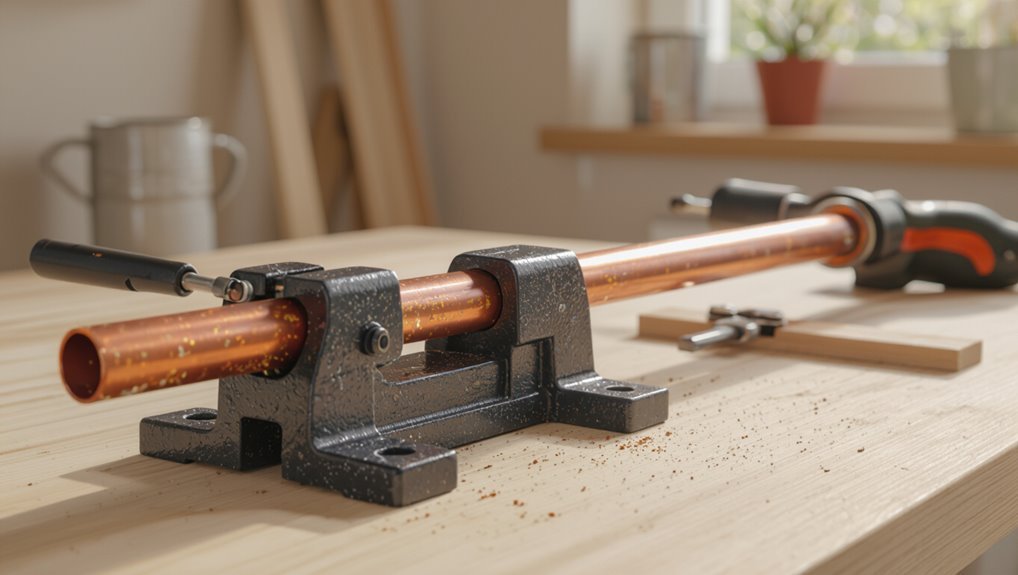
Yes — a homeowner with basic tools and care can cut copper pipe themselves.
The process requires simple equipment: a tubing cutter, hacksaw with a fine-tooth blade, or a powered pipe cutter, plus a deburring tool or file and measuring tools.
Proper technique—secure the pipe, mark the cut, rotate the cutter evenly, and deburr the inside and outside—ensures a square, clean edge for reliable fittings.
Straightforward projects like replacing short sections or installing fixtures are suitable for competent DIYers.
For unfamiliar situations, consulting instructions or a professional prevents mistakes; otherwise, many cuts are quick, safe, and effective.
Key Risks, Codes, and Materials Before Cutting Copper Pipe
What hazards, regulations, and material choices must be considered before cutting copper pipe? Safety risks include sharp edges, metal shavings, and lead contamination in older systems; eye, hand, and respiratory protection is advised. Local plumbing codes dictate approved joint methods and maximum pressure ratings. Material selection—Type K, L, M, or C122/C110—affects wall thickness, suitability, and soldering versus compression fittings. Assess whether valves, supports, and insulation require removal.
| Consideration | Action |
|---|---|
| Safety PPE | Wear gloves, goggles, mask |
| Code compliance | Check local plumbing code |
| Material type | Confirm pipe grade and fittings |
When to Cut the Pipe vs. Replace the Fitting?
The decision to cut a copper pipe or replace the fitting hinges on where the leak is located, whether the pipe itself shows corrosion or cracks, and how easily future access can be maintained.
If the leak is confined to the fitting and the pipe is sound, replacing the fitting may suffice; extensive pipe damage or inaccessible fittings often require cutting and section replacement.
Practical assessment of damage and access should guide the chosen repair method.
Assess Leak Location
When a leak appears, a clear assessment of its location determines whether the pipe itself must be cut or the fitting replaced. The inspector examines the exact origin: a bead of solder at a joint, a hairline crack on tubing, or corrosion beneath a compression nut.
Leaks originating at the joint or fitting interface often indicate fitting failure and permit replacement without cutting farther back. If leakage tracks along the pipe surface away from the joint or emerges mid-span, cutting may be necessary to remove and replace the damaged section. Precise location guides the least invasive, most reliable repair choice.
Evaluate Pipe Damage
A technician weighing repair options next examines the extent and type of damage to decide whether cutting the tube or replacing only the fitting is warranted.
Corrosion pitting, hairline cracks and denting are inspected; the technician measures remaining wall thickness and checks for hard-to-reach flaws.
If damage is localized near a joint, swapping the fitting may suffice; pervasive thinning or long cracks mandate cutting back to sound copper.
Accessibility, available spare length, and joint integrity inform the choice.
Decisions prioritize a reliable seal and minimal additional work while avoiding future failures.
- A corroded ring eaten into pipe wall
- A bent section with stress lines
- A long, hairline fracture running along the tube
Consider Long-Term Access
For long-term reliability, technicians weigh not just immediate repairability but future access for inspections, maintenance, and potential rework. Decisions hinge on whether the fitting obstructs serviceable areas, the likelihood of future leaks, and the cost and complexity of repeated interventions.
If a coupling or elbow sits where access panels or traps will be needed, replacing the fitting with a removable union or adding an access panel is prudent. Cutting pipe to remove a damaged section suits confined, one-off fixes; replacing a problematic fitting with a more serviceable type reduces cumulative labor and preserves system integrity over time.
Which Copper Types and Sizes Affect Your Cut
The cutting approach varies with copper type: soft copper requires gentler handling to prevent deformation, while hard (rigid) copper holds its shape but may need firmer sawing or a different blade.
Pipe diameter also affects tool choice and technique, with common sizes (1/2″, 3/4″, 1″) demanding steadier support and cleaner cuts as diameter increases.
These factors will determine the recommended tools, cutting speed, and preparation steps.
Soft vs. Hard Copper
How does the alloying and tempering of copper change the way it is cut? Soft (annealed) copper bends and deforms easily, requiring gentler clamping and slower sawing or tubing-cutter rotations to avoid crushing. Hard (work‑hardened) copper resists deformation and gives cleaner cuts but demands sharper blades and firmer, steadier force.
Tool choice, blade tooth count, and feed rate adjust for temper. Burrs form differently and may need distinct deburring techniques. Consider wall thickness and support to prevent kinking in soft pipe or jagged edges in hard pipe.
- A malleable tube yielding under light pressure
- A stiff tube biting the blade
- A clean circular disk of removed metal
Common Pipe Diameters
In plumbing and HVAC work, copper pipe diameters commonly range from 1/4 inch to 2 inches, and those nominal sizes—paired with type (M, L, K, DWV) and wall thickness—directly influence cutting technique and tool selection.
Smaller 1/4–3/8 inch lines used for refrigeration or instrumentation often require fine tubing cutters or tubing shear.
1/2–3/4 inch for domestic water favors standard wheel cutters or a hacksaw with guided cutting.
1–2 inch service lines and thick-walled type K/L demand heavy-duty cutters, reciprocating saws, or abrasive wheels and steady clamping to prevent deformation and assure square ends.
Required Safety Gear for Cutting Copper
Always wear appropriate personal protective equipment when cutting copper to prevent injuries from sharp edges, flying metal shards, and hot surfaces.
The cutter should use eye protection, gloves, and respiratory protection as needed.
Safety glasses or a face shield guard against chips; cut-resistant gloves protect hands from burrs and sharp ends; a dust mask or respirator is recommended when sanding or deburring to avoid inhaling fine particles.
Additionally, sturdy clothing and closed-toe shoes reduce skin exposure.
Maintain a clear workspace and adequate lighting to minimize slips and mistakes.
- Safety glasses or face shield
- Cut-resistant gloves
- Dust mask or respirator
Best Tools for the Cleanest Copper Cuts
The comparison between a tubing cutter and a hacksaw frames the choice of tool for achieving a square, burr-free copper cut.
A tubing cutter typically produces a cleaner, more precise edge with less effort, while a hacksaw can work in tight spots if paired with a fine-toothed blade and steady technique.
Selecting the right blade—fine-toothed for clean cuts, coarser for speed—helps minimize filing and improve joint fit.
Tubing Cutter Vs Hacksaw
Choosing between a tubing cutter and a hacksaw hinges on the desired cut quality and the pipe’s size: a tubing cutter delivers a smooth, square edge with minimal burrs on standard copper lines, while a hacksaw is more versatile for larger diameters or tight access but often leaves rougher edges that require extra filing.
The tubing cutter excels for repeatable, clean joints; it rotates around the tube for controlled pressure. The hacksaw suits awkward angles or thick-walled pipe where a cutter cannot fit.
Deburring remains necessary after either method to guarantee proper fittings and flow.
- gleaming, even ring left by a cutter
- jagged teeth marks from a saw
- fine metal shavings on the bench
Choosing The Right Blade
When a clean, square copper cut is the goal, blade selection becomes the next decision after choosing the cutting method; different saws and blades produce markedly different edges and burr levels.
The ideal blade depends on tool and pipe diameter: fine-tooth hacksaw blades (18–32 TPI) reduce raggedness; bi-metal blades balance life and finish.
For powered reciprocating or circular saws, use carbide-tipped or abrasive blades rated for non-ferrous metals to minimize deformation and heat.
Rotary tool cutting wheels require steady speed and cooling.
Always inspect blade sharpness and replace worn blades—dull edges increase burrs and require more deburring work.
Pipe Cutters vs. Hacksaws: Which to Pick?
Decide based on speed, finish, and access: a rotary pipe cutter slices cleanly and quickly on straight runs, leaving a smooth, burr-free edge ideal for soldering, while a hacksaw fits awkward spaces and removes material without specialized alignment but requires more time and deburring to achieve a square, clean end.
The choice depends on the job: for repeated, neat cuts choose a cutter; for one-off or tight spots choose a hacksaw. Consider portability, blade replacement, and the need for finishing work. Proper technique yields reliable joints regardless of tool selection.
- A bright, circular score widening with each turn
- Metal shavings spiraling from a saw blade
- A smooth ring of copper ready for flux
Choosing a Pipe Cutter for Your Pipe Size
For most jobs, matching the cutter to the pipe diameter and wall thickness guarantees a clean, square cut with minimal rework. The writer recommends selecting a cutter rated for the pipe’s nominal size and material—thin-walled tubing needs a different grip than thick-walled pipe. Adjustable rotary cutters suit a range of diameters; ratcheting cutters add leverage for larger sections. Verify cutter jaw opening, blade alignment, and ease of rotation before purchase. Proper fit reduces scoring and deformation. Below is a quick reference comparing common cutter types and size ranges.
| Cutter type | Typical size range |
|---|---|
| Mini rotary | 1/8″–5/8″ |
| Standard rotary | 1/4″–1-1/8″ |
| Ratchet cutter | 1/2″–2″ |
| Heavy-duty cutter | 1″–4″ |
Picking Blades or Wheels for Saws and Hacksaws
Which blade or wheel suits copper depends on cut type and equipment: fine-tooth blades or abrasive wheels minimize tearing on thin tubing, while coarse blades handle thicker, heavily scaled pipe with less clogging.
One-inch-tooth hacksaw blades (18–32 TPI) give controlled, burr-light cuts on small tubing; bi-metal blades resist heat and last longer on repeated cuts.
Circular saws fitted with thin, carbide-tipped blades provide fast, straight cuts on larger sections; abrasive cutoff wheels remove material quickly but create more heat and sparks. Selection balances tooth count, material, and blade thickness for the pipe wall and desired finish.
- A gleaming carbide disk biting cleanly
- A worn abrasive wheel sparking
- A fine-tooth hacksaw slicing gently
Preparing Your Workspace for Neat Cuts
After selecting the appropriate blade or wheel for the copper, the work area should be arranged to support accurate, safe cuts.
A stable bench or sawhorse positioned at comfortable height prevents shifting; clamp the pipe with a padded vise to avoid marring.
Clear nearby clutter and make certain adequate lighting focused on the cut line.
Place a non-slip mat and keep cutting tools, deburring files, and measuring aids within arm’s reach.
Wear safety glasses and gloves, and position a container for metal shavings.
Maintain ventilation for power tools and mark an unobstructed exit route in case of emergency.
Measure and Mark Copper Pipe Accurately
Measure twice and mark once: accurate measurements and clear layout marks are essential to clean, functional joints.
The technician measures run length, accounts for fittings and burr removal, and transfers dimensions to pipe with a fine-tip marker or scribe.
Marks should be perpendicular to the axis and visible from all angles.
A square, tape measure, and straightedge produce repeatable results.
Before cutting, recheck critical distances and confirm allowance for insertion depth.
- Fresh ink line circling the pipe, crisp and thin
- Tape measure held firmly against the pipe end, numbers aligned
- Scribe scoring a faint, precise groove
Support and Clamp Pipe for a Straight Cut
Before cutting, the pipe is secured with a pipe clamp to prevent rotation and movement.
A wood block is placed beneath the pipe to support it and distribute pressure from the clamp.
Proper clamping and support guarantee a straight, clean cut.
Secure With a Pipe Clamp
With the pipe supported on a stable surface and the marked cutting line visible, the user positions a pipe clamp to hold the copper firmly in place; this prevents rotation and minimizes vibration so the saw or cutter can produce a straight, clean cut.
The clamp is aligned so its jaws contact the pipe just outside the cut line, tightened gradually to avoid deformation. Padding protects the copper finish while maintaining grip.
The operator checks for firm, even pressure before cutting, confirming the pipe remains accessible along the marked line and that clamps will not obstruct the blade path.
- Metal jaws biting a gleaming copper tube
- Rubber pad cushioning the clamp
- Tightening handle ready for one final turn
Support With a Wood Block
Placed beneath the pipe near the cutting mark, a hardwood block provides a firm, level backing that prevents sagging and absorbs cutting forces.
The block should be solid, flat, and slightly longer than the cutting area.
Position the pipe on the block so the mark aligns with the block edge; this supports both sides during sawing or using a tubing cutter.
Clamp the pipe and block together lightly, avoiding deformation of the pipe.
For inside fittings, use a V-groove block to cradle the pipe.
After cutting, remove the block and check the cut for squareness before deburring and installation.
Cut Copper With a Tubing Cutter (Step‑by‑Step)
Using a tubing cutter guarantees a clean, square cut on copper pipe while minimizing burrs and distortion. The technician marks the cut, secures the pipe against the wood block, and positions the cutter wheel on the mark. The tool tightens incrementally, rotated around the pipe to score and deepen the groove evenly. After a few revolutions and additional tightening, the pipe separates cleanly.
A deburring tool removes the inner lip; a quick check with a square confirms perpendicularity. Proper technique preserves pipe roundness and fit for soldering or compression fittings.
- Bright, freshly exposed copper ring
- Smooth inner bore after deburring
- Even, square end ready for fitting
Cut Copper With a Hacksaw (Step‑by‑Step)
When a tubing cutter is unavailable or the workpiece is large or awkward, a hacksaw provides a reliable alternative for cutting copper pipe.
Secure the pipe in a vise or with clamps, protecting the surface with soft jaws or scrap wood.
Mark the cut line with a fine marker or scribe.
Fit a new, fine-toothed blade and maintain a straight, steady stroke, applying light downward pressure and letting the blade do the work.
Periodically back off to clear swarf and check alignment.
Deburr the inside and outside with a file or deburring tool, then clean the area before fitting.
Cut Copper With a Reciprocating Saw (Step‑by‑Step)
Before using a reciprocating saw, the operator should don eye protection, gloves, and hearing protection and confirm the work area is clear.
The pipe must be firmly supported and clamped to prevent movement and vibration during cutting.
The saw should be fitted with a fine-tooth bi-metal blade and used with steady, controlled strokes to produce a clean cut.
Safety Gear First
Always prioritize appropriate safety gear to reduce the risk of injury when cutting copper with a reciprocating saw. One should wear eye protection, hearing protection, gloves, and long sleeves to shield from flying metal shards and vibration. A dust mask prevents inhalation of particles from corrosion or old solder. Footwear should be sturdy and non-slip. Before starting, check that gear fits and is undamaged.
- Goggles shielding against sparks and small metal chips
- Thick, vibration-damping gloves gripping the saw securely
- Sturdy boots and long sleeves protecting legs and arms
Cut And Support
With protective gear in place, attention shifts to securing the pipe and planning the cut. The pipe is clamped firmly to prevent movement; nearby fittings are shielded. Blade selection and stroke control determine a clean, square cut. Work proceeds steadily, cooling the blade if needed and checking alignment frequently. After cutting, deburring and supporting the remaining pipe minimize stress on joints and prevent leaks.
| Step | Action | Tip |
|---|---|---|
| 1 | Clamp pipe | Use padded vise |
| 2 | Mark cut | Square line |
| 3 | Saw steadily | Short strokes |
| 4 | Debur & support | Add hangers |
Use a Ring or Mini Cutter (Step‑by‑Step)
Using a ring or mini cutter provides a quick, controlled way to score and cut copper pipe without large tools. The cutter is positioned squarely, the knob tightened, and the wheel rotated around the pipe while gradually increasing pressure.
After several rotations the score becomes visible; continue until the pipe snaps cleanly when bent or taps lightly to separate. Deburr the inner and outer edges with a reamer or file. Inspect the cut for roundness and remove any burs to make certain proper fitting.
- Shiny, circular score line hugging the pipe
- Small wheel biting copper with each turn
- Smooth, deburred edge ready for fitting
Cutting Copper in Tight or Hard‑to‑Reach Spots
When space is limited, compact pipe cutters provide controlled cuts without the bulk of full‑size tools.
A mini hacksaw can be used where a cutter won’t fit, employing short, steady strokes to avoid buckling the blade.
For awkward angles, accessory extensions and low‑profile tooling help reach and maneuver around obstacles.
Compact Pipe Cutters
Compact pipe cutters are small, wheel‑type tools designed to fit into narrow spaces where standard cutters or tubing saws cannot reach. They clamp around the pipe, the knurled knob advances the cutting wheel, and a few rotations score and sever copper cleanly. Lightweight and often ring‑shaped, they allow controlled pressure to prevent crushing thin tubing. Ideal for behind cabinets, near valves, or in junction boxes, they minimize movement and finishing work. Users should deburr after cutting and choose the correct wheel size for pipe diameter to make certain a square, leak‑free joint.
- A tight cabinet crawlspace lit by a flashlight
- Fingers turning a small knurled knob
- A neat, square copper stub ready for deburring
Mini Hacksaw Techniques
In tight or awkward locations where wheel cutters can’t reach, a mini hacksaw provides a simple, reliable way to sever copper pipe. The operator selects a fine-tooth blade (32–24 tpi) for clean cutting and secures the pipe with one hand or a nearby support to prevent twisting.
Make steady, short strokes, keeping the blade perpendicular to the pipe to avoid angled cuts. Progress slowly near fittings to prevent damage.
Deburr the cut with a round file or reamer, and inspect for burrs and distortion. Work with steady lighting and eye protection; a small saw excels where larger tools cannot fit.
Accessory Extensions Tooling
Accessory extensions—telescoping shafts, flex-head adapters, and offset handles—allow cutting tools to reach tight or obstructed areas where standard cutters or saws cannot be positioned.
The writer explains selection by tool compatibility, shaft rigidity, and clearance; adapters must maintain cutting angle to prevent binding and guarantee a square cut. Use quick-release fittings and check for play before cutting.
Support the pipe and control torque to avoid damaging fittings.
After cutting, deburr with angled reamers.
Visualize common setups:
- A telescoping shaft reaching behind a water heater, blade angled around insulation.
- A flex-head cutter snaking between joists.
- An offset handle letting force be applied beside a stub.
Cutting Copper in Walls or Ceilings Without Damage
When working on copper pipes embedded in walls or ceilings, careful planning and the right tools minimize structural damage and reduce the risk of nicking or deforming the tubing.
Inspect location with a stud finder and pipe detector, mark cut points, and shut off water.
Use access panels or cut minimal drywall sized to reach the pipe; preserve removed sections for patching.
Support the pipe on both sides of the cut to prevent movement.
Use a slim tubing cutter or oscillating tool with a metal blade, applying steady, controlled strokes.
Deburr and test for leaks before closing the wall.
Cutting Copper Fittings and Couplings Cleanly
Cutting fittings and couplings requires more precision than straight tubing because joints, solder sleeves, and seating surfaces must remain undamaged to guarantee a reliable seal.
The worker marks removal points, supports the fitting to prevent rotation, and uses a fine-toothed hacksaw or compact tubing cutter with light, steady strokes.
Heat-sensitive components are protected; plastic inserts are noted and preserved.
After separation, the cut face is inspected for burrs or distortion (deburring will be addressed later).
Care is taken to avoid nicking mating surfaces that could compromise capillary action during soldering or mechanical compression.
- a snug coupling held in a vise
- a thin saw blade slicing copper
- a clean, round seating edge
Deburr Copper Pipe After Cutting
After cutting, the pipe’s edges should be smoothed to remove any sharpness that can impede fitting.
Internal burrs must be removed to prevent flow restriction and potential debris in the system.
Finally, the cut area should be inspected to make certain all shavings and residues have been cleaned away.
Smooth The Cut Edges
Deburr the freshly cut copper pipe to remove sharp burs and make certain a clean, square edge that seals properly and prevents injury. Using a deburring tool or fine file, the technician works with steady, light strokes around the outside edge until it feels smooth to the touch.
Care is taken to maintain the pipe’s round profile and square end for a reliable joint. The exterior finish is inspected visually and by fingertip to confirm no snags remain. Final wiping removes metal dust before fitting.
- Shiny, rounded rim catching the light
- Smooth fingertip glide along the cut
- Crisp, even end ready for fitting
Remove Internal Burrs
Having smoothed the cut edge, attention turns to removing internal burrs that can obstruct flow, snag fittings, and cause leaks. A proper internal deburr prevents turbulence and guarantees a tight joint.
The technician uses a tapered reamer or a round file, inserting gently and rotating to shave away the lip inside the pipe. Deburring should reach slightly past the cut to eliminate any fragmented metal.
After reaming, the inside is wiped with a clean cloth or brush to collect filings. Care is taken not to distort the pipe profile or thin the wall.
Proper deburring readies the pipe for reliable fitting.
Inspect For Cleanliness
Before proceeding to fit the joint, the technician inspects the freshly deburred copper pipe to confirm it is clean and free of metal shavings, oil, and other contaminants that could compromise a seal.
The inspection focuses on the cut face, inner bore, and outer surface, using a clean rag and flashlight to reveal particles or discoloration.
Any residue is wiped away, and a quick brush or compressed air clears trapped filings.
Final checks assure the pipe fits snugly into fittings without gaps or obstruction. Clean surfaces promote solder or compression seals that are reliable and leak-free.
- glinting metal shavings on a rag
- oily fingerprints near the joint
- smooth, bright copper edge
Square the Pipe End for Soldering or Compression
To guarantee a reliable joint, the cut end of the copper pipe must be square and flat so the fitting or ferrule seats evenly. Using a file, deburring tool, or emery cloth, remove any burrs and high spots created by cutting.
Rotate the pipe while lightly filing the outer edge until the end face is perpendicular to the pipe axis; check with a small square or by sight against a straightedge. Make certain the internal edge is free of sharp lips that can interfere with seating.
Finish by wiping away metal debris and rechecking squareness before attempting to join or compress fittings.
Prepare Cut Copper for Sweat (Soldered) Joints
When preparing a cut copper pipe for a sweat (soldered) joint, the pipe end must be clean, bright, and free of oxidation or oil so solder and flux can bond properly. The technician removes burrs, files the inside edge, and uses abrasive cloth or a wire brush to expose fresh metal. Flux is applied evenly to the joint surfaces to promote wetting. Care is taken to avoid contaminating cleaned areas with hands or debris. Proper preparation guarantees capillary action draws molten solder into the joint for a reliable seal.
- Shiny, polished pipe end glinting under light
- Small metal shavings brushed away
- Even, glossy flux coating
Prepare Cut Copper for Compression Fittings
Next, the cut end is deburred and reamed to remove any sharp edges and internal burs that could prevent a proper seal.
The pipe is then cleaned of dirt, grease, and oxidation so the ferrule and nut seat evenly.
Finally, the length is measured and marked to guarantee the fitting slides on fully and the joint is assembled to the correct depth.
Deburring And Reaming
Deburr and ream the freshly cut end to remove sharp edges and internal burrs that can damage a compression sleeve or prevent a proper seal.
The technician uses a round reamer or deburring tool, rotating gently inside the pipe until the lip is smooth.
External edges are chamfered slightly with a file to allow the nut and sleeve to seat evenly.
Inspect visually and by touch; no snags should remain.
Proper deburring guarantees alignment and longevity of the fitting without affecting pipe length.
- A smooth, matte ring at the pipe mouth
- A chamfered outer edge catching light
- A tactilely clean, burr-free rim
Clean And Measure
Before fitting compression components, the technician cleans and measures each cut end to guarantee a reliable seal and correct alignment.
Using a lint-free cloth and solvent, oxidation and residual oil are removed until the copper gleams. The seating surface is inspected for burrs, scratches, or deformities that could compromise the ferrule’s bite. A tape measure or caliper verifies length from the fitting reference shoulder, accounting for insertion depth and nut engagement. Markings are made for consistent assembly.
Final checks make certain roundness and straightness; any imperfection prompts recut and repeat of cleaning to maintain proper compression fitting performance.
Prepare Cut Copper for Push‑Fit Connectors
With the cut end square and smooth, the copper must be cleaned, de-burred, and measured to guarantee a proper push-fit seal.
The exterior should be wiped with a cloth and a mild abrasive or emery cloth to remove oxidation; the interior must be free of swarf. A round deburring tool removes the inner lip; a fine file or emery finishes the outer edge.
Mark the insertion depth on the pipe with tape or a pen, referencing the connector’s spec. Test fit gently to make certain alignment; avoid twisting that could damage the O‑ring.
- gleaming pipe end against the palm
- curled metal shaving from the aperture
- pen mark aligned with connector collar
Working With Soft vs. Rigid Copper: Technique Tips
After preparing and marking the tube for push-fit connectors, the installer must adjust technique depending on whether the copper is soft (annealed) or rigid (hard).
Soft copper requires gentler handling: support longer lengths to prevent sag, use a tubing cutter with light, steady rotations to avoid crushing, and deburr carefully to maintain a smooth, round end.
Rigid copper tolerates firmer cutting pressure and straighter clamping; apply consistent cutter tension and square the cut for proper seating.
In both cases, verify roundness and remove burrs, then clean the OD and ID to make certain reliable push-fit engagement and leak-free joints.
Preventing Kinks in Soft Copper Tubing
A few simple practices greatly reduce the risk of kinking soft copper tubing during handling and installation.
Careful support, controlled bending radius, and proper tools preserve tubing integrity.
When uncoiling, work from the roll’s center where tension is lower.
Use spring or foam forms for temporary support and avoid sharp bends near fittings.
Protect tubing from pinches against studs and edges.
- A gloved hand guiding a gentle arc while uncoiling
- A prepared wooden form wrapped with tubing to maintain radius
- Tubing cushioned against a joist with foam blocks to prevent pinch points
Re‑Routing Copper Pipe During Remodels
During a remodel, rerouting copper pipe requires planning that balances system function, accessibility, and code compliance. The crew evaluates existing runs, identifies obstructions, and selects routes minimizing joints and heat exposure. Supports, pitch for drainage, and isolation valves are positioned for serviceability. Connections follow solder, brazing, or compression standards per code. Permits and inspections are scheduled; insulation and protection in walls are guaranteed. Temporary water shutoffs and labeling reduce downtime. Final pressure testing verifies integrity before wall closure.
| Consideration | Action |
|---|---|
| Route length | Minimize bends |
| Supports | Every 4 ft (horizontal) |
| Valves | Accessible locations |
| Materials | Match system type |
| Testing | Pressure test before closure |
Cutting Copper Outdoors vs. Indoors: Weather Tips
Weather conditions affect cutting tools’ performance and safety, so the writer recommends evaluating temperature, humidity, and wind before working outdoors.
Protective measures for exposed copper—such as temporary covers, anti-corrosion coatings, or rapid sealing—are advised to prevent oxidation and debris contamination.
The discussion compares indoor stability with outdoor variables and offers practical tips for choosing the best environment and protections.
Weather Effects On Tools
Exposed to sun, rain, or cold, cutting copper outdoors introduces tool and material variables that differ markedly from indoor work.
Tools respond to temperature and moisture: blades can dull faster in gritty wet conditions, lubricant behavior changes with heat, and metal contracts in cold, affecting fit and cutting force.
Users should inspect tools for corrosion, guarantee grips remain non-slip, and adjust cutting technique for thermal expansion or contraction.
Power tool motors may overheat in direct sun or stall in wet conditions; battery performance also drops in cold.
Visualize conditions to anticipate tool performance:
- A rain-slick hacksaw with stained teeth
- Frost-nipped tape measure recoiling slowly
- A sun-warmed cutter handle softening under grip
Protecting Copper From Elements
In outdoor settings where moisture, UV, and airborne contaminants accelerate tarnish and corrosion, copper requires proactive protection to preserve cleanliness and fit for cutting and joining. The writer recommends storing pipe under cover, wiping surfaces before cutting, using temporary seal caps, and choosing sheltered work areas. Protective coatings or quick flux application prevent oxidation at cut ends. For repeated outdoor work, use corrosion-resistant fittings and inspect joints closely. Timing cuts for dry, mild conditions reduces problems; indoors offers stable temperature and less debris, improving cut quality and solder adhesion.
| Action | Benefit |
|---|---|
| Covering pipe | Keeps dry |
| Wiping | Removes contaminants |
| Caps | Blocks ingress |
| Coating | Prevents tarnish |
| Shelter cuts | Improves joint quality |
Avoid Contaminating Potable Water Pipes
When working on copper plumbing, take steps to prevent contaminants from entering potable water lines: isolate the section being cut, shut off and drain the supply, and use a temporary cap or plug on open ends.
A professional approach keeps debris, solder flux, and metal shavings out of drinking water. Clean cutting surfaces, collect filings with a magnet or cloth, and avoid blowing into pipes.
After cutting, flush and disinfect the line before restoring service. Inspect fittings and seals for leaks. Maintain tools dedicated to potable work to reduce cross-contamination risk.
- shiny shavings collected on a cloth
- capped pipe end with a rubber plug
- flushed clear water running from a tap
Cutting Corroded or Aged Copper Pipe
After preventing contamination and clearing a work area, attention turns to pipes that show corrosion or age-related weakness. The installer assesses thickness, pinholes, and brittleness, choosing hand-held cutters or a tubing saw. Support the pipe close to the cut, work slowly to avoid crushing, and back up cuts with a crescent or clamp when edges crumble. Deburr gently and inspect for unseen fractures. If corrosion is extensive, replace the section rather than attempt a repair.
| Condition | Tool choice | Action |
|---|---|---|
| Light patina | Tube cutter | Slow, steady turns |
| Pitting | Hacksaw | Support behind cut |
| Brittle | Recip saw | Minimal pressure |
| Pinholes | Replace | Cut wider section |
Cutting Through Insulation or Wrap
Before cutting, the insulation or wrap should be inspected to identify its material—foam, fiberglass, rubber, or cloth—since each behaves differently when cut.
Where possible, the insulation should be carefully removed to expose the pipe; if removal is impractical, trim the covering back enough to allow a clean, unobstructed cut.
Any torn or compressed insulation should be replaced or repaired after the pipe work to restore thermal protection and prevent moisture issues.
Identify Insulation Type
In evaluating a copper line for cutting, the installer must first determine whether the pipe is bare, covered with wrap, or encased in foam insulation, since each type affects cutting technique and tool choice. The inspector visually and manually assesses texture, thickness, and fastening method: thin fibrous wrap, taped cloth, thick closed-cell foam, or no covering. Identifying adhesive residues, vapor barriers, or vapor-retarding jackets guides preparation and safety measures. Personal protective equipment and dust control are chosen accordingly. Proper identification prevents damage to the pipe or insulation and informs whether cutting will expose vapor barriers or require special disposal.
- frayed cloth wrap fluttering under a fingertip
- dense foam sleeve compressing with gentle pressure
- smooth metallic jacketing reflecting light
Remove Or Cut Back
Cut or peel insulation back to expose a clear length of pipe sufficient for the chosen cutting method and for making a proper joint or repair.
The technician should inspect the wrap type—foam, fiberglass, or cloth—and remove only the necessary section to avoid thermal or moisture issues.
For glued or taped covers, score along the pipe and peel gently to prevent damaging the copper.
When cutting through thicker insulation, use a sharp utility knife and steady pressure, keeping hands clear of the blade.
Dispose of contaminated or moldy insulation appropriately.
After cutting work, restore or replace insulation to original condition to maintain performance.
Dealing With Soldered or Brazed Joints When Cutting
Recognizing that soldered or brazed joints are considerably stronger and heat-resistant than plain fittings, the cutter must account for fused metal when planning the cut. The technique shifts: use a fine-toothed hacksaw or rotary tool with a metal-cutting wheel, avoid prying that stresses the joint, and mark clear cut lines well away from the fillet to preserve surrounding brazing. After cutting, deburr edges and inspect for heat-affected discoloration or gaps that indicate weakened alloy. If rejoining, clean thoroughly and consider reflowing with appropriate flux and rod; otherwise, replace the fitting to guarantee integrity.
- A bright orange flame-free joint glinting under a lamp
- Sparks from a thin cutting wheel kissing copper
- A clean, polished pipe end ready for flux and solder
Measure for Lap Allowances and Accurate Repeats
After preparing pipe ends and confirming joint integrity, attention turns to measuring lap allowances and setting up for repeatable cuts.
The technician marks each pipe according to fitting type: slip fittings need full insertion depth, compression requires gasket clearance, and flare or coupling lap is noted.
Use calipers or a reliable tape to record insertion distances, then transfer marks with a scribe for visibility.
For multiple pieces, create a simple jig or stop block to guarantee identical placement against the cutter or saw.
Verify one test fit, adjust marks if needed, and document measurements to maintain consistency across all cuts.
Make Clean Angled Cuts in Copper Pipe
Begin by securing the pipe firmly in a vise or clamp to prevent rotation, then mark the cut line clearly at the measured angle with a protractor or angle guide.
A tubing cutter with a rotating guide or a fine-toothed hacksaw produces the neat bevel needed for soldering or fittings. Rotate the cutter evenly, tightening incrementally; with a saw, use steady strokes along the guide.
Deburr the inside and lightly file the outside to remove burs and refine the bevel. Inspect the face for flatness and consistent angle before assembly.
- gleaming copper edge catching light
- smooth, even beveled profile
- clean interior surface free of shards
Cutting Copper for Refrigeration and Chilled Lines
When cutting copper for refrigeration and chilled lines, the installer must consider proper line sizing to maintain system performance and avoid pressure drop.
Choice of connection method—flare versus sweat—affects wall thickness, sealing, and future serviceability.
Insulation and routing requirements determine where cuts are made and how joints are protected against condensation and heat gain.
Proper Line Sizing
In sizing copper lines for refrigeration and chilled-water systems, precise tube diameter and wall thickness determine performance, pressure drop, and long-term reliability.
The designer selects sizes to match refrigerant type, flow rate, and allowable pressure loss; undersized tubing raises compressor load and noise, oversized tubing adds cost and hinders oil return.
Wall thickness resists internal pressure and mechanical wear while influencing thermal capacity.
Proper sizing balances velocity, pressure drop, and lubrication return to assure efficient, durable operation.
Field technicians must verify specifications on equipment data and adjust runs for elevation, bends, and serviceability before cutting.
- A slim line threading through joists
- Curved runs around insulation bundles
- A measured stub near the unit connection
Flare Versus Sweat
After confirming proper line sizing and routing, the installer must decide between flare and sweat connections for refrigeration and chilled-water copper lines.
Flare fittings use flared tube ends secured by flare nuts, offering reliable mechanical seals and ease of assembly or disassembly; they suit vibration-prone systems and field service.
Sweat (soldered) joints provide compact, low-profile joints with excellent leak resistance when properly brazed, preferred for permanent runs and higher-pressure refrigerants.
Cutting technique differs: flaring requires a clean square cut and deburr; sweating demands oxidation-free ends and correct heating.
Material compatibility, access, serviceability, and code requirements dictate the final choice.
Insulation And Routing
For routing and insulating refrigeration and chilled-water copper lines, careful planning of path, support, and thermal barrier selection minimizes heat gain, condensation, and mechanical stress.
The installer measures runs to avoid unnecessary bends, keeps distance from heat sources, and selects closed-cell insulation sized to maintain thermal performance and prevent moisture ingress.
Supports are placed at regular intervals with vibration isolation; fittings receive continuous insulation seals.
Service access and pressure drop are considered when routing.
Proper joint insulation and cladding protect against corrosion and damage while meeting code and manufacturer specs.
- Frosted pipe with snug foam sleeve
- Clamps with rubber isolators
- Insulation jacket and taped seams
Test Fit After Cutting and Before Final Joining
Dry-fit the cut pieces to confirm alignment, orientation, and gap size before applying flux or solder. The fitter inspects seating, verifies that chamfers match, and checks that fittings slip on without force. Movement is limited, and any misalignment is corrected by minor re-cutting or straightening. Markings indicate final position; the gap should match soldering practice. Once satisfied, parts are cleaned and reassembled for soldering.
| Checkpoint | Observation |
|---|---|
| Alignment | Pipes concentric, no twist |
| Orientation | Elbows face correct way |
| Gap size | Consistent with solder method |
| Seating | Full insertion without gaps |
Common Cutting Mistakes and How to Avoid Them
While even experienced installers can make avoidable errors when cutting copper pipe, most mistakes stem from predictable causes—dull blades, incorrect tool choice, poor measurement, or rushed technique.
Attention to tool condition, correct cutter selection for pipe diameter, stable clamping, and measuring twice eliminates common problems.
Clean, steady cuts reduce rework; scoring then rotating works for thin tubing, pipe cutters suit thicker walls, and a powered saw requires a fine-tooth blade.
Deburr and inspect edges before fitting.
- A worn wheel marring the surface
- A slipped clamp twisting the tube
- A misread mark leading to a short piece
Troubleshoot Uneven, Crushed, or Out‑of‑Round Cuts
When cuts come out uneven, crushed, or out of round, the first checks are alignment of the cutter and the condition of its wheels.
Worn or damaged wheels should be replaced promptly to restore a consistent cut.
Adjusting grip pressure and rotating the tool smoothly will prevent crushing and produce a true round profile.
Check Cutter Alignment
Before cutting, the cutter should sit squarely on the pipe so its wheels and blade align with the pipe’s centerline; misalignment is the most common cause of uneven, crushed, or out‑of‑round cuts.
The operator inspects visually and by feel, rotating the cutter to confirm even contact.
Slight tilt or off‑center positioning produces tapered or oval edges.
Adjust the tool so the blade bisects the pipe circumference and the rollers bear evenly; tighten the frame gradually while spinning to maintain alignment.
If the cut still wanders, re-seat the cutter and repeat checks before applying full pressure.
- A wheel tracing a perfect circle
- A blade centered on the pipe seam
- Rollers pressing evenly on both sides
Replace Worn Wheels
If cut quality shows scalloping, crushing, or an out‑of‑round profile, worn cutter wheels are a likely cause and should be inspected and replaced promptly.
The inspector should remove the wheel assembly and examine wheel edges for flat spots, chips, or glazing.
Replacement wheels must match the tool model and bearing type; incompatible parts can worsen cuts.
Clean the housing and lubricate bearings before fitting the new wheel.
Reassemble and spin the wheel by hand to confirm smooth rotation and proper axial alignment.
Test with a scrap copper piece; consistent, clean score lines indicate successful replacement.
Use Proper Cutting Technique
Begin the cut with firm, even pressure and a steady rotational rhythm to produce a true, round profile; inconsistent force or jerky turns leads to scalloping, crushing, and out‑of‑round results.
The operator eases the cutter onto the pipe, tightens gradually between rotations, and adds small incremental torque after each pass.
Visual cues—consistent shaving, even score line—indicate correct technique.
If the pipe deforms, back off, realign the wheel, and remove less material per pass.
For best results, clamp the pipe loosely in a vise or hands to allow rotation without bending and recheck diameter frequently.
- A clean, continuous score along the circumference
- Even thin metal ribbons removed each turn
- Pipe remaining perfectly circular under light inspection
Fix an Out‑of‑Round Pipe End After Cutting
After a cut that crushed or distorted the tube, the installer must restore the round profile so fittings seal properly and the pipe mates with valves.
Begin by deburring and removing sharp edges inside and outside the cut. Use a conical reamer or round file to gradually reshape the oval section, applying even pressure while rotating around the pipe.
For severe deformation, employ a mandrel or appropriately sized drift inserted into the tube and gently tapped or expanded with a soft mallet until circular.
Verify concentricity with a fitting or coupling; repeat reshaping steps until the fitting seats evenly and slides on smoothly.
Finish and Protect Exposed Copper After Cutting
With the pipe reshaped and fittings verified, attention turns to finishing and protecting the freshly exposed copper to prevent corrosion and guarantee a reliable joint.
Edges are deburred with a file or reamer, then sanded smooth with fine emery cloth to remove nicks and bright the metal.
Flux is applied sparingly for soldering; for compression or press fittings a thin coating of joint compound or approved lubricant protects seals.
Finally a short coat of corrosion inhibitor or primer on visible sections extends life without affecting joints.
- A shiny, chamfered edge reflecting light
- Flux wetting the joint seam
- A thin protective film on copper
Dispose of Copper Scrap Responsibly
How should leftover copper be handled to minimize waste and environmental impact? Leftover copper should be sorted, cleaned of contaminants, and stored safely for recycling. Local scrap yards or municipal recycling centers accept copper; check guidelines and pricing. Small pieces can be collected in labeled containers to prevent loss and contamination. Hazardous fittings (lead solder, PCB residues) require special disposal per local rules. Document pickups or receipts for records. Donating usable lengths to community projects extends material life. Follow local regulations to avoid fines and pollution.
| Action | Where | Tip |
|---|---|---|
| Sort | Home | Remove debris |
| Recycle | Scrap yard | Compare quotes |
| Donate | Community | Label lengths |
| Dispose | Hazardous facility | Follow rules |
When to Call a Pro Instead of DIY Cutting
In situations involving complex plumbing layouts, confined spaces, or connections to gas or public water lines, a professional should be engaged rather than attempting DIY cutting. A qualified plumber assesses risks, secures permits, and guarantees code-compliant joints; this prevents leaks, contamination, or costly rework. Homeowners should call a pro when access is limited, when multiple fittings or soldered joints are involved, or when liability and warranty considerations apply.
- A cramped crawlspace with tangled pipes and limited maneuvering room
- A multi-branch manifold feeding critical systems or adjacent units
- Corroded joints near meters, gas lines, or shared mains
Budget: Tools, Consumables, and Material Costs
A clear budget distinguishes between one-time tool purchases, recurring consumables, and replacement materials so homeowners can weigh upfront investment against long-term savings.
Copper pipe cutters and deburring tools range from economical manual models to pricier ratcheting or power versions; choose based on project frequency.
Consumables include cutting wheels, replacement blades, and joint flux or solder—small per-item costs that add over multiple jobs.
Material costs cover pipe lengths, fittings, and solder; prices vary with diameter and grade.
Allocate contingency for damaged sections or unexpected fittings.
Comparing rental versus purchase for infrequent tasks can reduce total expense.
Quick Maintenance Tips to Keep Cutters Sharp
Regularly inspecting and maintaining pipe cutters preserves cutting performance and extends tool life. The user inspects the wheel for nicks, cleans debris from the track, and lightly oils moving parts to prevent rust.
After each project, cutting wheels are wiped with a solvent and spun to check true rotation. Replace worn wheels promptly; dull blades cause deformation and extra force. Store cutters dry in a case to avoid impact damage.
Calibration of alignment screws keeps cuts square. Simple, routine care minimizes pinch points and guarantees consistent, clean cuts when working with copper piping.
- a glinting wheel checked under light
- a lint-free cloth wiping metal dust
- a small oil drop on a pivot
Time‑Saving Tricks for Cutting Many Pipes
When faced with cutting many copper pipes, efficiency comes from batching tasks and minimizing tool reconfiguration; grouping pipes by diameter, scheduling cuts by length, and setting up a dedicated cutting station reduce setup time and repeated measurements.
A simple jig or stop block speeds repeatable lengths. Label bundles to match fittings and sequence cuts to avoid backtracking.
Use a pipe cutter with quick-release and a cordless saw for thicker runs, keeping spare blades and deburring tools on hand. Clamp work securely and clear chips frequently to maintain speed and safety.
Track progress with a checklist to prevent rework and wasted material.
Final Checklist: 10 Steps to a Perfect Copper Cut
Before proceeding to fittings or soldering, the cutter should run through a concise ten-step checklist that verifies safety, measurement accuracy, clean cuts, and proper preparation of pipe ends to guarantee leak-free, code-compliant joints.
The technician confirms PPE and shutoff, measures twice, marks clearly, secures the pipe, chooses the correct cutter, rotates evenly, stops at a square cut, deburrs inside and outside, cleans flux and oil, and rechecks fit before assembly.
This methodical sequence prevents leaks, saves time, and meets code. Visualize the final, trimmed end: smooth, round chamfer; straight face; cleanly aligned joint.
- gleaming chamfered edge
- square marker line
- snug, seated fitting
Conclusion
Cutting copper pipe is a straightforward DIY task when safety, correct tools, and code awareness guide the process. For example, a homeowner replacing a leaky sink supply used a basic tube cutter, deburred the ends, and pressure‑tested the joint—avoiding a costly plumber call—because they followed proper preparation and inspection steps. With care, the right cutter, and attention to fittings and measurements, clean, leak‑free connections are reliably achievable for most small plumbing repairs.