How Copper Pipes Are Made: Step-by-Step Manufacturing Guide
Copper pipe production involves several key steps to transform refined copper into finished tubing. Here’s a concise overview of the manufacturing process:
- Billet Casting: Refined copper is cast into billets.
- Forming: The billets are formed into seamless or welded tubes through extrusion or hot rolling.
- Refinement: Cold drawing and mandrel sizing are employed to achieve precise diameter and wall thickness.
- Annealing: Controlled annealing processes are applied to restore ductility.
- Quality Checks: Finished tubing undergoes hardness checks, hydrostatic and leak testing, and surface inspections.
- Final Processing: Additional coatings or annealing may be applied as needed.
- Cutting and Packaging: Pipes are cut, deburred, marked for traceability, and packaged for distribution.
This structured approach ensures high-quality copper pipes that meet industry standards. For more detailed steps, standards, and testing practices, further information can be provided.
Copper Pipe Production: Quick Process Overview
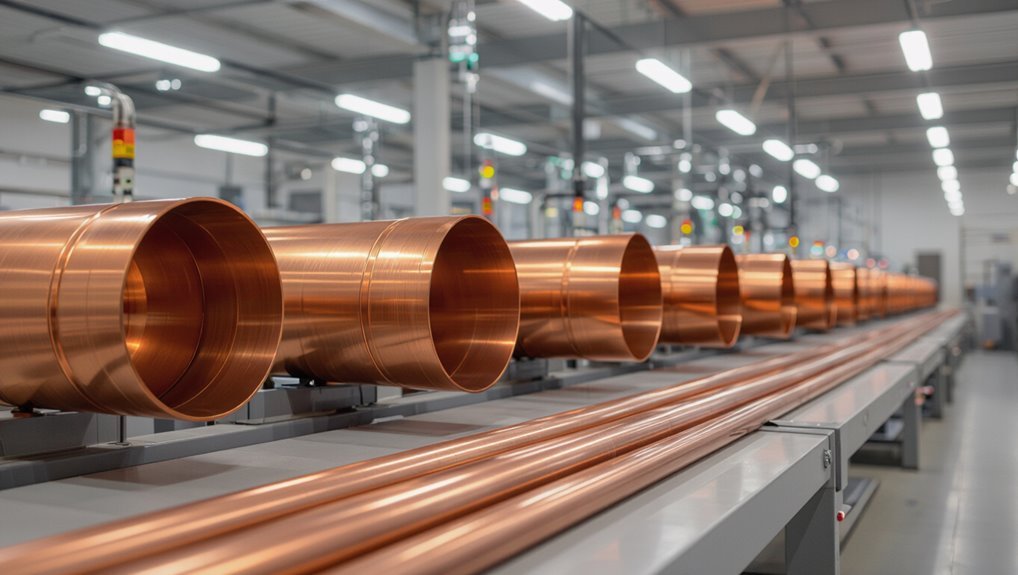
A typical copper pipe production line begins with refined copper cast into billets, which are then heated, extruded or pilgered, and drawn to size before undergoing annealing, cleaning, and testing; this sequence transforms raw metal into standardized, code-compliant tubing ready for cutting and finishing.
The process continues with straightening, sizing, and quality inspections that verify dimensional tolerances, wall thickness, and surface condition. Non-destructive testing may detect flaws.
Pipes are cut to length, deburred, and packaged. Traceability markings and inventory control guarantee conformity. Waste material is recycled, and process control monitors temperature, speed, and tooling to maintain repeatable output.
Why Copper Pipe Manufacturing Matters for Plumbing and HVAC
Manufacturers’ choices in alloy composition and processing directly affect copper pipe corrosion resistance, which determines service life and maintenance needs in plumbing systems.
Equally important is the material’s high thermal conductivity, which influences heat transfer efficiency in both residential and commercial HVAC applications.
Understanding these manufacturing factors clarifies why copper remains a preferred material for durable, efficient fluid and heat distribution.
Corrosion Resistance Benefits
Many plumbing and HVAC systems rely on copper pipes because the metal’s inherent resistance to corrosion reduces leaks, maintenance, and premature system failure.
Copper’s passive oxide layer limits chemical attack from water, soils, and common contaminants, preserving wall thickness and joint integrity.
Manufacturing controls—purity, alloy selection, and annealing—optimize this resistance, ensuring predictable long-term performance.
Reduced scaling and biofilm formation further maintain flow and sanitary conditions.
For building operators and installers, these properties translate into lower lifecycle costs, fewer service interruptions, and extended replacement intervals compared with less corrosion-resistant materials.
Thermal Conductivity Importance
Why does thermal conductivity matter in copper pipe performance for plumbing and HVAC systems?
Copper’s high thermal conductivity enables efficient heat transfer, influencing energy use, system responsiveness, and temperature control.
Manufacturing processes that preserve purity and optimize wall thickness guarantee consistent thermal performance and reliability over time. Properly produced copper reduces thermal losses, shortens warm-up and cool-down cycles, and supports accurate system balancing.
Key impacts include:
- Reduced energy consumption through efficient heat exchange.
- Faster system response and improved temperature stability.
- Enhanced sizing accuracy for predictable load calculations and reduced oversizing risk.
Manufacturing quality directly affects these operational outcomes.
From Ore to Ingot: Smelting and Refining Copper for Piping
The process begins with ore extraction, where open-pit and underground mining recover copper-bearing rock for processing.
That ore is concentrated and then subjected to smelting to separate metal from gangue, producing a crude copper matte.
Subsequent refining—often through electrorefining—yields high-purity copper suitable for casting into ingots used in pipe production.
Ore Extraction Methods
Although ore extraction methods vary with geology and deposit type, they all aim to recover copper-bearing minerals efficiently and with minimal contamination before smelting. Methods are chosen by deposit depth, ore grade, and environmental constraints.
Open-pit mining removes large volumes of overburden to access near-surface ore, enabling bulk recovery.
Underground mining targets deeper, high-grade veins with less surface impact.
In-situ recovery suits soluble copper deposits, leaching minerals without conventional excavation.
Ore is sorted, crushed, and sometimes concentrated on site to reduce transport mass and limit impurities prior to downstream processing.
- Open-pit mining
- Underground mining
- In-situ recovery
Smelting And Refining
Begin with concentrating ore into a form suitable for high-temperature processing: smelting separates copper from gangue by heating concentrates in a furnace to produce molten matte, while subsequent converting and electrolytic refining remove remaining impurities to yield high-purity cathodes or ingots for piping.
The matte undergoes converting to oxidize iron and sulfur, producing blister copper (~98–99% Cu). Fire refining and/or electrolytic refining increase purity to >99.99% where required.
Electrolytic refining casts cathodes from anodes in acidic copper sulfate solutions. Resulting ingots or cathodes are homogenized and cast into billets or slabs, ready for rolling and tube production.
Casting Billets and Slabs: Preparing Feedstock for Pipe Production
Casting billets and slabs establishes the metallurgical and dimensional foundation for copper pipe production, transforming molten copper from the refinery into solid feedstock with controlled composition and geometry.
The metal is poured into molds or continuous casters, cooled to refine grain structure, and trimmed to specified dimensions. Inspections verify chemistry, porosity, and surface quality before downstream forming.
Billets suit round-section processes; slabs serve plate or wide-forming lines. Heat treatment may normalize internal stresses.
Logistics and inventory staging guarantee correct alloys reach the mill in sequence, minimizing rework and maintaining downstream process stability.
- Casting method choice
- Quality checks
- Staging and handling
Hot Rolling vs. Extrusion: Selecting the Initial Shaping Method
The choice between hot rolling and extrusion determines the initial geometry and grain structure of copper pipe feedstock.
Hot rolling compresses and elongates slabs to produce plate or strip with favorable surface finish and workability, while extrusion forces billet material through a die to create seamless tubular profiles with tight dimensional control.
Comparison of the two highlights trade-offs in production speed, material properties, and suitability for subsequent tube finishing.
Hot Rolling Overview
Hot rolling offers a rapid, cost-effective way to form copper billet into long, continuous shapes by passing heated metal through successive rolls that reduce thickness and refine grain structure.
The process yields uniform wall thicknesses and improves mechanical properties through controlled deformation and recrystallization.
Typical applications favor high throughput and lower tooling costs, with improvements in surface finish achieved by scale removal and secondary rolling passes.
Limitations include less precise near-net geometry compared with other shaping methods and the need for downstream sizing or annealing to meet tight dimensional tolerances.
- High production rate
- Improved grain structure
- Requires downstream finishing
Extrusion Process Comparison
Compare extrusion and hot rolling to determine which initial shaping method best matches copper pipe production goals, since each offers distinct trade-offs in geometry control, throughput, and tooling cost.
Hot rolling efficiently produces plate or slab stock for subsequent tube rolling with high throughput and lower die cost, but yields less precise cross-sections and more post-processing.
Extrusion creates near-net tubular forms with tight dimensional control, smoother surfaces, and reduced welding, albeit at higher tooling and press expense and lower line speed for large volumes.
Selection depends on required tolerances, surface finish, production scale, material grade, and total lifecycle cost.
Seamless Pipe: Extrusion and Mandrel Drawing
When copper must be formed into seamless tubing for plumbing, refrigeration, or industrial uses, manufacturers rely on extrusion and mandrel drawing to produce uniform, hole-free pipe with controlled dimensions.
Billets are heated and forced through a die to create a hollow shell; no welds are present. A mandrel is inserted during drawing to refine internal diameter, wall thickness, and surface finish.
Multiple passes and annealing cycles relieve work hardening and achieve mechanical properties. Quality checks include dimensional measurement, non-destructive testing, and microstructural inspection.
- Precise extrusion to form hollow shell
- Mandrel drawing for dimensional control
- Anneal and inspect between passes
Welded Tube: Forming and Longitudinal Welding
Forming flat copper strip into welded tube combines precise roll forming with continuous longitudinal welding to produce economical, dimensionally consistent pipe for plumbing, HVAC, and industrial applications.
The strip is fed through progressive rollers that bend edges together, creating a controlled V or U seam. Induction or resistance welding heats the abutting edges while pressure forges them into a uniform bond.
Weld flash is removed by trimming and scarfing, then non‑destructive inspection (eddy current or visual) verifies seam integrity.
After cooling, straightening and cut‑to‑length operations prepare tubes for downstream processes, packaging, or inventorying.
Cold Drawing and Sizing for Final Diameter and Wall Control
Cold drawing refines welded or seamless copper tube to final diameter and wall thickness by pulling the tube through progressively smaller dies under controlled tension.
The process yields accurate dimensions, improved surface finish, and work-hardened strength while maintaining straightness. Lubrication, die geometry, and draw speed are adjusted to prevent scoring and ovality.
Multiple passes with intermediate sizing mandrels guarantee concentricity and wall uniformity without describing heat treatments. Final inspection checks outside diameter, wall thickness, and surface quality before coiling or cutting.
- Control parameters: die size, tension, lubrication
- Tools: mandrels, multi‑pass draw benches
- Quality checks: dimensional and surface inspection
Annealing Cycles for Copper Pipe (Inter-Stage and Final)
After cold drawing and sizing establish final dimensions and surface finish, controlled annealing cycles restore ductility, relieve residual stresses, and homogenize the copper’s microstructure before further handling or installation.
Inter-stage anneals occur at lower temperatures and shorter durations to soften work-hardened sections between drawing passes, preserving dimensional stability while enabling additional deformation.
The final anneal uses higher temperature, controlled atmosphere or inert gas to prevent oxidation and decarburization, producing consistent grain structure and mechanical properties.
Cooling rates are managed to avoid thermal shock.
Process monitoring records temperature profiles, time-at-temperature, and atmosphere composition to guarantee repeatable metallurgical outcomes and compliance with specifications.
Straightening and Cutting to Precise Lengths
Pipes proceed to straightening and cutting, where automated rollers and precision shear or saw systems correct mill and draw-induced bow and spring, then sever lengths to specification.
Tensioning frames and rotary straighteners eliminate residual curvature; servo controls adjust feed for consistent cut quality.
Sensors verify straightness and length; rejects are segregated automatically.
End faces are inspected for burrs and concentricity prior to downstream processing.
Handling carts and conveyors index finished lengths for packaging.
- Alignment: rollers, guides, and feedback loops guarantee axial straightness.
- Cutting: shears or saws deliver burr-minimized ends at set lengths.
- Verification: laser or encoder checks confirm tolerances before dispatch.
Cleaning and Finishing: Pickling, Tumbling, and Flux Removal
Following cutting, the pipe surfaces undergo controlled pickling to remove oxides and prepare the metal for joining and coating.
Mechanical tumbling both deburrs edges and polishes the exterior to meet dimensional and surface-finish specifications.
Precise control of acid concentration, immersion time, and tumbling parameters guarantees consistent cleanliness without compromising wall thickness.
Pickling Process Control
Control of the pickling process guarantees consistent removal of oxides and mill scale from copper tube surfaces while minimizing metal loss and chemical consumption.
Process control relies on monitored variables, timed immersion, and bath chemistry adjustments to ascertain uniform cleaning without over-etching. Parameters are recorded and trended to detect drift, enabling corrective actions that preserve mechanical tolerances and surface integrity.
- Measure: concentration, temperature, immersion time, and acid strength.
- Adjust: replenishment rates, filtration, and neutralization schedules based on test data.
- Verify: surface analysis, rinse effectiveness, and compliance with downstream brazing and coating requirements.
Tumbling And Deburring
Tumbling and deburring removes residual scale, edge burs, and particulate created by extrusion and pickling through mechanical agitation and controlled media action, producing uniform edges and a consistent surface profile ready for fluxing or coating.
Rotational or vibratory tumblers employ ceramic, steel, or polymer media selected for aggressiveness and finish target; cycle time, media-to-part ratio, and machine amplitude are optimized to avoid overworking thin walls.
Debris is separated, and parts undergo secondary washing to eliminate media fragments and residues.
Inspection verifies edge radius, dimensional tolerance, and surface roughness before flux application or protective coating, ensuring solderability and corrosion resistance.
Quality Control Tests for Copper Pipe: Dimensions, Hardness, Visual
A series of standardized tests guarantees copper piping meets dimensional tolerances, hardness specifications, and visual standards critical to performance and safety.
Inspection follows documented procedures and calibrated instruments. Gauges, micrometers, and optical comparators verify outer diameter, wall thickness, and straightness against drawing limits.
Hardness testing uses Rockwell or Brinell methods on samples to confirm temper after annealing or work hardening.
Visual inspection under controlled lighting detects surface defects, discoloration, scratches, and seam irregularities; samples are marked and retained per lot. Nonconforming items are segregated and traced for corrective action, ensuring consistent product quality.
- Dimensional verification
- Hardness sampling
- Visual inspection
Pressure and Leak Testing Methods for Certification
Certification of copper pipe includes rigorous pressure and leak testing to verify integrity under service conditions.
Hydrostatic pressure testing subjects pipes to elevated water pressure to confirm they withstand specified loads without permanent deformation or rupture.
For detecting fine leaks and ensuring certification-level tightness, helium leak detection provides sensitive, quantitative measurement of permeation and pinhole defects.
Hydrostatic Pressure Testing
Multiple controlled hydrostatic tests are used to verify copper pipe strength and leak-tightness before certification. The process fills sections with water, pressurizes to specified multiples of working pressure, and holds for set durations while monitoring pressure decay and visible seepage.
Test protocols record temperature, pressure ramps, and fixture integrity. Failed samples undergo inspection for wall defects, joins, or forming anomalies, guiding corrective measures.
- Test setup: filling, venting, and calibrated gauges.
- Hold phase: dwell time at target pressure with leak monitoring.
- Evaluation: pressure loss analysis, visual inspection, and documentation for certification.
Helium Leak Detection
When greater sensitivity than hydrostatic testing can provide is required, helium leak detection is employed to identify microleaks and quantify leak rates in copper pipe assemblies.
The process pressurizes the part with a helium-containing tracer or exposes it externally while a mass spectrometer-based leak detector scans for helium signatures.
Testers follow calibrated procedures: evacuation or backfilling, stabilization, and incremental pressure steps to determine flow characteristics.
Results are reported as standard leak rate units (e.g., Pa·m3/s) and compared to certification limits.
Documentation includes test parameters, detector calibration records, and traceability to standards for regulatory compliance and quality assurance.
Common Standards and Grades: Type K, L, M, DWV and Uses
Although copper tubing is produced to the same metallurgical specifications, it is classified into distinct grades—Type K, L, M, and DWV—each defined by wall thickness, pressure rating, and planned application.
Type K has the thickest walls for buried mains and high-pressure systems. Type L is intermediate, common for interior water distribution and some HVAC. Type M is thinner, used in residential supply where pressures are lower.
DWV (Drain, Waste, Vent) is dimensioned for gravity flow, not pressure. Typical uses, advantages, and selection depend on local code and system demands:
- Type K — mains, buried lines
- Type L — general plumbing, HVAC
- Type M — economical residential supply
Coatings, Plating, and Alloying Used in Copper Pipe Manufacturing
Copper pipe manufacturers employ a range of coatings, platings, and alloying practices to modify corrosion resistance, mechanical properties, and suitability for specific environments.
Common alloying adjusts copper with small percentages of phosphorus, tin, silicon, or zinc to increase strength, improve formability, and reduce dezincification in brassed fittings.
Protective coatings include thin organic films, bituminous wraps, or epoxy linings for aggressive soils and potable-water compliance.
Electroplating (nickel, tin) is used selectively for enhanced wear or solderability.
Passivation treatments and annealing schedules complement metallurgical choices.
Selection balances cost, application (buried, HVAC, potable), regulatory requirements, and long-term durability.
Production Line Layout and Key Equipment in a Pipe Mill
Because efficient flow and precise coordination determine throughput and quality, a copper pipe mill’s production line is arranged as a sequence of specialized stations—coil handling and uncoiling, cleaning and annealing, forming and welding, sizing and straightening, heat treatment, cutting and end-finishing, inspection, and packaging—each served by material handling systems, control cabinets, and safety enclosures tailored to capacity and product range.
Equipment selection focuses on reliability and tolerances: tube mills, high-frequency welders, rotary dies, quench/temper furnaces, flying saws, deburring units, automatic gauging, and palletizing robots.
Typical considerations include:
- Throughput and layout optimization
- Modular equipment for product range
- Precision metrology and control integration
Environmental and Safety Controls in Copper Pipe Mills
Effective environmental and safety controls in a copper pipe mill combine engineered systems, administrative procedures, and worker training to manage hazards and regulatory obligations.
Ventilation and fume capture minimize exposure to oxides and flux vapors; dust suppression and enclosure reduce particulates.
Machine guards, lockout/tagout, and emergency stops prevent mechanical injuries. Continuous monitoring of air quality, noise, and temperatures supports compliance and incident prevention.
Permit systems, safety data sheets, and routine audits maintain regulatory alignment. Personal protective equipment and competency-based training guarantee worker protection.
Spill containment, secondary containment for process fluids, and clear evacuation routes complete an integrated risk-reduction framework.
Yield, Scrap Handling, Recycling, and Waste Reduction Practices
Optimize production yield and minimize waste through systematic scrap handling and recycling practices that reclaim material and reduce costs.
Plants segregate turnings, cutoffs, and defective lengths for re-melting or reclamation, tracking yields by batch to spot process losses.
Continuous improvement teams analyze scrap origins and adjust rolling, annealing, and draw parameters to raise usable output.
Secondary streams are crushed, cleaned, and fed back to the melting furnace or sold as high-value scrap.
Waste reduction includes optimized nesting, preventive maintenance, and operator training to prevent defects.
- Traceable segregation and batch yield monitoring
- On-site reclamation and closed-loop recycling
- Process adjustments to minimize recurring scrap
How to Choose the Right Copper Pipe: Manufacturing Differences and Buying Tips
Choosing the right copper pipe requires understanding how manufacturing methods, alloy grades, and fabrication standards affect performance, cost, and suitability for specific applications.
Buyers should compare seamless versus welded tubing: seamless offers greater pressure resistance, welded is cost-effective for low-stress uses.
Select alloy type (C110, C122, C12200, C70600) based on corrosion resistance and solderability.
Confirm temper and wall thickness meet pressure and temperature demands (K, L, M for plumbing).
Verify certifications (ASTM, EN, NSF) and supplier quality control records.
Evaluate finish, annealing, and sizing tolerances.
Balance initial price against lifecycle durability and installation requirements for best selection.
Conclusion
Like a river forged from mountain ore, copper pipe production traces molten beginnings through disciplined hands and humming machines to arrive as dependable veins in buildings. This manufacturing journey—smelting, casting, shaping, finishing and recycling—binds ancient craft to modern standards, ensuring safety, efficiency and longevity. For the specifier or homeowner, understanding these stages illuminates why choice of pipe matters: performance, sustainability and cost reflect the path from ore to installed service.