How to Fix Pipe Under Sink: Easy DIY Plumbing Repair Guide
To fix a leak under your sink, first turn off the nearest shutoff valves, place a bucket and towels to catch any water, and assess the damage. Determine if the leak is from a pressurized supply line or a slow drain seep to choose the appropriate repair method. Key takeaways for quick fixes include:
- Tighten slip-joint nuts: Often, simply tightening these can stop the leak.
- Replace washers or flexible hoses: Worn-out components can be easily replaced.
- Use a rubber sleeve or epoxy: These can serve as temporary patches until permanent repairs are made.
After making repairs, test under pressure to ensure the leak is resolved. For a lasting solution, replace any compromised parts. Follow the step-by-step guide for detailed repairs and necessary tools.
Emergency: Stop an Under‑Sink Leak Fast
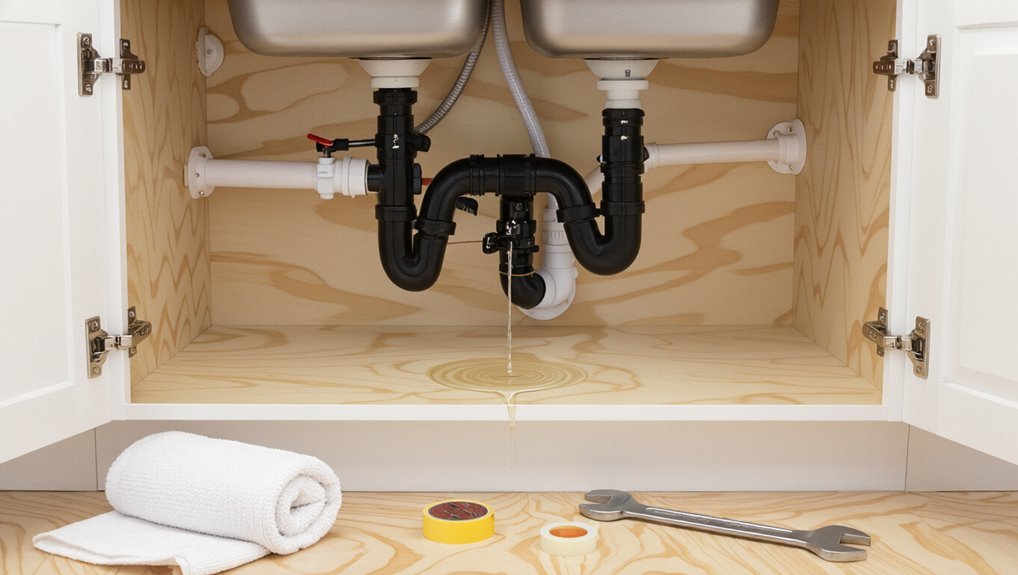
Shut off the water supply immediately to prevent further damage.
The homeowner assesses visible pooling, places a bucket beneath the leak, and lays down towels to limit spread.
Valves under the sink are turned clockwise; when inaccessible, the main shutoff is used.
Electrical risks are noted and power to nearby outlets is cut if needed.
Temporary containment follows: plumber’s tape or a compression clamp is applied to slow flow, or a hose clamp and rubber patch are used for larger tears.
Photographs document the problem for later reference.
After stabilization, the person schedules a proper repair or replacement promptly.
Identify Supply vs. Drain Leak
The next step is to distinguish a supply line leak from a drain leak by observing where the water originates and how it behaves.
Supply leaks usually produce a steady, pressurized spray or drip near shutoff valves and flexible lines, while drain leaks tend to be slower, often pooling under the trap and smelling of wastewater.
Identifying these indicators guides whether to shut off the water and replace fittings or to tighten or reseal the drain connections.
Water Supply Indicators
A homeowner’s quick visual and tactile checks can distinguish a supply-line leak from a drain leak: supply leaks are usually under pressure, producing a steady, often spraying stream or wetness at pipe joints and valve connections, while drain leaks tend to appear as slow, intermittent seepage, pooling from the trap or tailpiece and often accompanied by odor or gurgling when fixtures are used.
Water supply indicators include force, location, and response to shutoff. Look for high-pressure spray, dampness near shutoff valves, and sound of pressurized flow.
Useful checks:
- Feel for pulsation at connectors under pressure
- Inspect supply hose crimps and compression nuts
- Close shutoff to confirm stoppage
Drain Leak Characteristics
How can one tell a drain leak apart from a supply leak? The observer checks location: drain leaks originate at trap joints, tailpiece, or pipe seams beneath the sink, producing slow pooling, foul odor, or brownish stains.
Drain leaks worsen with water use and produce gurgling or slow drainage.
Supply leaks appear at shutoff valves, flexible lines, or fittings and create constant dripping, pressure-dependent sprays, or wet cabinet floors even when fixtures are idle.
Texture and smell differ: drain leaks often feel slimy and smell sewer-like; supply leaks smell clean.
Accurate identification directs appropriate repair: tighten or replace drain fittings versus fixing supply lines or valves.
Quick Visual Checklist for Common Leak Causes
When inspecting under a sink, a quick visual checklist helps identify the most common leak sources: loose slip-nut joints, cracked P-trap segments, deteriorated rubber washers or O-rings, corroded supply lines, and water stains on cabinet surfaces indicating slow drips.
The observer scans for obvious signs, then notes locations and severity to plan parts and tools.
- Check threaded connections for hand-tightness and visible gaps or mineral buildup.
- Inspect plastic and metal trap sections for hairline cracks, warping, or discoloration.
- Examine flexible supply hoses and shutoff fittings for bulges, rust, or wetness near crimp points.
Shut Off Water Under the Sink (Step‑by‑Step)
Before touching tools, the homeowner locates and closes the shutoff valves beneath the sink to stop water flow and prevent flooding. Then the sequence is followed: verify cold and hot valves are clockwise to close, test faucet to confirm water stops, and place a bucket under fittings. If valves are stiff, use pliers gently; do not force. For main shutoff, shut the house valve if under-sink valves fail. Note valve types and condition for repair. Record valve positions before starting work.
| Step | Action | Check |
|---|---|---|
| 1 | Locate valves | Visible under sink |
| 2 | Turn clockwise | Stops flow |
| 3 | Test faucet | No water |
Protect Cabinets and Flooring Before You Start
Before beginning any pipe repair, a protective drop cloth should be spread over the cabinet floor to catch water and debris.
Any valuables or frequently used items should be removed from the cabinet to prevent damage and create working space.
Taking these precautions reduces cleanup and lowers the risk of harming the cabinet or flooring.
Protective Drop Cloths
A heavy-duty canvas or plastic drop cloth should be laid beneath the sink area to shield cabinets and flooring from water, chemical cleaners, and falling debris. The cloth must extend beyond the cabinet edges and be secured with tape to prevent slipping.
Waterproof material eases cleanup; canvas absorbs spills but may need a tarp underneath. Work gloves and knee pads can be placed on the cloth to protect it from tools.
After the repair, fold contaminated cloth inward and dispose of according to local guidelines.
- Use a non-slip, waterproof drop cloth
- Secure edges with painter’s tape
- Replace soaked cloth immediately
Remove Valuables First
With valuables cleared from under the sink and surrounding counters, cabinets and flooring are better protected from spills, dropped tools, and accidental impacts.
The next step is to remove fragile items, cleaning supplies, and any stored papers or electronics. Place contents in a safe, dry area away from the work zone. Use shallow bins to keep small parts organized and labeled. Inspect cabinet bottoms for preexisting damage and lay a waterproof mat if needed. Clearing the area improves access, reduces trip hazards, and speeds repair.
After the job, return items only after confirming the area is dry and leak-free.
Clear the Space Quickly and Safely
To prepare the work area, remove all items from under the sink and place them at a safe distance to prevent contamination or obstruction. The technician clears remaining debris, wipes surfaces dry, and inspects for hazards like sharp edges or mold. Small containers hold loose parts and prevent loss. Protective gloves and eye protection are set aside for immediate use. Lighting is positioned to eliminate shadows while preserving access. The area is kept organized to speed work and reduce mistakes.
- Wipe and dry surfaces before starting
- Collect loose parts in a container
- Position a light for clear visibility
Essential Tools for Under‑Sink Repairs
Gathering the right tools guarantees under‑sink repairs proceed efficiently and safely.
A basin wrench reaches nuts in tight cabinet spaces; adjustable pliers and tongue‑and‑groove pliers provide grip for fittings and shutoff valves.
A pipe wrench handles metal pipe threads; channel locks manage larger connections.
Slip‑joint pliers and a compact socket set assist small fasteners.
A plumbers’ tape (PTFE) and a tube of plumber’s putty seal joints.
A utility knife, flash light or headlamp, and small bucket catch drips.
A set of towels and gloves protect surfaces and hands.
A pipe cutter suits copper or PVC clean cuts.
Which Replacement Parts to Buy First
A prioritized parts list helps avoid extra trips and keeps the repair focused. The guide recommends starting with common failure items: rubber washers, slip‑joint nuts, and short sections of pipe. Select parts matching the existing material (PVC, ABS, or metal) and standard dimensions under the sink. Include thread tape and a replacement gasket for sealed joints. Consider universal repair couplings for damaged runs. Verify finish and size for visible components. Keep receipts and small quantities.
Suggested starters:
- Replacement washers and gaskets
- Slip‑joint nuts and washers
- Short pipe segments and universal couplings
Tighten a Loose Slip‑Joint Drain Fitting
A homeowner inspects the slip‑joint drain to identify the necessary tools and materials, typically an adjustable wrench, channel‑lock pliers, plumber’s tape, and replacement washers.
They proceed with a clear step‑by‑step tightening sequence: support the trap, hand‑tighten the nut, then give a partial turn with pliers to secure the joint without over‑torquing.
Finally, they test for leaks and readjust if a slow drip persists.
Tools And Materials
Before starting, identify the specific tools and materials needed to tighten a loose slip‑joint drain fitting so the job goes smoothly and without surprises. Necessary items include basic hand tools, sealing supplies, and safety gear. The selection aims to prevent damage and make certain a durable seal without needing replacements.
- Slip‑joint pliers or adjustable wrench for nut tightening and counter-holding
- Replacement washers and a slip‑joint nut or coupling; plumber’s grease and plumber’s putty for lubrication and sealing
- Bucket, rags, and safety gloves to catch water, clean surfaces, and protect hands
All items should be inspected for wear and compatibility before beginning work.
Step‑By‑Step Tightening
With tools and materials gathered and inspected, the tightening procedure begins by positioning a bucket beneath the trap to catch water and loosening the slip‑joint nut just enough to expose the washer and seat.
The person inspects the washer for cracks or deformation, replaces it if needed, and cleans the seat and threads of debris or old plumber’s putty.
Reassemble the washer squarely on the seat, hand‑thread the nut to avoid cross‑threading, then use channel‑lock pliers to snug the nut a quarter to a half turn beyond hand‑tight.
Test for leaks by running water and observe; tighten slightly if drips persist.
Replace a Damaged P‑Trap (Step‑by‑Step)
Following safety precautions and isolating the water supply, the technician inspects the existing P‑trap to confirm damage, identify material type (PVC, ABS, or metal), and note connection styles and trap dimensions so the replacement parts match exactly.
The damaged trap is removed by loosening slip‑nut connections or cutting metal where necessary, preserving clean pipe ends.
A matching P‑trap assembly is fitted, ensuring correct orientation, gasket placement, and hand‑tightened nuts before final snug adjustments.
The work concludes with a leak test and adjustments as needed.
- Remove old trap and clean mating surfaces
- Install new trap with proper seals
- Test for leaks and secure fittings
Temporary Fixes for Hairline PVC Cracks
For hairline cracks in PVC, two common temporary options are a quick-setting epoxy patch and a rubber sleeve secured with a clamp.
The epoxy can seal small fissures when surfaces are clean and dry, while a rubber sleeve provides immediate mechanical reinforcement for slightly larger hairline splits.
Both methods are stopgaps designed to hold until a proper replacement or professional repair can be completed.
Quick Epoxy Patch
A small, rapid epoxy patch can temporarily seal a hairline PVC crack and stop leaks long enough to arrange a permanent repair. The surface must be clean, dry, and free of residue; sand lightly to promote adhesion. Mix a fast-setting epoxy per manufacturer directions and apply a thin layer over the crack, extending slightly beyond both edges.
Allow full cure before testing water flow. This method is temporary and suited for low-pressure drains.
- Clean and sand the area for better bonding.
- Apply mixed epoxy smoothly, covering the crack fully.
- Wait recommended cure time, then test for leaks.
Rubber Sleeve Clamp
With the cracked section cleaned and dried, a rubber sleeve clamp provides a quick, reliable temporary seal for hairline PVC fractures. The sleeve centers over the leak, held by a stainless steel band tightened with a screwdriver or nut driver. It compresses evenly to stop drips while allowing the pipe to remain functional until permanent repair occurs.
Suitable for small, non-structural cracks, the clamp resists common household pressures but is not a long-term solution. Inspect periodically for slippage or seepage, and replace with solvent-welded or replacement piping at the earliest opportunity to make certain lasting integrity.
Use Epoxy and Repair Tape Correctly
Beginning by cleaning and drying the damaged area, the repairer must select an epoxy or repair tape rated for plumbing use and matching the pipe material.
Apply epoxy putty to small cracks, pressing firmly and smoothing to remove air pockets; allow full cure time before testing.
For repair tape, stretch and wrap from upstream to downstream, overlapping by half the width and extending beyond the damaged zone.
After curing or set, inspect for gaps and test under normal water pressure.
Maintain ventilation and wear gloves.
Replace the temporary repair with a proper fitting promptly if leakage resumes.
- Use correct product rating
- Follow cure times
- Test under pressure
Replace a Corroded Drain Tailpiece
After a temporary epoxy or tape repair, the compromised drain tailpiece should be examined for corrosion that warrants replacement rather than repair.
The procedure begins by shutting off water, placing a bucket under the trap, and loosening slip nuts to remove the P-trap.
Inspect connection points and measure tailpiece length, diameter, and threading.
Select a matching tailpiece—metal or PVC—and clean mating surfaces.
Install new tailpiece with appropriate washers and hand-tighten slip nuts, then fully seat and tighten with pliers a quarter turn.
Reattach P-trap, restore water, and check for leaks, adjusting nut tension as needed.
Fix a Leaking Compression Supply Line
A leaking compression supply line often results from a loose compression nut, a damaged ferrule, or corrosion at the connection.
The technician drains water, shuts off the supply, and inspects the nut, ferrule, and valve outlet for damage.
Tightening the nut may stop minor leaks; a persistent leak requires replacing the ferrule and retightening to manufacturer torque.
Corroded fittings need replacement and thread sealant on pipe threads where appropriate.
After reassembly, the supply is slowly opened and checked for drips.
- Inspect nut, ferrule, and valve outlet
- Tighten or replace ferrule as needed
- Replace corroded fittings and test
When to Replace Flexible Supply Hoses
Regularly inspecting flexible supply hoses helps catch deterioration before it causes water damage. The guide recommends replacement when visible wear appears, the hose is over five years old, connections show corrosion, kinks reduce flow, or rubber bulges. Quick replacement prevents leaks and sudden failure.
| Condition | Action |
|---|---|
| Visible cracks or fraying | Replace immediately |
| Age >5 years | Consider replacement |
| Corroded fittings | Replace and clean connections |
| Kinks or flattening | Replace to restore flow |
| Bulging or blistering | Replace to prevent rupture |
Install a New Shut‑Off Valve Under the Sink
Having confirmed that supply hoses are sound, attention turns to installing a new shut-off valve under the sink to control water at the source and reduce the risk of leaks. The technician isolates the water, drains the line, and inspects the tailpiece and adapter. Selection favors a compression or quarter-turn ball valve sized to the incoming pipe. Installation follows manufacturer torque recommendations and uses joint compound or tape on threads where applicable. After mounting, the valve is cycled and checked for weeps.
- Verify pipe type and valve compatibility
- Tighten fittings incrementally to avoid distortion
- Test under pressure for several minutes
Safely Replace a Soldered Copper Joint
Begin by shutting off the water supply and draining the line so the technician can work on the joint without pressure or residual water.
Wear safety glasses and heat‑resistant gloves.
Clean the joint with a wire brush and remove old solder and flux.
Apply flux to cleaned surfaces.
Use a propane torch, heating evenly until solder melts and flows; avoid overheating surrounding fittings.
Feed lead‑free solder into the joint, letting capillary action draw it through.
Quench with a damp cloth and inspect the seal for continuity and gaps.
Reopen the valve slowly, check for leaks, and reheat or re‑solder if necessary.
Cut and Fit Copper With a Slip Coupling
The technician measures and marks the pipe to make certain correct length before cutting.
The pipe is cut cleanly and square to provide a proper seating surface.
A slip coupling is slid on and positioned, then tightened or soldered as required to restore the line.
Measure And Mark Pipe
Before cutting, measure twice to guarantee the copper fits precisely between the existing pipe and the slip coupling, accounting for the coupling’s insertion depth and any burrs or alignment offsets.
The installer marks the pipe with a fine permanent marker or scribe at the calculated length, including allowance for reaming.
Verify alignment by dry-fitting the coupling over the pipe ends to confirm seating depth and orientation.
Note clearance for nearby fixtures and shutoff valves.
Record measurements if multiple sections are needed.
- Mark the cut line square to the pipe axis.
- Measure insertion depth on both ends.
- Check for obstructions before final cutting.
Cut Cleanly And Square
Cut the copper squarely using a sharp tubing cutter, rotating it evenly until the wheel scores through without crushing the tube. After separating the section, remove burrs and filings with a reamer or fine file, deburring both inside and outside the end to guarantee a smooth, round profile.
Verify the cut face is perpendicular by sighting along the pipe; repeat trimming if necessary. Clean the outer surface with emery cloth to bright copper, removing oxidation and oils for reliable fitting.
Keep dimensions consistent with previous measurements so the prepared end will seat fully when the coupling is introduced.
Install Slip Coupling
Having prepared and cleaned the pipe ends, attention moves to fitting a slip coupling to join the two copper sections. The technician measures overlap, marks insertion depth on both pipes, and verifies alignment. Flux is applied sparingly to the cleaned surfaces before sliding the coupling into place. Proper gap and seating prevent solder wick and guarantee a reliable joint.
- Confirm both pipe ends reach the coupling stops.
- Heat evenly and feed solder until a continuous fillet forms.
- Allow cool, then test for leaks under low pressure.
Final inspection checks for smooth solder beads and secure, leak-free connection.
Replace a PEX Section Under the Sink
To replace a damaged PEX section under the sink, the repairer first isolates the water supply and drains the lines to prevent leaks; then the faulty segment is removed and a new PEX piece is fitted with appropriate connectors, clamps, or crimp rings to restore a watertight joint.
The worker measures and cuts PEX squarely, deburrs if needed, and selects matching fittings (push-fit, barbed with clamp, or crimp).
After assembly, joints are inspected for proper seating and tool marks.
The supply is slowly restored while checking for drips. Any leak requires immediate tightening or redoing the connector until no leakage is observed.
Reseat and Reseal a Sink Strainer
A sink strainer that leaks or rocks should be reseated and resealed to prevent water from pooling under the sink and damaging cabinets. The process begins by disconnecting the drain tailpiece, removing the locknut and old putty or gasket, and cleaning the sink opening and strainer flange.
A plumber’s putty or silicone gasket is applied evenly, the strainer pressed into place, and the underside secured with the locknut while aligning the tailpiece.
- Inspect flange for corrosion or cracks before resealing.
- Use plumber’s putty for metal sinks, silicone for porous surfaces.
- Hand-tighten then snug with tools; avoid overtightening.
Stop Clogs That Look Like Leaks
Leaks from a sink flange are not the only cause of water under the cabinet; slow drains and partial clogs can back up and escape at pipe joints, slip nuts, or through saturated trap seals, mimicking a leak. The guide recommends clearing blockages with a plunger, sink snake, or by removing the trap to inspect debris. After clearing, run hot water and test flow; check joints for moisture. Regular maintenance prevents recurrence.
| Cause | Symptom | Action |
|---|---|---|
| Hair/grease | Slow draining | Snake or clean trap |
| Debris | Gurgling | Flush with hot water |
| Mineral build-up | Reduced flow | Vinegar soak |
Test Repairs for Leaks Before Finishing
Before sealing or reinstalling cabinets, the repair should be pressure tested to confirm joint integrity and reveal any weak points.
A controlled pressure test with the water supply shut off and appropriate fittings attached helps identify leaks that might not appear under normal use.
After pressurizing, a careful visual inspection of all connections and nearby surfaces will catch slow weeps and permit targeted touch-ups before finishing.
Pressure Test Procedure
Begin by isolating the repaired section and filling the line with water or air to the specified test pressure, then monitor for pressure drop and visible signs of leakage over the required hold time.
The operator records initial pressure, notes test duration, and watches gauges.
If pressure falls, repressurize once to confirm; persistent loss indicates a fault needing rework.
After a successful hold, slowly relieve pressure before restoring service.
Safety precautions include using rated equipment and avoiding overpressurization.
- Use calibrated gauge and compatible pump.
- Maintain hold time per code or manufacturer.
- Tag the section as tested and document results.
Visual Leak Inspection
After a successful pressure hold and controlled depressurization, the repaired area is examined visually for seepage, drips, or moisture that the pressure test might not reveal.
Inspection proceeds under good lighting, using a flashlight and mirror for tight spots. Joints, fittings, and nearby surfaces are checked for tiny beads of water, stains, or fresh corrosion. Paper towels or tissue are run along seams to detect dampness.
Fixtures and supply lines are observed while valves are cycled and drains run briefly to simulate real use. Any sign of leakage prompts immediate tightening, resealing, or rework before finishing and restoring cabinetry.
Troubleshoot Persistent Drips After Repair
If a repaired sink joint continues to drip, the homeowner should methodically inspect the work to identify the cause: check that connections are tightened to the correct torque, gaskets and washers are seated and undamaged, threaded fittings have proper tape or compound, and no hairline cracks or corrosion remain on pipes or fittings.
Next steps include isolating the source, verifying water pressure, and retesting after each correction. Common issues to confirm:
- Misaligned slip nuts or crushed washers causing intermittent weeping.
- Incomplete removal of old sealant or foreign debris preventing a seat.
- Damaged compression rings or improperly cut tubing ends requiring replacement.
Diagnose Hidden Leaks Inside Cabinet Walls
When persistent drips continue despite surface repairs, attention should shift to concealed plumbing within cabinet walls where slow leaks can soak framing and finish materials before appearing at visible joints.
Inspect for soft spots, staining, mold, or warping on cabinet panels and baseboards. Remove contents and use a flashlight to trace pipe runs; follow sound and moisture trails.
Apply a paper towel or tissue along seams to detect dampness. Consider using a moisture meter or infrared thermometer to locate cool, wet areas.
Check supply lines, drain traps, and joints where pipes pass through studs or access panels for corrosion or weeping.
When to Call a Professional Plumber
When a repair involves complex fittings, concealed piping, or tools beyond basic household use, a professional plumber should be considered.
Repeated leaks or those that originate inside cabinet walls often indicate underlying issues that require diagnostic equipment and experience.
Safety risks or potential code violations, such as improper venting or gas line proximity, warrant immediate professional attention.
When Repairs Become Complex
Although many sink problems can be handled with basic tools and patience, some situations clearly exceed DIY scope and require a licensed plumber’s expertise.
A professional should be engaged when repairs involve structural risks, gas connections, or complex sewer issues that could worsen without specialized tools and permits.
Signs to call a plumber include:
- Sewage odors, persistent slow drains after basic clearing, or backups suggesting mainline problems.
- Corroded or cast-iron piping that needs replacement rather than patching.
- Work requiring permits, code compliance, or modifications to water mains or gas lines.
Timely professional intervention prevents damage and guarantees safety.
Hidden Or Repeated Leaks
Frequently, hidden or repeatedly returning leaks signal problems beyond simple DIY fixes and warrant a professional plumber’s assessment.
Persistent moisture, staining, mold growth, or fixtures that fail after repair indicate concealed damage, corroded fittings, cracked seals, or compromised supply lines.
A plumber can perform leak detection, pressure testing, and inspect inaccessible joints or appliance connections.
Professional intervention prevents escalation, structural harm, and repeated service calls. Homeowners should document occurrences, note locations and timing, and shut off water if damage worsens.
Engage a licensed plumber when leaks recur despite correct DIY attempts or when source and extent remain unclear.
Safety Or Code Concerns
Why call a professional for safety or code concerns? A licensed plumber assesses risks beyond routine fixes: gas lines, backflow prevention, structural damage, and municipal code compliance require expertise. Improper repairs can cause hazards, fines, or failed inspections. When uncertain, seek qualified help.
- Gas, sewer, or electrical interactions that pose immediate danger.
- Permits required for alterations affecting drainage, venting, or water pressure.
- Recurring failures indicating systemic issues or hidden damage.
A professional documents work, secures permits, and guarantees installations meet local codes, protecting occupants and property while avoiding costly corrections.
Common DIY Mistakes to Avoid
What are the pitfalls that turn a simple sink repair into a recurring problem?
Common mistakes include overtightening fittings, which strips threads or cracks connectors, and using incompatible sealants or tapes that fail under water exposure.
Skipping leak tests after reassembly lets slow drips go unnoticed.
Neglecting to shut off water or to relieve line pressure risks flooding.
Improperly supporting pipes causes stress and joint failure.
Reusing worn washers or corroded parts invites repeat leaks.
Incorrectly sized replacement pieces lead to poor seals.
Following correct steps, testing, and replacing damaged components prevents repeated failures and extra cost.
Choosing Pipe Materials for Your Sink
Select pipe materials based on durability, local code, and the sink’s function. The homeowner evaluates common options: metal for strength, plastic for corrosion resistance, and flexible connectors for tight spaces. Choices hinge on waste vs. supply lines, temperature exposure, and longevity expectations. Matching fittings and adhesives matters as much as pipe type. Consider ease of future repairs and compatibility with existing plumbing while prioritizing safety and reliable seals. When unsure, consult manufacturer guidance. Recommended materials balance practicality and cost for typical under‑sink scenarios.
- PVC/ABS: lightweight, inexpensive, corrosion‑resistant
- Copper: durable, heat‑tolerant, more costly
- PEX/flexible: easy install, ideal for constrained spaces
Read Local Codes for Under‑Sink Work
How should a homeowner proceed before altering under‑sink plumbing to guarantee compliance and safety? A homeowner should consult local building and plumbing codes, permit requirements, and any homeowners’ association rules.
Verify allowable materials, trap and vent configurations, and connection methods. Contact the municipal building department or review official code online for specific requirements and whether a permit or inspection is needed.
When in doubt, request written guidance or verify code sections cited. Adhering to codes prevents failed inspections, fines, and unsafe installations. If the scope exceeds simple repairs or codes are unclear, hire a licensed plumber to make certain compliance.
Estimate Cost and Time for Common Fixes
A straightforward estimate of cost and time helps homeowners decide whether to DIY or hire a pro.
Typical repairs and their rough ranges (materials plus basic tools, labor excluded) and time commitments are outlined to guide decisions.
- Dripping P-trap: $10–30; 15–30 minutes to replace gasket or tighten connections.
- Leaking supply line: $20–80 for replacement hose; 30–60 minutes including shutoff and bleeding.
- Corroded tailpiece or trap replacement: $25–75; 30–90 minutes depending on accessibility.
Complex issues and hidden damage increase both cost and duration; professional quotes recommended for uncertainty.
Safety When Using Chemicals and Cleaners
When using drain cleaners and other chemical products under a sink, users should treat them as hazardous materials: read labels, wear appropriate PPE (gloves, eye protection), guarantee ventilation, and never mix different chemicals.
Work slowly, avoid spills, and keep skin contact minimal.
Store products upright in original containers away from children and pets.
Rinse tools and surfaces thoroughly after use and dispose of leftovers per local regulations.
If splashes occur, follow label first‑aid instructions and seek medical help for significant exposure.
Prefer mechanical methods or enzyme-based cleaners when possible to reduce chemical hazards and corrosion risk.
Winterize Under‑Sink Pipes in Cold Climates
After handling chemical hazards and cleaning agents, attention should turn to protecting under‑sink piping from freezing in cold climates. The guide recommends simple preventive steps to avoid burst pipes and costly repairs.
Insulate exposed pipes, maintain gentle heat in adjacent rooms, and drain lines when the home will be vacant. Monitor vulnerable fittings and shutoff valves for signs of stress.
- Wrap foam pipe insulation snugly around cold‑water and drain lines; tape seams.
- Keep cabinet doors open during cold snaps to allow warm air circulation from heated rooms.
- Before extended absence, shut water, drain fixtures, and leave faucets slightly open to relieve pressure.
Improve Cabinet Ventilation to Reduce Corrosion
In enclosed cabinets where moisture and chemicals accumulate, improving ventilation reduces humidity and limits the electrochemical conditions that accelerate metal corrosion. The guide recommends simple measures: add vents, install a small passive grille near the base and top, and keep stored chemicals sealed. Improved airflow dries surfaces, slows rust, and prolongs fittings and solder joints. Periodic inspections should accompany ventilation upgrades to spot early corrosion. Maintain clearances around pipes and avoid blocking airflow with stored items. Consider moisture-absorbing packets as a supplement, not a replacement for proper ventilation.
| Action | Location | Benefit |
|---|---|---|
| Passive vent | Base/top | Air exchange |
| Grille | Door | Prevents pooling |
| Sealants | Joints | Chemical protection |
| Packets | Shelf | Supplemental drying |
| Inspection | Monthly | Early detection |
Install a Water Alarm Under the Sink
Improving cabinet airflow and routine inspections reduce corrosion risk, but leaks can still occur and go unnoticed; installing a water alarm under the sink provides an immediate alert to liquid presence before damage spreads.
The device is compact, battery-powered, and triggers audible or wireless notifications when sensors detect moisture.
Placement near trap, supply connections, and water heater lines maximizes coverage.
Regularly test the alarm and replace batteries per manufacturer guidance.
Consider models with multiple probes for larger cabinets.
- Place alarm on flat, dry surface near likely leak sources
- Test monthly and replace batteries annually
- Choose Wi‑Fi or audible models per preference
Handling Slow Leaks If You Rent
Tenants should promptly document slow leaks and notify their landlord or property manager in writing, since small drips can quickly cause mold, structural damage, or higher utility bills if left unaddressed.
Photographs, dates, and brief descriptions create a record.
Review the lease for maintenance responsibilities and required notice procedures.
If the landlord authorizes access, allow qualified personnel to inspect and repair; avoid DIY alterations that could violate the lease or create liability.
If repairs are delayed and damage worsens, follow local tenant-rights steps: send a formal repair request, keep records, and consider contacting housing authorities or legal aid for guidance.
Recycle or Dispose of Old Plumbing Parts
Clearing out old plumbing parts responsibly reduces waste and prevents hazardous materials from entering landfills. The homeowner assesses material types—metal, plastic, rubber—and separates items for recycling or disposal.
Local recycling centers accept copper and brass; contaminated pieces may require special handling. When parts are oil- or chemical-soaked, they go to hazardous waste collection. Small reusable items can be donated to habitat or community workshops instead of thrown away.
- Clean metal fittings: recycle at scrap facilities.
- Plastic traps and PEX: check local curbside rules.
- Contaminated or electronic components: take to hazardous waste sites.
Documentation or receipts are recommended for proof of proper disposal.
Document Repairs for Warranty or Insurance
Recordkeeping preserves proof of work and protects warranty and insurance rights when a sink repair occurs.
Photographs before, during, and after the repair, dated and labeled, establish condition and completion. Keep receipts for parts, tools, and disposal services, plus copies of product warranties.
Note the scope of work, parts replaced, measurements, and any homeowner or contractor signatures. If a professional performed work, request a signed invoice and license number.
Store records digitally with backups and a physical file. Organized documentation speeds claim processing, validates coverage limits, and defends against future disputes.
Upgrade to Touchless or Filtered Faucet Lines
When upgrading to touchless or filtered faucet lines, the homeowner should first confirm compatibility with existing sink fittings and water pressure.
Selecting certified filter cartridges or reliable touchless kits guarantees both water quality and sensor longevity.
Professional installation or careful adherence to manufacturer instructions helps avoid leaks and preserves warranty coverage.
Choosing Compatible Faucet Lines
Upgrading to touchless or filtered faucet lines requires confirming compatibility with the existing sink fittings, water pressure, and supply connections. The homeowner should measure thread sizes (compression vs. threaded), verify flow rate needs for sensors or filters, and inspect space under the sink for valves and adapters.
Materials must match—stainless, braided, or reinforced hoses—to prevent galvanic corrosion. Consider certification for filtration components and make certain shutoff valves support new line pressures.
Include a checklist of essential specs before purchase:
- Thread size and connection type
- Required flow rate and pressure range
- Material and certification requirements
Installing Filtered Or Touchless
With compatibility confirmed and measurements recorded, the installation of filtered or touchless faucet lines proceeds by isolating the water supply and preparing the under-sink space for new components.
The installer drains residual water, disconnects existing supply lines, and inspects mounting points and valves.
For filtered systems, a dedicated cold-water feed is tee’d in, filter housing mounted securely, and tubing routed to the faucet with proper fittings and leak-resistant tape.
For touchless units, an electrical or battery power source is positioned, sensors aligned, and control valves connected per manufacturer instructions.
Final steps include pressure testing, checking for leaks, and verifying operation.
Teach Household Members to Spot Early Leaks
Regularly checking under sinks for dampness, drips, or staining helps household members catch leaks before they worsen.
The homeowner explains simple visual cues, safe touch checks, and routine timing so everyone knows when and how to inspect without tools.
Brief instructions reduce hesitation and guarantee prompt reporting to the person responsible for repairs.
Encourage documenting findings with a quick photo and note of time to track progression.
Share clear thresholds for escalation—small damp spots versus active streams—and emphasize not to tighten fittings without guidance.
Consistent, simple habits prevent minor seepage from becoming costly water damage.
- Check for new stains, water beads, or musty odors.
- Feel pipe joints and cabinet bottoms after use.
- Photograph and record observations with date and time.
Build a Basic Under‑Sink Plumbing Repair Kit
After household members learn to recognize early leaks, assembling a compact under‑sink repair kit guarantees small problems can be handled quickly before they worsen.
The kit should include adjustable pliers, a pipe wrench, basin wrench, slip‑joint pliers, assorted screwdrivers, plumber’s tape, a roll of rubber repair tape, pipe joint compound, a small tube of epoxy putty, spare washers and O‑rings, a P‑trap replacement kit, and a compact flashlight.
Include disposable gloves, rags, a bucket, and zip ties.
Store items in a labeled waterproof container under the sink and review contents seasonally to replace used or degraded supplies.
Conclusion
When a drip appears beneath the sink, swift, methodical action keeps water from turning small trouble into a flood. The guide walks through stopping the leak, distinguishing supply from drain problems, and taking preventive steps—shutting water, protecting cabinets, and recording work for warranties. Equipping the home with basic tools and teaching occupants to notice signs makes future fixes smoother. Like a dependable anchor in rough seas, preparedness steadies the household against plumbing surprises.