
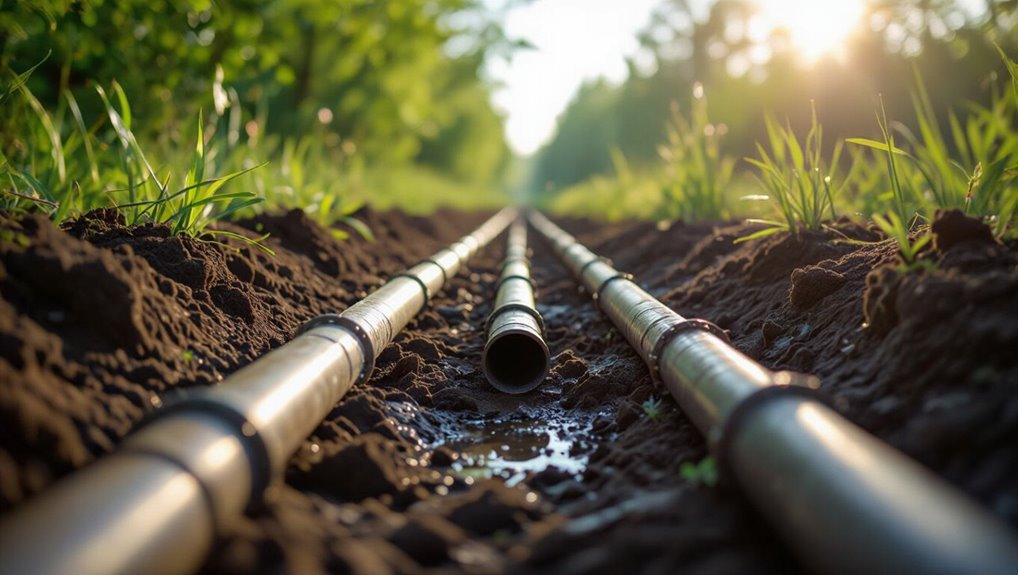
How to Detect Water Pipes Underground: Easy DIY Tips & Tools
To effectively detect underground water pipes, follow these key steps:
- Contact Local Utilities: Always start by calling your local one-call center to have utilities marked and to check any existing plans or easements.
- Use Detection Tools: For metallic pipes, employ a basic electromagnetic locator or acoustic listening device. For non-metallic pipes, consider hiring a professional locator.
- Gentle Probing: Before digging mechanically, probe the area gently by hand to avoid damaging any pipes.
- Observe the Ground: Look for signs such as wet spots, depressions, or unusual vegetation that may indicate the presence of pipes.
- Safety First: Wear appropriate personal protective equipment (PPE), document all markings, and take photographs of locations for future reference.
These steps will help you safely and effectively locate underground water pipes before starting any digging or excavation projects.
What People Mean By “Detecting Water Pipes Underground”
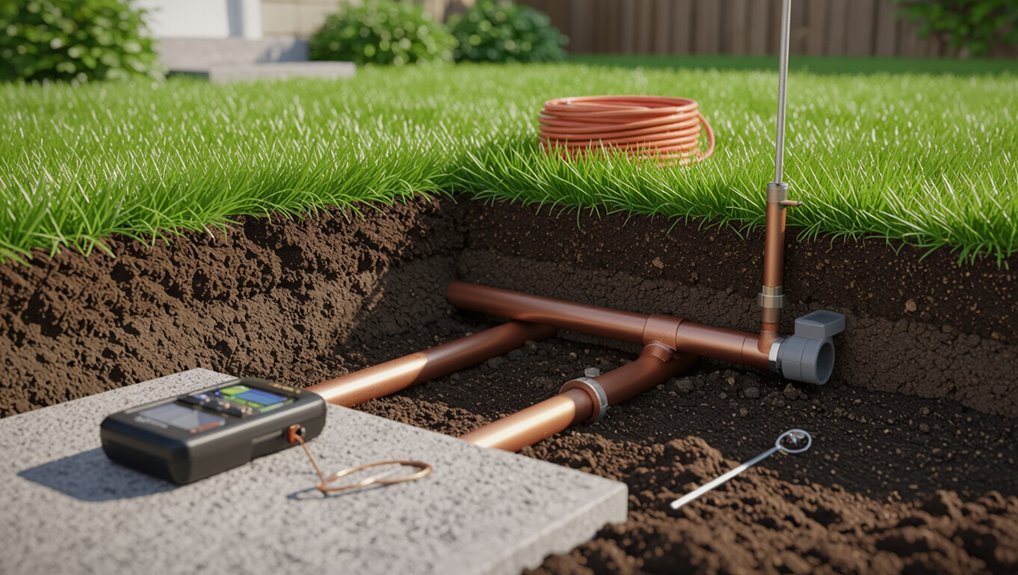
In the context of utilities and construction, “detecting water pipes underground” refers to locating and mapping the position, depth, and sometimes material of buried water mains, service lines, and related fittings using tools such as acoustic listening devices, electromagnetic locators, ground-penetrating radar, and excavation records.
It encompasses confirming pipe continuity, identifying valves, joints, and unexpected deviations, and distinguishing metallic from nonmetallic materials where possible.
Objectives include preventing damage during digging, planning repairs, and documenting infrastructure.
Practitioners combine sensor data, site history, and visual inspection to produce accurate, confidence-rated maps while acknowledging detection limits imposed by soil conditions, depth, and nearby utilities.
Quick 3-Step Plan: Locate Buried Water Pipes Safely
For safe and efficient location of buried water pipes, a concise three-step plan guides technicians: verify records and marks, scan with appropriate detection tools, and confirm positions by cautious test excavation or nondestructive verification.
Technicians review plans and utility markings, choose ground-penetrating radar, electromagnetic locators, or acoustic methods as suited, and mark probable lines. Next, systematic scanning establishes depth and lateral position.
Finally, nondestructive checks or shallow hand-excavation confirm continuity before any heavy digging. Safety protocols and traffic or site controls are maintained throughout. Documentation of findings and updates to maps conclude the operation.
- Review maps and utility marks
- Select suitable detection tools
- Conduct methodical scans
- Verify with cautious test digs or sensors
- Record results and update plans
Who Should Try DIY Pipe Locating and When to Call a Pro
Homeowners with basic DIY experience and simple tools can locate shallow, clearly marked water lines on small residential lots.
Those comfortable using hand tools, basic locators, and following straightforward instructions may attempt simple searches—to confirm a valve, mark a line before light digging, or verify visible infrastructure.
Professionals should be engaged when lines are deep, routes uncertain, pipe materials nonmetallic, or other utilities are nearby.
Call a licensed locator or plumber for complex properties, commercial sites, suspected leaks, or projects requiring permits and precise depth mapping.
Prioritize safety and liability concerns; professional work reduces risk of costly damage and service interruptions.
Pre-Search Checklist: Safety, Permits, and Calling 811
Before any locating or excavation begins, a concise safety checklist should be reviewed covering personal protective equipment, traffic control, and safe excavation procedures.
The article recommends contacting 811 to have underground utilities marked and confirming any required local permits.
Following these steps reduces the risk of injury, utility damage, and regulatory penalties.
Safety Gear And Procedures
Equipped with appropriate personal protective equipment and a clear plan, the team verifies permits, reviews site maps, and confirms that 811 (or the local utility notification service) has been contacted and marking is scheduled; this pre-search checklist guarantees regulatory compliance, reduces risk of striking live utilities, and sets protocols for emergency response before any locating or excavation begins.
Personnel wear hard hats, high-visibility vests, steel-toe boots, gloves, and eye protection. Training in tool use, lockout/tagout, and basic first aid is mandatory. Communication devices and an emergency plan are established. Continuous monitoring for hazards guides safe proceeding.
- Hard hats and hi-vis vests
- Protective gloves and boots
- Eye protection and hearing plugs
- Trained operator and spotter roles
- Communication and emergency plan
Call 811 Before Digging
After confirming permits, PPE, and an emergency plan, the team places the utility notification call to 811 (or the local one-call center) to request professional marking of underground lines. The call guarantees utility owners locate and mark pipes, cables, and other hazards before any excavation. Response times, marking colors, and legal waiting periods vary; the crew documents ticket numbers and follows marked boundaries. Excavation proceeds only after all marks are verified and additional private utilities are located. Calling 811 reduces risk, prevents service disruptions, and meets regulatory obligations.
| Action | Responsible | Expected result |
|---|---|---|
| Call 811 | Excavator | Ticket issued |
| Verify marks | Crew lead | Safe boundaries |
| Wait period | Contractor | Compliance |
| Document ticket | Site admin | Records |
Before You Dig: Essential Safety and Legal Rules
Before breaking ground, the homeowner should call utility locators to identify underground lines and obtain any required permits.
Property boundaries must be clearly marked to avoid encroachment and guarantee locators focus on the correct area.
Following these legal and safety steps reduces the risk of damage, service outages, and liability.
Call Utility Locators
Contacting local utility locating services is the essential first step before any excavation project; these professionals mark the locations of underground water, gas, electric, and communication lines to prevent damage, service interruptions, and injury.
They respond to calls, use specialized equipment, and provide color-coded markings or flags that guide safe digging. Homeowners and contractors should wait for clear marks, respect clearance zones, and follow any on-site instructions.
Accurate locating reduces repair costs and legal liability. When uncertain, verify markings with the utility company before proceeding.
- Request a locate call several days ahead
- Provide precise site details
- Note color codes and flags
- Keep marks visible
- Call back if marks fade
Obtain Permits First
When planning any excavation, obtaining the required permits is a legal and safety imperative. The homeowner or contractor should check local regulations, submit applications, and await approvals before digging. Permits guarantee coordination with utility companies, set conditions for safe work, and document liability and inspections. Failure to secure permits can result in fines, halted work, and increased repair costs. Records from permitting also aid future property transfers and maintenance planning. Below is a concise permit checklist for common requirements and contacts.
| Requirement | Purpose |
|---|---|
| Application | Official authorization |
| Inspection | Verify safe completion |
| Utility clearance | Prevent service damage |
Mark Property Boundaries
Several clear boundary markers—survey stakes, corner pins, or a recorded plat—should be identified and physically marked before any digging begins.
The property lines define legal responsibility for utilities and make certain excavation stays within permitted zones.
Confirm recorded boundaries with local land records or a licensed surveyor if unclear.
Use durable, visible markers and record their locations with photos and measurements.
Communicate boundaries to contractors and neighbors to avoid disputes.
Respect setback requirements, easements, and shared utilities that may lie outside visible limits.
- Verify recorded plats and surveys
- Place durable flags or stakes
- Photograph and log marker positions
- Notify neighbors and contractors
- Check for easements and setbacks
Reading Property Plans and Utility Maps
Before digging or scanning, a thorough review of property plans and utility maps establishes the likely routes, depths, and ownership of underground water pipes.
Plans and maps reveal lot lines, easements, building footprints, and recorded utility corridors.
Readers learn to read scale, legend, line types, and color codes that indicate water mains, service lines, and other utilities.
Contour lines and spot elevations suggest burial depth changes.
Historic plans can show older alignments.
Comparing municipal utility maps with private site plans identifies discrepancies.
Noted uncertainties should prompt cautious locating with hand tools or electronic detectors before any excavation.
How to Ask Your Utility Company for Pipe Location Records
To obtain official pipe location records, contact the local water utility or municipal public works department with a clear request that includes the property address, parcel number, and any job or permit reference; this allows staff to locate plans, as‑built drawings, or GIS data and to advise on available formats, fees, and lead times.
The requester should specify desired detail level, planned use, and preferred delivery (digital paper).
Be prepared to provide ID and sign disclaimers.
If records are incomplete, ask about recent field surveys or locator services the utility recommends.
Track communications and reference numbers for follow up.
- State purpose and urgency
- Provide exact site identifiers
- Request file types
- Ask about fees
- Note contact and reference numbers
Spot Surface Signs That Hint at Buried Water Pipes
Surface cues often reveal the path of buried water pipes without excavation.
Depressions or sinkholes can indicate soil loss over a leaking line, while unusually lush or discolored vegetation may mark moisture lines.
Wet spots on pavement or persistent damp patches are direct signs to investigate for an underground pipe issue.
Depressions Or Sinkholes
Among the clearest indicators of an underground water issue are persistent depressions or sinkholes forming in lawns, roads, or fields; these changes in grade often result from soil being washed away by leaking pipes and can appear suddenly or worsen over weeks.
Observers note softened ground, pooling water, and cracked pavement as symptoms. Investigations should prioritize safety and shallow probing before heavy equipment. Early detection limits damage and repair costs.
Regular monitoring after heavy rain or thaw helps distinguish seasonal settling from active loss of subsoil.
- Sunken turf patches
- Cracked or sagging pavement
- Localized standing water
- Sudden lawn collapses
- Soft, spongy ground
Vegetation Differences
After noting depressions or sinkholes, investigators often scan surrounding vegetation for telltale differences that signal buried water pipes. Variations in color, growth rate, and species distribution can indicate altered soil moisture from leaks or pipe placement. Lush, greener strips may trace slow leaks; stunted or yellowing patches can mark compacted soil over trenches. Seasonal context and irrigation patterns are considered to avoid false positives. Observers compare plant health across short distances and note linear alignments. Simple visual surveys combined with the table below help prioritize areas for probing or electronic detection.
| Indicator | Likely cause |
|---|---|
| Lush strip | Persistent moisture |
| Yellow patch | Disturbance/compaction |
| Different species | Soil change |
| Linear alignment | Trench or pipe path |
Pavement Wet Spots
Noting damp patches on pavement can provide a direct, immediately visible clue to an underground water line. Observers should scan sidewalks, driveways, and parking areas for localized wetness that does not match recent weather.
Persistent spots, especially with no surface drainage cause, suggest groundwater or leaking pipe influence. Temperature differences may keep patches longer in cold or shaded areas.
Documentation with photos and timestamps helps track progression. If found, avoid heavy loading and contact utility specialists for safe investigation.
- Look for circular or elongated wet shapes
- Compare nearby dry areas
- Note odor or discoloration
- Check after several hours
- Photograph and timestamp patches
How Soil Type Affects Surface Clues and Detection
Soil composition markedly influences which surface clues appear and how easily underground pipes can be detected.
Sandy soils drain quickly, reducing visible pooling but enabling subtle depressions and faster heat transfer detectable with infrared.
Clay holds moisture, producing persistent wet areas, soft spots, and surface cracking near leakage.
Loamy, mixed soils moderate signs, making detection reliant on small texture or color changes.
Rocky or compacted soils mask subsidence and restrict acoustic signal propagation, complicating listening techniques.
Organic-rich topsoil may obscure moisture contrasts yet reveal odor or vegetation vigor differences.
Awareness of these patterns guides the selection of probes, thermal imaging, and acoustic methods.
How Vegetation Patterns Reveal Underground Water Pipes
Observers note that unusually lush, linear growth can trace the path of leaking or moisture-rich water pipes.
Adjacent plants may appear stunted or stressed where roots compete with concentrated moisture or altered soil chemistry.
Seasonal changes in vigor or early greening along a narrow corridor further indicate subsurface moisture anomalies worth investigating.
Lush Linear Growth
Lush linear growth describes the distinct ribbons of denser, greener vegetation that often trace the course of leaking or intentionally routed underground water pipes, revealing subsurface moisture anomalies through contrast with surrounding plant cover.
Observers note uniform direction, increased vigor, and changes in species where soil moisture is elevated; such lines can appear across lawns, fields, or roadsides.
Seasonal persistence distinguishes pipe-related moisture from short-term runoff.
Mapping these lines and comparing them to known utility routes helps narrow search areas without intrusive probing.
- Look for continuous green bands
- Compare plant types along the strip
- Check seasonality and permanence
- Measure width and direction
- Cross-reference maps and plans
Stunted Nearby Vegetation
Detecting stunted nearby vegetation can indicate underground water pipes where excess moisture, salinity, or altered soil chemistry disrupts normal root function and plant growth.
Observers note patches of smaller, yellowing, or sparse plants directly above suspected pipe routes. Pattern alignment with straight lines, joints, or known utility corridors strengthens the inference.
Comparison with surrounding healthy growth helps isolate anomalies caused by leaks versus shading or soil compaction.
Simple inspection tools—soil probes and moisture meters—confirm localized wet or saline conditions without digging.
Careful mapping of stunted zones guides targeted investigation, reducing unnecessary excavation and focusing repairs.
Seasonal Moisture Signals
Often, seasonal shifts in plant vigor and groundcover coloration provide clear clues to subterranean water leaks: patches that green up earlier in spring, remain damp and vibrant into dry spells, or display delayed senescence in autumn commonly trace the path of leaking pipes.
Observers note linear or elongated zones of exceptional growth, moisture-loving weeds, and moss where surrounding turf is stressed.
Correlating these patterns with hardscape and known pipe runs helps narrow search areas.
Visual surveys conducted across seasons reveal repeatable anomalies that suggest persistent leaks rather than temporary irrigation differences.
- Early spring greener strips
- Persistent damp spots
- Moss or algae lines
- Late autumn retention of color
- Concentrations of water-loving weeds
Using Sound: Tapping and Listening for Buried Pipes
By tapping along suspected lines and listening for differences in sound, an inspector can locate buried water pipes without specialized instruments.
A firm, consistent tap with a wrench or hammer produces clearer echoes; hollow or sharper responses often indicate voids or metal beneath.
Walking parallel grids and comparing tones narrows alignment. Moist soil and shallow depth change pitch and decay time, so repeating taps at intervals refines position.
Marking points with flags avoids rechecking.
Combine listening with visible clues—valve boxes, meter locations, utility maps—to confirm.
This low-cost method is noisy, simple, and effective for initial pipe tracing.
Use a Metal Detector to Find Metallic Water Pipes
A handheld metal detector can help locate metallic water pipes by sensing the magnetic or conductive signature of buried fittings and lines.
It is suited for ferrous or other metal piping near the surface; sensitivity and coil height affect detection depth.
Systematic sweeps in overlapping passes reduce missed targets.
Mark detected anomalies, then verify with probing or small test excavations.
Be aware of false positives from other buried metal.
- Choose a detector with adjustable sensitivity and discrimination
- Sweep at a steady low height above ground
- Overlap passes in a grid pattern
- Mark and re-scan suspected locations
- Verify before digging
How a Consumer EM Pipe Locator Works
Metal detectors detect metal objects by sensing changes in the local magnetic or conductive field; electromagnetic (EM) pipe locators use related principles but add a transmitter–receiver system and signal processing to locate buried pipes more precisely.
A handheld locator’s transmitter induces a known signal onto a conductive pipe or into the ground. The receiver senses the induced electromagnetic field; signal strength and phase differences indicate line direction and depth.
Advanced units filter noise, display peak indicators, and differentiate between coupled and directly energized signals. Consumer models balance sensitivity with ease of use, offering visual meters and audible cues for practical home pipe tracing.
Step-by-Step: Using an EM Pipe Locator at Home
Begin by preparing the work area and the locator equipment: make certain the transmitter and receiver are charged or have fresh batteries, read the quick-start guide for that specific model, clear surface debris where access to the pipe or test points will be needed, and put on hearing protection if the locator uses loud audio cues.
The operator powers the units, selects frequency, and verifies receiver response near the transmitter.
Walk systematic parallel lines, note peak signal positions, and mark them.
Confirm depth readings per manufacturer instructions and re-sweep marked lines to guarantee consistency before digging.
- Power on and pair units
- Choose frequency
- Sweep in straight lines
- Mark signal peaks
- Verify depth readings
How to Induce a Signal in a Nonmetallic Pipe for Detection
When nonmetallic pipes must be located, technicians rely on coupling techniques that transfer a detectable electromagnetic signal onto or alongside the plastic conduit; common methods include direct connection to exposed fittings or the use of a clamp transmitter, and where physical contact is impractical, applying a sonde or using conductive tracer wire inside the pipe will create a reliable source for the receiver to trace. Techniques vary by access and pipe contents. Choose sondes for closed runs, tracer wire for long buried sections, and clamp/transmitter for accessible joints. Safety and signal polarity considerations guide selection.
| Method | Best use |
|---|---|
| Sonde | Closed runs |
| Tracer wire | Long buried runs |
| Clamp | Accessible joints |
Set a Safe Test Signal for Nonmetal Pipes
For nonmetallic pipe locating, technicians set a test signal at an amplitude and frequency that balances detectability with safety and interference control.
The technician chooses low-power, low-frequency signals that couple to tracer wires or conductive media without risking equipment or nearby systems.
Signals are verified with calibrated receivers, documented levels, and brief test durations.
Operators avoid frequencies used by local services and adjust amplitude to reduce cross-talk.
Prior to testing, site inspection confirms safe access and absence of sensitive equipment.
Records note settings, time, and locator identity for repeatability and liability management.
- Choose low-power, low-frequency settings
- Verify with calibrated receiver
- Limit test duration
- Avoid known service frequencies
- Document settings and operator
How Tracer Gas (Sonic Gas) Helps Find Leaks and Voids
Tracer gas is introduced into a pressurized pipeline and migrates through fractures to the surface, where trained technicians locate its presence using sensitive detectors. Discussion will cover the gas’s behavior and limitations, applicable safety practices and regulatory requirements, and the comparative capabilities of infrared, ultrasonic and catalytic sensors.
Practical considerations for choosing and deploying detection equipment will follow.
How Tracer Gas Works
Introducing an inert, low-density gas into a buried pipe or void creates a detectable pathway to the surface, where sensitive sonic and concentration sensors locate the escape points; technicians use controlled pressurization and timed release to map leak locations and connected voids accurately.
The gas migrates through cracks, joints, or soil, producing pressure pulses and concentration gradients.
Detection tools translate sonic signatures and parts-per-million readings into precise surface coordinates.
Results guide excavation or repair and distinguish isolated leaks from networked voids.
Data logging and repeat surveys verify fixes and monitor slow-developing leaks.
- Gas injection
- Pressure pulsing
- Sonic detection
- Concentration mapping
- Data logging
Safety And Regulations
Typically, safety and regulatory frameworks require that sonic tracer gas surveys follow strict protocols to protect workers, the public, and the environment. Personnel must use approved gases at safe concentrations, maintain ventilation, and employ trained operators. Permits or notifications may be required for urban or environmentally sensitive locations. Monitoring for gas presence and leaks is mandatory during injection and recovery phases.
Documentation of procedures, calibration records, and incident reports supports compliance. Emergency response plans and confined-space precautions apply when accessing pits or manholes. Adherence to local codes and industry standards minimizes liability and guarantees detection activities proceed responsibly and transparently.
Detection Equipment Types
Following safety and regulatory preparations, attention turns to the detection equipment used to locate leaks and voids with sonic tracer gas.
Tracer gas (often a helium or hydrogen mix) is introduced into the pipe system; sensitive acoustic and gas sensors detect escaping gas and the sound signatures of leak-induced turbulence.
Technicians use portable leak detectors, correlation instruments, and ground microphones to triangulate sources.
Results guide targeted excavation and repairs while minimizing disruption.
- Tracer gas cylinders and regulators
- Portable gas sniffers with sensitivity settings
- Ground microphones and acoustic amplifiers
- Leak correlation analyzers
- Data loggers and GPS mapping tools
Thermal Methods: Using an Infrared Camera to Find Buried Pipes
When ground surface temperatures differ from those of buried water pipes, an infrared (IR) camera can reveal the resulting thermal contrasts as visible patterns on the soil or pavement.
The method detects surface temperature anomalies caused by heat transfer from flowing water or buried mains.
Operators scan systematically, ideally at dawn or dusk when ambient gradients are pronounced and sunlight effects minimal.
Interpretation requires understanding of depth, pipe material, moisture, and surface cover, since insulating layers reduce signal.
Handheld IR units offer quick surveys; higher-resolution cameras improve accuracy.
Thermal imaging is noninvasive but should be corroborated with maps or other detection methods before excavation.
How Ground-Penetrating Radar (GPR) Detects Pipes and When to Rent It
By emitting short pulses of radio waves and recording their echoes, ground-penetrating radar (GPR) locates subsurface discontinuities—such as the dielectric contrast between soil and a buried pipe—by measuring the time and strength of reflected signals.
It creates a profile that indicates depth, size, and sometimes pipe material when contrasts are sufficient. Performance depends on ground conductivity, moisture, and depth; utility markings and probing validate interpretations. Rental is recommended for deep, uncertain sites, larger projects, or where noninvasive mapping avoids excavation. Operators with basic training improve results.
- Best for nonmetallic and metallic contrasts
- Reads depth and alignment
- Limited in highly conductive clay
- Quick survey option
- Rent by day or week
Comparing GPR, EM Locators, and Metal Detectors for Different Pipe Types
Ground-penetrating radar excels at mapping nonmetallic and deeply buried pipes by imaging contrasts in subsurface materials.
Electromagnetic locators are effective for tracing conductive or tracer-wired utilities and for following active signals along metallic lines.
Metal detectors, however, are limited to detecting ferrous materials near the surface and often miss plastic or nonferrous pipes.
Ground Penetrating Radar Strengths
Often overlooked in brief equipment comparisons, ground penetrating radar (GPR) excels at detecting nonconductive and variably composed buried pipes that electromagnetic (EM) locators and metal detectors cannot reliably find. It images contrasts in subsurface dielectric properties, revealing plastic, clay, concrete, and composite conduits and their surroundings.
Penetration depth and resolution vary with frequency and soil conditions; dry, sandy soils yield best results while saline or clay-rich soils reduce effectiveness. GPR also maps pipe depth and alignment without needing metallic targets. Proper antenna choice and survey technique optimize outcomes for diverse pipe materials and installation scenarios.
- Detects plastic and nonmetallic pipes
- Provides depth estimates
- Maps alignment and anomalies
- Varies by frequency and soil type
- Nondependent on pipe conductivity
Electromagnetic Locator Uses
Comparing electromagnetic locators, GPR, and metal detectors clarifies which tool suits each pipe type and installation.
Electromagnetic locators excel locating conductive and actively traced metallic or tracer-wire-equipped plastic pipes; they provide depth estimates and continuous line tracking.
GPR maps nonmetallic pipes, complex subsurface layers, and areas where tracer wires are absent, though soil conditions affect performance.
Metal detectors quickly find exposed or shallow ferrous pipes and fittings but offer limited depth or nonmetal detection.
Combining methods yields best results: use EM locators for traced lines, GPR for unknown or nonmetal conduits, and metal detectors for confirmed metallic targets.
Metal Detector Limitations
While metal detectors are useful for locating exposed or shallow ferrous pipes, they have clear limitations when compared with GPR and electromagnetic (EM) locators.
They cannot reliably detect non-ferrous materials (copper, PVC), struggle with depth discrimination, and give no information about pipe orientation or surrounding features.
In contrast, GPR images subsurface strata and EM locators trace active conductive lines.
Metal detectors remain affordable and simple for surface-level ferrous finds but are poor for exhaustive utility mapping.
Consider tool choice based on pipe material, depth, and whether polarity, depth profile, or live-signal tracing is required.
- Detects mainly ferrous metal
- Limited depth accuracy
- No orientation or imaging
- Affected by soil and clutter
- Cheap and simple option
How to Locate Plastic (PVC/PE) Pipes Specifically
Plastic water pipes—PVC and PE—pose locating challenges because they are non-conductive and produce weak electromagnetic signatures; success depends on combining indirect detection methods (surface indicators, tracer gases, acoustic listening) with specialized equipment such as ground-penetrating radar tuned for dielectric contrasts, inert-gas leak detectors, and pressure/vibration sensors adapted for low signal pathways.
Practitioners map visible traces (valves, service lines, depressions), introduce tracer gas or dye at accessible points, and use sensitive acoustic probes to pick up flow or leak sounds.
GPR surveys at appropriate frequencies reveal dielectric discontinuities.
Careful calibration, systematic grid scanning, and corroborating methods minimize false positives.
How to Locate Older Clay, Cast-Iron, or Galvanized Pipes
After addressing the specific challenges of non-metallic mains, attention shifts to older buried lines made from clay, cast iron, or galvanized steel, which present a different set of locating opportunities and obstacles.
A mix of material conductivity, joint types, and deterioration affects detection. Cast iron and galvanized respond to metal detectors and ground-penetrating radar better than ceramic clay, which may require indirect signs: alignment with sewer or storm lines, soil depressions, historic maps, and careful probing. Avoid invasive excavation until confirmed. Use multiple methods to reduce false positives and respect safety and utility regulations.
- Metal detector scans for ferrous materials
- Ground-penetrating radar sweeps
- Surface clues and historical records
- Careful hand-probing in identified zones
- Hire a locator when uncertain
How to Trace Service Lines From the Street to Your Home
The process begins by locating the water meter and nearby shutoff valve at the property edge.
From there, visible utility trenches or surface clues can be followed toward the house while noting offsets and crossings.
When visual tracing is uncertain, specialized pipe tracing tools—sonic locators, electromagnetic locators, or ground-penetrating radar—are employed to confirm the service line route.
Locate Meter And Valve
Beginning at the curb, a visual and tactile search for the meter and main shutoff provides the quickest clues to a property’s service route.
The inspector notes box lids, curb boxes, and utility markers, lifts accessible covers, and listens for flow noise.
Identification of the meter orientation and the valve style narrows likely pipe direction toward the house.
Record locations relative to fixed landmarks and photograph for reference.
If access is restricted, contact the utility for meter info before digging.
- Check curb box location and depth
- Inspect sidewalk/driveway edges for markers
- Open accessible meter covers
- Note valve type and handle orientation
- Photograph and map findings
Follow Utility Trench
With the meter and curb box located, attention turns to the visible trench or conduit running between the street and the building to follow the service line’s path.
Observers should scan for surface clues: compacted soil, a shallow depression, pavement cuts, utility markers, and valve boxes aligned toward the structure.
Follow these cues along the most direct route, noting where the trench angles, deepens, or intersects other utilities.
Mark progress with flags or chalk at intervals.
Maintain safe distance from electrical or gas markers and avoid excavation.
Document the route with photos and measurements to guide any future digging or professional assessment.
Use Pipe Tracing Tools
Pipe-tracing tools — such as electronic locators, signal transmitters, and ground microphones — let a user follow a buried service line’s route without excavation.
A transmitter injects a signal onto the metallic pipe or a clamp-on adapter; the locator detects the signal above ground, showing depth and direction.
Ground microphones pick up flow or tapping sounds on nonmetallic lines when combined with induced signals.
Operators should verify utility maps, use proper grounding, and work slowly to avoid confusing nearby utilities.
For accuracy, repeat readings along the route and mark findings clearly before any digging.
- Use transmitter and receiver together
- Clamp or direct-connect to the pipe
- Sweep slowly, note strongest signal
- Verify depth readings at intervals
- Cross-check with utility records
How to Find Shutoff Valves and Curb Stops Underground
Locating underground shutoff valves and curb stops requires combining records, visual cues, and simple field techniques to pinpoint their typical positions without unnecessary excavation. Utility maps, property plans, and municipal records narrow search zones. Look for meter boxes, short service pipes, sidewalk seams, or small access lids. A probe, magnet, or electronic locator over the service line can confirm locations. Expose minimally to reveal valve stems or curb stop boxes. Mark positions and depth for future reference. Contact the water authority before digging near mains.
| Indicator | Action |
|---|---|
| Records | Check utility maps |
| Visual cues | Inspect meter areas |
| Probe | Gentle probing |
| Locator | Electronic scan |
| Authority | Notify utility |
How to Detect Hidden Irrigation and Sprinkler Piping
In yards and landscapes, hidden irrigation and sprinkler piping is most often revealed by changes in surface patterns, valve and controller locations, and the alignment of sprinkler heads and drip components; these clues, combined with simple tools like probes, moisture meters, and electronic locators, allow a systematic search that minimizes digging.
Observers note linear wet spots, repeatable turf color changes, and accessory placement.
Tracing from visible sprinkler heads toward valves and controllers reduces guesswork.
Hand-probing along expected runs and using a moisture meter confirms buried lines before excavation.
Electronic locators can detect tracer wires or conductive pipes.
- Inspect surface patterns
- Map controller and valve positions
- Follow sprinkler head alignments
- Probe shallowly along suspected runs
- Use moisture meters and locators
How to Detect Pipes Near Foundations and Under Slabs
Near foundations and under slabs, buried plumbing and utilities are most reliably inferred from structural access points, acoustic responses, and changes in ground conductivity.
Inspect crawlspace, meter boxes, and utility cutouts for pipe headers and penetrations.
Tap slabs while listening for hollow or muted tones; localized metallic or water sounds suggest nearby lines.
Use a handheld pipe locator or metal detector over perimeter zones and along likely service routes; verify with a soil conductivity meter to detect moist anomalies indicating leaks.
Trace visible supply lines from fixtures toward foundation.
When uncertain, mark suspected paths and consult utility maps or a licensed locator before breaking concrete.
How Weather and Season Affect Pipe Detection
Weather and seasonal conditions noticeably influence the methods and reliability of underground pipe detection. Soil moisture, frost, and temperature alter signal conductivity, ground-penetrating radar returns, and acoustic transmission, affecting tool choice and timing. Practitioners should plan around seasonal extremes to improve accuracy.
- Wet soil increases conductivity, aiding electromagnetic locators but degrading radar clarity.
- Frozen ground reduces acoustic coupling and makes excavation harder.
- Dry, compacted soil can attenuate signals and mask shallow pipes.
- Heavy rain creates noise and temporary water pathways that mislead detection.
- Seasonal vegetation and surface debris affect access and visual tracing.
How to Budget for DIY Tools Versus Professional Services
A concise tool cost breakdown contrasts entry-level locators and probes with advanced units to clarify upfront expenditures.
Guidance on when to hire professionals highlights complex diagnostics, safety risks, and time constraints that outweigh DIY savings.
Consideration of long-term savings examines durability, calibration needs, and the potential expense of missed or incorrect detections.
Tool Cost Breakdown
Budgeting for underground water-pipe detection requires comparing the upfront cost of DIY tools against the recurring expense of hiring professionals. The breakdown clarifies purchase, maintenance, and likely lifespan, helping decide whether occasional use justifies investment.
Basic locators cost less but offer limited depth; advanced pipe and cable locators or ground-penetrating radar raise prices substantially. Include batteries, probes, and calibration in totals. Consider amortizing purchase over expected uses and comparing to per-visit service fees.
- Basic pipe locator: low cost, limited range
- Mid-range locator: moderate cost, better accuracy
- GPR rental: high cost, short-term option
- Accessories: batteries, probes, cases
- Professional visit: recurring fee, expertise included
When To Hire
Decide between DIY and professional detection by matching the project’s scope, risk tolerance, and long-term cost implications.
For small jobs—garden beds, shallow lines, or one-off checks—affordable rental tools or basic purchase models may suffice.
Choose professionals when complex piping maps, deep lines, potential utility conflicts, or liability concerns exist.
Factor in time, tool accuracy, and possible repair costs from mistakes.
Obtain quotes, verify licenses and insurance, and compare against tool purchase plus learning time.
Prioritize safety and code compliance; hire when the financial or legal risks of an incorrect locate exceed the savings from DIY efforts.
Long-Term Savings
Many homeowners and contractors weigh upfront tool costs against repeated service fees to determine which approach yields the best long-term savings.
A concise cost-benefit analysis compares purchase price, tool lifespan, maintenance, frequency of use, and time saved.
Break-even time clarifies when buying pays off versus hiring a pro.
Consider resale value and multiuse tools that cover pipe locating, excavation guidance, and minor repairs.
Budget for training and safety gear.
Account for emergency service premiums and potential liability if DIY errors occur.
Prioritize tools that immediately reduce recurring service calls and offer reliable performance.
- Compare purchase cost to annual service fees
- Estimate tool lifespan and maintenance
- Factor in training and safety gear
- Include resale or trade-in value
- Consider frequency and complexity of tasks
Best Inexpensive Tools for Beginners Who Want to Detect Pipes
Which entry-level devices provide reliable pipe-location without a large investment? Beginners often choose magnetic stud finders, basic pipe locators, and utility wands.
Magnetic stud finders detect ferrous pipe fittings; they are inexpensive and simple but limited to metal.
Basic electronic pipe locators use a ground-search mode to sense conductor contrast and work for metal and some conductive plastic when wet.
Utility wands (handheld metal detectors) quickly reveal shallow metallic lines.
Complementary tools include tape measures, spray paint, and a probe rod for cautious verification.
These choices balance cost, portability, and sufficient accuracy for routine DIY locating tasks.
Mid-Range Tools Worth Renting for Better Accuracy
After inexpensive handhelds and basic locators have been tried, renters often step up to mid-range instruments that offer improved depth, signal discrimination, and placement accuracy without the cost or complexity of commercial-grade systems.
These units balance usability and performance: better depth readings, adjustable gain, and clearer audio/visual cues help distinguish pipes from other utilities.
They suit yard repairs, remodels, and preparatory surveys.
Renting reduces expense while providing calibrated tools.
Accessories like dedicated transmitters and clamps extend capability.
Operators should still follow safety practices and utility marking procedures.
- Cable and pipe locators with depth readout
- Clamp-on signal transmitters
- Ground microphones
- Multi-frequency locators
- Receiver headsets
Professional-Grade Tools and When They Matter
For complex projects or high-risk sites, professional-grade locating systems provide the accuracy, depth range, and diagnostic features that mid-range rental units cannot match.
These systems include multi-frequency utility locators, ground-penetrating radar (GPR) with advanced imaging, and induction transmitters paired with precision sondes.
Professionals use them when precise depth measurement, locating multiple overlapping utilities, or evaluating conduit condition is required.
Training, calibration, and interpretation skills are essential to avoid false positives.
Costs and regulatory requirements typically justify hiring a licensed locator for commercial builds, roadworks, or excavation near critical infrastructure rather than purchasing high-end equipment.
How to Perform a Systematic Grid Search on Your Property
The operator first establishes a measurement grid across the property, marking consistent intervals to guarantee full coverage.
They then sweep the detector methodically along each row, keeping the device level and maintaining uniform speed.
Results are recorded at each intersection to map anomalies and guide follow-up passes.
Establish A Measurement Grid
Beginning with a clear baseline and a fixed reference point, a measurement grid divides the property into regular, labeled squares to guarantee systematic coverage and repeatable recordings.
The practitioner marks origin, orients north, and selects a square size suited to sensor resolution and site scale.
Stakes or flags mark intersections; labels use coordinates or alphanumeric codes.
A sketch and GPS points document the grid.
Tools include tape, string, spray paint, and a handheld GPS.
Consistent notation records observations per square for later comparison and mapping.
Calibration checks confirm spacing accuracy before any scanning begins.
- Choose square size based on tool sensitivity
- Mark origin and orientation
- Use durable intersection markers
- Record labels and GPS coordinates
- Verify spacing with calibration checks
Scan Methodically Row-By-Row
After the grid is established and calibrated, scanning proceeds in straight, evenly spaced passes that follow the square lines to guarantee full coverage.
The operator moves the detector at a steady pace along each row, maintaining consistent height and orientation. Overlap adjacent passes slightly to avoid gaps and mark anomalies with flags or chalk. Record signal strength and position, noting repeatable responses for follow-up.
Reverse direction on alternating rows to confirm linear targets and reduce directional bias.
After completing the grid, review collected marks, prioritize stronger contacts, and plan targeted rescans or small exploratory pits to verify pipe locations before digging.
How to Interpret Signal Strength and Direction While Locating
When interpreting signal strength and direction during underground pipe locating, an operator relies on changes in meter readout and antenna orientation to infer depth, alignment, and signal source.
The operator notes peaks and nulls while walking along a line, comparing consistent high readings to map probable pipe trenches.
Sweeps perpendicular to suspected runs help pinpoint centerlines; stronger signals often indicate proximity, while gradual drops suggest depth increase.
Signal direction is confirmed by rotating the antenna to find maximum response.
Readings are cross-checked from multiple passes to reduce ambiguity before marking.
- Watch for signal peaks and nulls
- Rotate antenna for direction
- Sweep perpendicular for centerline
- Compare multiple passes
- Note sudden strength changes
How to Avoid Common False Positives During Pipe Searches
Interpreting signal peaks and antenna orientation helps narrow a pipe’s path, but operators must also guard against common false positives that mimic true pipe signals. Metallic debris, fence posts, rebar, and underground utilities create misleading returns; distinguishing them requires pattern recognition and repeatable sweeps. Varying frequency, changing antenna angle, and relocating the receiver help confirm continuity and depth consistency.
Surface features like wet soil or pooled water can amplify signals, while electrical interference from nearby cables produces erratic readings. Logging multiple passes, comparing with maps, and marking only after consistent alignment reduce wasted excavation and the risk of misidentification.
How to Use Probe Rods and Soft Digging Safely Around Located Lines
When a water line has been located, operators should follow probe rod safety basics to maintain control and avoid accidental strikes.
Soft digging techniques, such as air or vacuum excavation, are recommended near marked lines to expose utilities without heavy impact.
Consistent attention to preventing line damage—using proper angles, pressure, and hand tools—reduces the risk of ruptures and service interruptions.
Probe Rod Safety Basics
Guided by locating marks and utility maps, a technician should use probe rods and soft-digging tools with steady, controlled motions to confirm the position and depth of underground water pipes without damaging them.
The technician wears gloves and eye protection, inspects the rod for defects, and advances slowly at shallow angles.
Tactile feedback and incremental probing limit force; any unexpected resistance prompts reassessment and utility verification.
Markings are updated to reflect findings, and adjacent utilities are avoided.
Communication with site personnel prevents accidental disturbance.
All actions prioritize preventing pipe puncture, collapse, or inadvertent contact with live services.
- Wear appropriate PPE
- Inspect equipment first
- Probe slowly, shallow angles
- Stop at unusual resistance
- Reconfirm utility markings
Soft Digging Techniques
Using controlled, tactile methods and appropriate tools, a technician soft-digs around located lines to expose buried water pipes without damaging them.
The process begins by confirming utility maps and marking safe zones, then advancing with probe rods at shallow angles to detect obstructions.
Hand tools—trowels, hand shovels, and soft-faced digging bars—remove soil incrementally while preserving pipe coatings.
Air or vacuum excavation may supplement manual work where available, loosening soil and clearing debris.
Continuous tactile feedback, incremental exposure, and frequent visual checks minimize risk.
Excavation stops if unusual resistance or signs of other utilities appear, prompting reassessment before proceeding.
Preventing Line Damage
Begin by establishing a clear work zone and verifying the exact location and depth of the marked pipe before any probing or soft-digging starts.
Operators should use insulated probe rods, advance vertically in short, controlled increments, and stop immediately if resistance or conductive feedback occurs.
Soft digging with low-pressure water or air must remain outside a safe radius until depth confirmation. Hand tools replace mechanical cutters near marked lines.
Maintain communication, wear PPE, and document findings.
- Use insulated, non-conductive probe rods
- Probe at shallow angles to avoid slicing the pipe
- Keep excavation shallow until depth is known
- Prefer hand tools within safety zone
- Call utility services for unclear results
How to Measure Depth of a Located Water Pipe Reliably
Determining the depth of a located water pipe requires combining signal-based locators with physical verification methods to achieve reliable results; technicians typically start by establishing a stable surface reference point, then use the locator’s depth readout, corroborate with electromagnetic or ground-penetrating radar (GPR) data, and where safe and permitted, confirm by limited excavation or vacuum probing to account for signal error and local soil conditions.
Measured depths should record locator settings, probe angles, and soil type.
Multiple readings along the pipe run reduce single-point error.
Calibration checks against known depths and manufacturer guidelines improve accuracy before any intrusive work.
How to Confirm a Suspected Pipe Location With Multiple Methods
To confirm a suspected pipe location, one practical approach combines a metal detector sweep with cautious probing using a tapping rod.
The metal detector helps map metallic fittings or pipe runs without disturbing the ground. Light tapping with a rod then verifies depth and continuity while minimizing risk of damage.
Use a Metal Detector
A handheld metal detector offers a quick, noninvasive way to confirm a suspected underground pipe location by sensing the ferrous components or metallic fittings commonly present in water lines. It is swept over the ground in a grid pattern, noting consistent signal peaks that align with other indicators (maps, utility marks).
The operator should adjust sensitivity to reduce false positives from surface debris and mark detected lines with flags. Readings are best combined with visual inspection and documentation for future reference. Interpreting signal strength and repeatability helps distinguish pipe from random metal fragments.
- Sweep slowly in overlapping passes
- Use medium sensitivity
- Mark consistent peaks
- Compare with maps
- Record GPS points
Probe With Tapping Rod
After using a metal detector to locate likely pipe traces, probing with a tapping rod provides a tactile confirmation of an underground line by feeling for changes in resistance and hollow sounds when the rod contacts pipe material or bedding.
The operator inserts the rod vertically at shallow intervals along the suspected path, noting sudden give, metallic taps, or a denser feel indicating pipe, concrete, or compacted soil.
Short, controlled strikes reduce damage risk.
Marking confirmed points creates a reliable map.
Combine probing results with detector readings and surface clues before digging.
Wear gloves, eye protection, and stop if unexpected voids or utilities are encountered.
How to Verify Exact Depth Before Excavation Begins
Before breaking ground, the excavation team confirms pipe depths using a combination of utility records, precise geophysical tools, and targeted test holes to eliminate uncertainty and reduce risk.
They cross-reference as-built plans with field locate data, then use ground-penetrating radar or electromagnetic locators to estimate depth.
Small, controlled hand-auger or vacuum test holes verify readings at critical points.
Results are recorded and communicated to operators, and any discrepancies prompt re-evaluation before heavy equipment moves in.
This layered approach minimizes strikes, service interruptions, and repair costs while maintaining safety and regulatory compliance.
- Review utility records and locate tickets
- Use GPR for continuous depth profiles
- Apply EM locating for conductive lines
- Excavate targeted test holes by hand or vacuum
- Document findings and adjust plans accordingly
How to Mark and Map Pipe Locations Safely as You Find Them
When a pipe is located, the team marks the surface clearly with color-coded flags, spray paint, or stakes to show exact position.
They map the route on a site plan or GPS device while noting offsets and orientation.
Depths and any pertinent observations are recorded immediately in a log for future reference and safety.
Marking The Ground
With a clear, consistent marking system in place, technicians can record pipe locations quickly and unambiguously as they uncover them.
Ground markings should be durable, weather-resistant, and non-invasive, allowing future crews to identify exposed pipe points without disturbing soil integrity. Use color-coded flags or spray paint tied to material or depth, and combine temporary markers with photographed references.
Avoid permanent excavation markings that could mislead later mapping. Maintain a simple key logged with date and initials. Communicate changes to onsite personnel immediately to prevent accidental damage or confusion during ongoing work.
- Use color-coded flags for quick visual cues
- Apply temporary spray paint sparingly
- Photograph each marked spot with scale
- Note depth and material on marker log
- Replace markers after severe weather
Mapping The Route
In mapping the route, crews should record each uncovered pipe segment immediately using standardized symbols and coordinates so the network’s continuity is preserved and errors are minimized. The team traces lines on a base map, links marks to landmarks, and updates digital files after verification. Temporary flags and durable tags connect field notes to map features. Consistent naming, version control, and photo references reduce confusion when multiple crews work. Final maps show connectivity and access points for future work; sharing copies with stakeholders prevents accidental strikes. Use simple legends and clear scales to keep maps usable and transferable.
| Symbol | Feature | Note |
|---|---|---|
| — | Pipe run | visible |
| ○ | Access point | marked |
| × | Crossing | checked |
Recording Depths And Notes
Following each exposure, crews must record pipe depths and contextual notes immediately and precisely to preserve site conditions and guarantee future safety.
Observations are logged with depth from surface, measurement method, compass orientation, nearby features, and any damage or fittings.
Use durable tags, waterproof notebooks, or digital forms with timestamps and photos.
Mark surfaces with color-coded flags and spray for quick reference, then transfer to a site map and permanent record.
Accurate records reduce excavation risk, enable future repairs, and support utility coordination.
Consistent conventions and cross-checked entries assure clarity for all stakeholders.
- Depth (cm/in) and measurement method
- GPS or grid coordinates
- Nearby landmarks and utilities
- Condition and fittings observed
- Photo timestamp and author
How to Document Your Findings for Future Projects
Record observations immediately using a consistent format that captures location, depth estimates, equipment used, signal strengths, and any anomalies.
Notes should include date, weather, GPS coordinates or reference points, sketches or photos with scale, and sample measurements.
Use labeled layers on maps or digital files for clarity.
Store originals and backups, timestamped, in both local and cloud locations.
Create a short summary for each site: key risks, required follow-ups, and suggested permissions.
Standardize file names and a simple legend.
Maintain a log of who performed the survey and instrument calibration details for reproducibility in future projects.
DIY Fixes You Can Do and Red Flags That Require a Pro
Having thorough documentation from the survey makes it easier to decide which repairs a homeowner can safely attempt and which situations demand professional intervention.
Homeowners can handle small tasks: tightening visible fittings, replacing accessible hose bibs, applying epoxy putty for hairline leaks, patching shallow pipe insulation, and clearing minor trench debris.
Red flags requiring a pro include sudden pressure loss, persistent wet spots despite temporary fixes, suspected mainline breaks, gas-scented soil, or signs of contamination.
Proper photos and notes guide decisions; when doubts arise, hiring a licensed plumber prevents larger failures and liability.
- Tightening fittings
- Epoxy putty for hairline leaks
- Replacing accessible hose bibs
- Clearing trench debris
- Insulation patching
How to Locate Repairs or Joints That Indicate Weak Spots
When inspecting a survey map or exposed trench, attention should focus on visible joints, past repair sites, and changes in pipe material or diameter, since these locations concentrate stress and are likeliest to reveal leaks or failures.
The inspector notes collars, saddle fittings, and taped or wrapped sections; corrosion, patchwork, or mismatched pipes signal prior intervention. Measure spacing where expansion joints or mechanical couplings occur.
Record soil disturbances, depressions, or fresh compaction above such points.
Use simple probes and shallow excavation to confirm suspect spots, documenting photos and measurements for repair planning or professional assessment without attempting complex internal diagnostics.
How to Train Yourself to Recognize Reliable Locator Signals
Regularly practicing with known mains and marked lines accelerates an inspector’s ability to distinguish true locator returns from noise. Objective exercises build pattern recognition: noting signal strength, tone changes, depth consistency, and reaction to ground conditions.
Comparative runs—testing different frequencies and gains—help separate coupled utilities from target pipes. Recordings and notes create a reference library for future decisions. Consistent calibration checks and cross-verification with a second method reduce false positives.
- Practice on clearly mapped mains weekly
- Vary frequency and document differences
- Note depth vs. signal amplitude correlations
- Repeat scans after environmental changes
- Keep a concise signal log for review
How to Prepare a Handover Packet for Contractors After Locating
For a clear handoff to contractors, the handover packet should consolidate all verified locate data, site context, and instructions into a concise, standardized bundle that supports safe excavation and minimal follow-up queries. The packet includes maps, depth measurements, signal confidence, photos, permitted work windows, contact list, and required safety precautions. It labels buried features, notes nearby hazards, and gives stepwise excavation guidance plus required markings. Digital and printed copies improve accessibility. Templates reduce errors; version control and sign-off fields confirm acceptance. Clear restoration instructions and reference to utility records close the loop without imposing contractor methods.
| Item | Content |
|---|---|
| Map | Marked lines |
| Depths | Measured points |
| Photos | Site views |
| Contacts | Responsible persons |
| Notes | Safety/permits |
Cost-Saving Tips for Repeat Locating Projects on Large Properties
Across large properties, repeat locating projects become cost-effective by standardizing procedures, leveraging technology, and prioritizing preventive data collection to reduce field time and rework. A consistent workflow, centralized mapping, and scheduled scans cut duplicate effort. Investing in durable markers and training on best practices limits callbacks. Remote data access and simple reporting templates speed coordination with crews and contractors. Bulk procurement of consumables lowers unit costs. Planning routes to minimize travel and grouping tasks per visit reduce labor hours without sacrificing accuracy.
- Standard operating checklist for each survey
- Central GIS with versioned maps
- Durable, reusable surface markers
- Scheduled preventive scans
- Bulk purchasing of supplies
Quick Troubleshooting Guide When Your Locator Gives No Signal
When a locator suddenly produces no signal during a planned scan, crews should follow a concise troubleshooting sequence to identify whether the issue lies with the equipment, the environment, or the utility itself.
First, verify power: check batteries, connections, and fuses; reboot the unit.
Confirm correct mode, frequency, and clamp/transmitter hookup.
Inspect leads and clamps for damage and guarantee firm contact with the conductor or tracer.
Move to a different spot to rule out local interference from nearby utilities or electromagnetic sources.
If still silent, attempt a known-good test cable or call the utility for line status and mapping verification.
Conclusion
In closing, the guide gently reminds readers that unseen pipes merit discreet regard rather than bold interference. By encouraging measured steps, quiet vigilance, and respectful collaboration with professionals, it offers a softer path through a potentially sharp problem. Those who follow the suggested precautions and signal-reading practices will likely avoid unpleasant surprises and preserve peace of mind. Ultimately, tending to buried lines is portrayed as prudent stewardship rather than a fraught gamble.