How to Become a Pipe Welder: Step-by-Step Career Guide
To become a pipe welder, follow these key steps:
- Complete Basic Education: Finish high school or obtain a GED.
- Enroll in Trade School or Apprenticeship: Gain formal training through a trade program or apprenticeship.
- Learn Welding Techniques: Focus on mastering SMAW, GTAW, GMAW, and FCAW specifically for pipe work.
- Gain Hands-On Experience: Accumulate practical hours, mastering fit-up techniques, various welding positions, and safety protocols.
- Assemble Documentation: Create tested weld coupons and maintain NDT (Non-Destructive Testing) records.
- Pursue Qualifications: Obtain AWS (American Welding Society), ASME Section IX, and API (American Petroleum Institute) certifications for expanded job opportunities and higher pay.
- Build a Portfolio: Document your work and inspections.
- Advance Your Career: Explore specialty areas or move into supervisory roles.
These steps will guide you in establishing a successful career as a pipe welder.
How To Become a Pipe Welder : Step‑By‑Step
To become a pipe welder, an individual typically follows a clear sequence: complete foundational education (usually a high school diploma or equivalent), enroll in a welding training program or apprenticeship to learn pipe-specific techniques and code requirements, obtain certifications such as those from the American Welding Society (AWS) or employer-specific qualifications, gain on-the-job experience in progressively challenging pipe welding assignments, and maintain credentials through periodic requalification and continuing education in new materials, positions, and safety standards.
Next steps include selecting a specialty (e.g., high-pressure, stainless, or cryogenic piping), building a portfolio of tested welds, and pursuing industry networking and safety training.
What Pipe Welders Do And Typical Work Settings
In industrial and construction settings, pipe welders join, repair, and inspect piping systems that carry liquids, gases, and slurries. They interpret blueprints, measure and align pipe sections, select appropriate fittings and consumables, and execute welds to specified standards. Routine tasks include nondestructive testing, leak diagnosis, and corrosion mitigation.
Work environments vary: fabrication shops, refineries, power plants, water treatment facilities, chemical plants, offshore platforms, and construction sites. Projects range from new installations and maintenance to emergency repairs.
Operators often collaborate with engineers, pipefitters, and inspectors, adhering to safety protocols, confined-space rules, and industry codes to make certain system integrity and regulatory compliance.
How To Learn Pipe‑Welding Processes (SMAW, TIG, MIG, FCAW)
After mastering the tasks and environments of pipe welding, the next step is learning the core welding processes—SMAW, TIG, MIG, and FCAW—each chosen for specific materials, joint types, and field conditions. A practical approach emphasizes hands-on practice, understanding electrode/filler selection, heat control, and position techniques; practice includes root, hot-pass, and cap passes. Safety and inspection criteria are reinforced. Progress is measured by consistent bead quality, weld penetration, and code familiarity.
| Process | Strengths |
|---|---|
| SMAW | Portability, field repair |
| TIG | Precision, thin materials |
| MIG/FCAW | Speed, productivity |
Get Formal Training: Trade Schools & Apprenticeships
Formal training through trade school programs and registered apprenticeships provides structured instruction and hands‑on experience in pipe welding fundamentals and safety.
Trade schools condense core skills and certifications into classroom and lab time, while apprenticeships pair on‑the‑job learning with journeyman mentorship over several years.
Choosing between them depends on how quickly one wants entry‑level qualifications versus long‑term supervised experience and wage progression.
Trade School Programs
For aspiring pipe welders, enrolling in a trade school or apprenticeship provides structured instruction in welding theory, safety, and hands-on techniques that on-the-job learning alone may not deliver.
Trade school programs focus on foundational skills: blueprint reading, metallurgy, welding processes (SMAW, GTAW, GMAW), and code standards. Laboratories and simulated pipe rigs let students practice joint preparation, fit-up, and position welding under instructor supervision.
Courses often include certification preparation, workplace safety, and basic machining. Graduates leave with documented hours and evaluated competency, which can accelerate hiring and eligibility for industry certifications.
- Curriculum: core welding processes and codes
- Labs: hands-on pipe practice
- Safety: PPE and protocols
- Outcomes: certifications and job readiness
Apprenticeship Pathways
In choosing an apprenticeship pathway, aspiring pipe welders pair paid on-the-job experience with classroom instruction to build practical skills, certifications, and industry connections.
Apprenticeships, typically sponsored by unions or employers, last three to five years and combine mentorship, weld practice, blueprint reading, safety, and metallurgy.
Participants earn wages while progressing through structured competency checkpoints and preparing for certification exams such as ASME, API, or AWS.
Successful apprentices graduate with journeyman credentials and stronger job prospects.
Entry requirements often include a high school diploma, drug screening, and aptitude testing.
Completion fosters professional networking, steady employment, and pathways to advanced specialties or supervisory roles.
Which Certifications To Get (AWS, ASME, API) And Why
Certification choices steer a pipe welder’s career path and employability.
AWS credentials validate practical welding skills and are widely recognized across industries.
ASME and API certifications further attest to code compliance and suitability for pressure vessels, piping systems, and oil & gas applications.
AWS Certification Importance
Frequently, employers and clients look to certifications as the clearest evidence that a pipe welder meets industry standards and can perform to specification. AWS certifications validate practical skill, procedure knowledge, and safety awareness, directly impacting hireability and project qualification. Employers rely on AWS for welding procedure acceptance and inspector confidence. Candidates gain measurable proof of technique under test conditions, improving wage potential and mobility across sectors.
Consider these AWS-related focuses:
- Certified Welder (CW) — hands-on skill verification.
- Certified Welding Inspector (CWI) — inspection and quality control authority.
- Certified Welding Supervisor (CWS) — leadership and procedure oversight.
- D1.1 Specialist — structural welding proficiency.
ASME Code Credentials
Among regulatory frameworks governing pressure-retaining piping and vessels, ASME codes and related API standards define the credentialing path a pipe welder should prioritize to work on code-stamped, high-pressure systems. ASME Section IX qualification is essential for demonstrating procedure and welder performance. AWS certifications (e.g., D1.1, CWI) complement ASME skills for fabrication contexts. API certifications target industry-specific requirements and are discussed later. Employers commonly expect documented ASME endorsements plus relevant AWS credentials. Practical exams, endorsed PQRs, and employer-specific endorsements close the gap between classroom learning and code-compliant field work.
| Credential | Focus | Typical Employer Expectation |
|---|---|---|
| ASME Section IX | Procedure/welder qual | Required for pressure systems |
| AWS | Fabrication/inspection | Valued across shops |
| API | Industry-specific | Supplementary in oil/gas |
API Certification Benefits
A strategic mix of API, ASME, and AWS credentials positions a pipe welder for the full spectrum of oil-and-gas and pressure-vessel work by aligning industry rules, shop practices, and code enforcement into a clear qualifications package.
API certifications (such as 1104 and 570) validate pipeline and inspection competence; ASME authorizes pressure-vessel and boiler work; AWS certs (D1.1, CWI) confirm fabrication and quality-control skills.
Employers prioritize combined credentials for safety, compliance, and market access.
Certification also supports higher pay and project eligibility. Which to pursue depends on target sector, but overlap maximizes opportunity and credibility.
- API: pipeline and inspection specialization
- ASME: pressure-retained equipment authorization
- AWS: welding technique and inspection proof
- Combined: broader jobs, higher pay, regulatory acceptance
Essential Tools, PPE, And Setting Up A Basic Pipe Rig
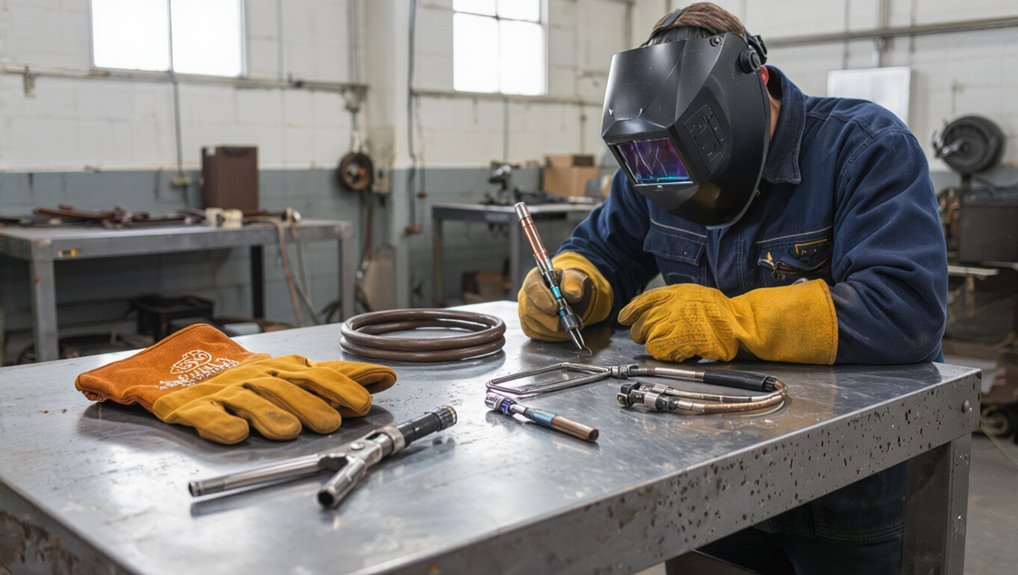
For pipe welding, having the right tools, personal protective equipment, and a properly configured rig is foundational to safety and quality: basic hand tools (tape, pipe wrenches, reamers), alignment gear (chain clamps, V-blocks, fixtures), welding equipment (TIG/MIG/STICK machines, filler rods, gas supplies), and PPE (helmets with correct shade, respirators, gloves, flame-resistant clothing, and eye protection) must be selected, inspected, and organized before work begins.
A basic pipe rig includes secure stands, adjustable rollers, and stable supports to prevent movement. Proper grounding, gas routing, and cable management reduce hazards. Routine inspection, maintenance, and orderly storage extend tool life and guarantee consistent, safe welds.
Skills & Physical Fitness Checklist For Pipe Welders
Having the right tools and rigging sets the stage, but competence at the weld joint depends on a specific mix of technical skills, safety knowledge, and physical conditioning.
A checklist helps evaluate readiness: procedural welding ability (SMAW/GTAW/GMAW), code familiarity, and fit-up accuracy; safety habits such as lockout/tagout, confined‑space protocols, and PPE discipline; physical stamina for long shifts, kneeling, and awkward positions; and hand-eye coordination with steady heat control.
Regular practice, basic fitness training, and routine safety drills keep proficiency reliable.
Use this checklist to spot gaps and prioritize targeted training or conditioning before taking complex pipe work.
- Technical welding skills and code knowledge
- Safety procedures and PPE discipline
- Physical stamina and mobility
- Fine motor control and visual acuity
Build A Pipe‑Welding Portfolio: Test Coupons, X‑Rays, Resumes
When assembling a pipe‑welding portfolio, practical evidence and clear documentation take precedence: test coupons that demonstrate weld quality across processes, radiographs or other NDT records that verify internal integrity, and a concise resume highlighting certifications, code experience, and project roles.
Include labeled photographs of coupons before and after finishing, with joint types, filler metals, parameters, positions, and acceptance criteria.
Attach certified X‑ray films or digital reports with inspector stamps and any UT, PT, or MT results.
The resume should list ASME/API/ANSI qualifications, welding codes, employer references, and measurable achievements to allow quick assessment by employers or inspectors.
Finding Work & Career Paths: Pay, Specialties, Inspection Roles
A strong pipe‑welding portfolio opens doors to many employment paths, and choosing among them depends on pay expectations, technical specialties, and interest in inspection or supervisory roles.
Opportunities range from shop fabrication to construction, oil and gas, power generation, and offshore work.
Pay varies with certification level, location, and hazard premiums.
Specialties like stainless, duplex, or exotic alloys command higher rates.
Inspectors and NDT technicians shift from welding with certifications (CWI, API, ASNT) and often earn supervisory pay.
Career growth follows clear certification ladders, field experience, and networking to secure higher‑paying, technically demanding, or managerial positions.
- Shop vs field: stability vs premiums
- Industry choice: oil, power, maritime
- Specialty skills: alloys, orbital welding
- Inspection/supervisor: certifications, oversight
Conclusion
A pipe welder’s journey is less about sparks and more about quiet mastery — a steady hand shaping tomorrow’s arteries. Through guided training, certified proofs, and practiced endurance, one graduates from hopeful apprentice to trusted craftsman. The work asks for grit, subtle pride, and careful attention to unseen joins that keep communities flowing. For those willing to answer the call, the trade offers a dignified path where competence becomes a lasting, hopeful legacy.