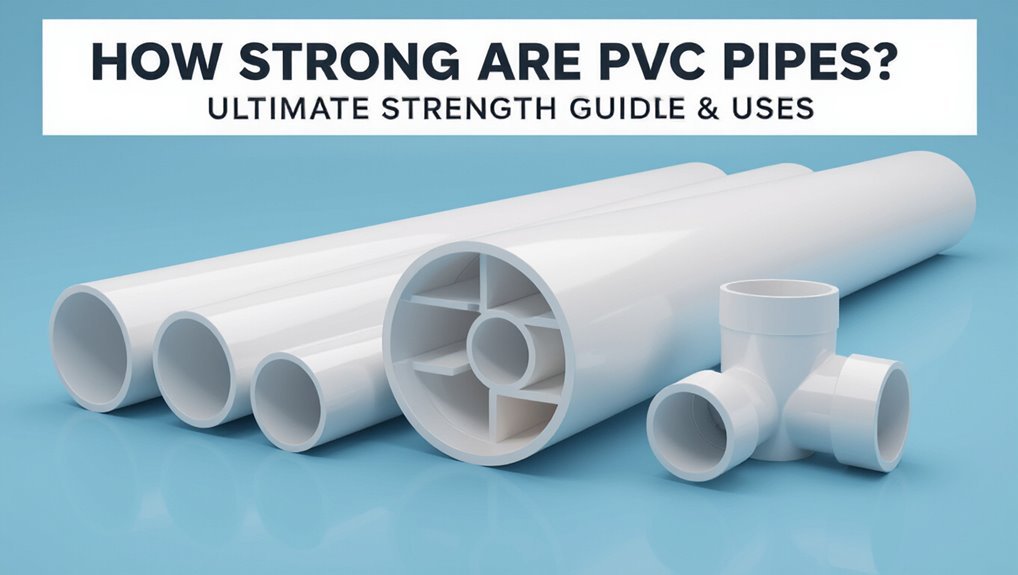
How Strong Are PVC Pipes? Ultimate Strength Guide & Uses
PVC pipes are known for their strong tensile and compressive performance, making them suitable for plumbing, irrigation, and conduit applications. Here are the key takeaways regarding their strength:
- Performance Metrics: Strength is assessed through working pressure, burst tests, and flexural stiffness. Higher schedule numbers indicate thicker walls, enhancing pressure capacity.
- Limitations: Performance can degrade due to sustained heat, UV exposure, chemical damage, or poorly made joints.
- Installation Best Practices: Adhering to proper bedding, support, and solvent-welding techniques is crucial for maximizing service life.
For detailed ratings, failure modes, and selection guidance, continue reading.
Quick Answer : PVC Pipe Strength Limits and Safe Uses
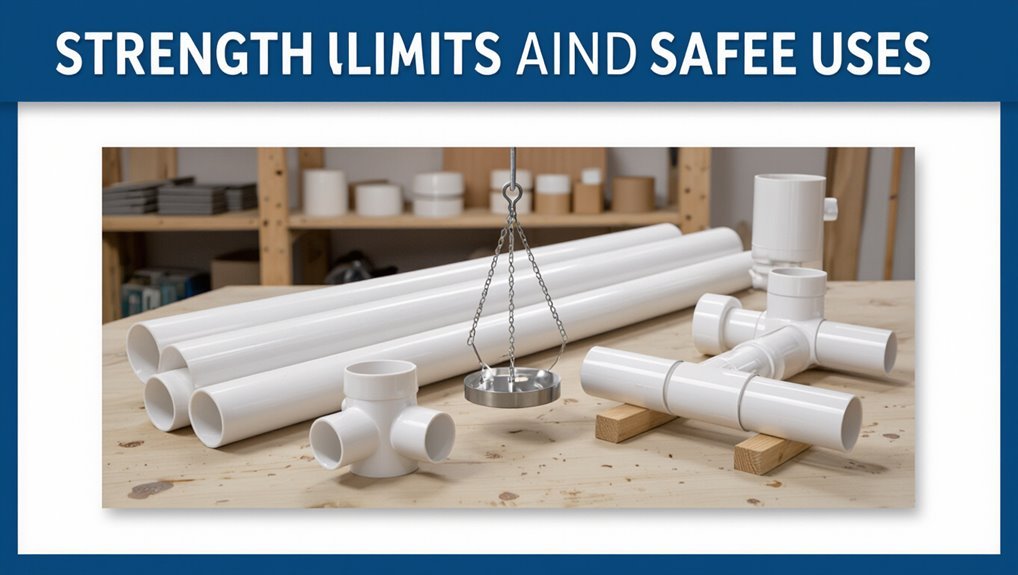
In practical terms, PVC pipe can safely carry light to moderate loads: Schedule 40 and Schedule 80 PVC are designed for pressurized liquids and resist typical indoor plumbing stresses, while thinner-walled PVC (e.g., irrigation or conduit) supports lower pressures and nonstructural applications.
PVC performs well in dry, temperate environments and when installed per manufacturer guidance. Typical uses include household water distribution, drain lines, irrigation, and electrical conduit.
It is unsuitable for heavy structural support, high-temperature fluids, or prolonged UV exposure without protection. Proper joinery, support spacing, and avoidance of chemical solvents extend service life and maintain safety.
PVC Pipe Strength: How It’s Measured (Pressure, Burst, Flex)
Having outlined practical applications and limits, attention turns to how PVC strength is quantified: pressure ratings, burst strength, and flexural properties.
Manufacturers publish working pressure (psi) based on temperature and long-term stress; hydrostatic testing verifies integrity. Burst strength indicates the pressure at catastrophic failure, offering safety margins. Flexural (modulus and yield) measures resistance to bending and deflection under load.
These metrics guide selection without invoking schedules or class numbers.
- Working pressure: continuous allowable pressure at specified temperature.
- Burst pressure: empirical failure point, used to calculate safety factors.
- Flexural strength: stiffness and deformation limits under transverse load.
PVC Pipe Classes and Schedules: What the Numbers Mean
What do the numbers stamped on PVC pipes actually signify? They identify class or schedule designations indicating wall thickness relative to nominal diameter.
“Schedule” (e.g., SCH 40, SCH 80) applies to newer systems and standardizes wall thicknesses across diameters; higher schedule equals thicker wall.
“Class” (e.g., Class 200) historically tied pressure rating at a given temperature, derived from material strength and wall thickness.
Markings also include material type (PVC, PVC-U), manufacturing standard (ASTM, ISO), and nominal size.
These codes allow selection of appropriate pipe for mechanical loads, compatibility, and code compliance without directly stating working pressure.
Typical PVC Pressure Ratings for Residential and Irrigation Use
Typical residential and irrigation PVC pressure ratings vary by pressure class, with higher-class pipe offering greater working pressure.
Temperature changes reduce allowable pressure, so ratings at 73°F cannot be assumed at elevated temperatures.
Pipe size and schedule also influence pressure capacity because wall thickness and nominal diameter determine strength.
Pressure Class Differences
How much pressure a PVC pipe can safely handle depends on its pressure class, which combines material formulation, wall thickness, and nominal diameter to yield a rated working pressure. Pressure classes (e.g., 100, 200, 330) indicate differing safety margins for residential plumbing and irrigation. Higher classes use thicker walls or stronger formulations, raising allowable working pressure; lower classes reduce cost and weight for low-pressure supply lines.
Selection considers expected operating pressure, surge events, and code requirements. Typical residential systems use moderate classes, while irrigation mains may require higher classes for long runs or pressurized sprinklers.
- Class 100: low-pressure distribution
- Class 200: common residential use
- Class 330: high-pressure mains
Temperature Effects On Rating
Exposed to higher temperatures, PVC pipe strength and its rated working pressure decline because the polymer softens and its yield stress drops.
Manufacturers publish pressure-temperature derating tables showing allowable working pressure at specific temperatures; commonly, a pipe rated 150 psi at 73°F might be reduced to about 100 psi at 140°F.
Long-term hydrostatic performance is particularly sensitive to sustained elevated temperatures, accelerating creep and reducing safety margins.
Designers must select ratings based on expected operating temperature, fluid temperature, and ambient conditions.
For residential and irrigation systems, conservative temperature assumptions prevent unexpected failures and make certain longevity.
Pipe Size And Schedule
Temperature-dependent derating informs the selection of pipe size and schedule because allowable working pressures vary with both temperature and wall thickness. Typical residential PVC (Schedule 40) delivers higher pressure capacity in smaller diameters; Schedule 80 increases wall thickness and pressure rating for the same nominal size.
Irrigation systems often use SDR-rated pipe where pressure class (e.g., SDR 26, SDR 13.5) defines wall thickness relative to diameter. Selection balances expected system pressure, temperature, and mechanical loads.
Considerations include fittings, joint type, and safety factors to prevent deformation or failure under seasonal or operational temperature shifts.
- Match schedule/SDR to max operating pressure.
- Use thicker walls for higher temps.
- Factor fittings and surge events.
Load Limits: Buried Pipes, Shallow Trenches, and Above‑Ground Spans
When evaluating PVC pipe load limits, three installation scenarios—buried pipes, shallow trenches, and above‑ground spans—demand distinct design considerations because soil support, cover depth, and span length directly affect stress distribution and deflection.
Buried installations rely on uniform bedding and adequate cover to transfer loads into surrounding soil; compaction and backfill type determine allowable live loads.
Shallow trenches reduce soil cushion, increasing pipe hoop and bending stresses; traffic loads may require deeper cover or protective slabs.
Above‑ground spans behave as beams; span length, support spacing, and pipe stiffness control deflection and fatigue.
Design must match installation to load conditions and safety factors.
PVC Tensile, Compressive, and Impact Strengths : What the Numbers Mean
Beyond load cases tied to installation, the material strengths of PVC—tensile, compressive, and impact—define how the pipe itself resists forces and informs allowable stresses, safety factors, and selection of pipe class.
Typical tensile strength (30–60 MPa) governs axial pull and hoop stress capacity; compressive strength (>50 MPa for rigid PVC) resists localized crushing and external soil loads; impact resistance (measured by notched Izod or drop tests) indicates susceptibility to brittle fracture from strikes or sudden loads.
Designers translate these numbers into allowable stresses via safety factors, matching pipe thickness and class to expected service demands.
- Tensile: axial and hoop considerations
- Compressive: load distribution and stability
- Impact: fracture tolerance and energy absorption
How Temperature, Sunlight, and Aging Reduce PVC Strength
Temperature changes alter PVC’s stiffness and yield strength, with elevated temperatures reducing load-bearing capacity and low temperatures increasing brittleness.
Prolonged sunlight exposure causes UV-driven surface degradation and microcracking, accelerating strength loss over time.
Combined thermal cycling and weathering produce cumulative aging effects that can markedly shorten service life if not mitigated.
Temperature-Driven Strength Loss
How does heat, sunlight, and long-term use alter PVC’s mechanical properties? Elevated temperatures soften PVC, lowering tensile strength and increasing creep; prolonged exposure accelerates molecular mobility, reducing load capacity.
Thermal cycling induces microcracks and joint loosening, while retained moisture can exacerbate hydrothermal degradation. Sunlight-initiated effects and detailed photooxidation mechanisms are reserved for the next section.
- Temperature: higher service temperatures reduce modulus and yield stress, increasing deformation under constant load.
- Time: sustained heat causes permanent creep and loss of impact resistance.
- Combined stressors: heat plus mechanical load shortens service life via accelerated molecular relaxation and crack initiation.
UV And Aging Effects
When exposed to sunlight and long-term service conditions, PVC undergoes photooxidative and thermomechanical changes that reduce its mechanical performance.
Ultraviolet radiation breaks polymer chains and forms free radicals, causing surface embrittlement, crazing, and loss of impact resistance.
Heat accelerates oxidation and stress relaxation, lowering tensile strength and modulus over time.
Environmental stress cracking becomes more likely where residual stresses and chemicals coexist.
Additives like stabilizers and UV absorbers slow degradation but deplete, so protection is finite.
Proper specification, shielding, and periodic inspection extend service life; neglected exposure leads to premature failure, leaks, and compromised structural integrity.
Which Chemicals and Solvents Weaken PVC and Why
Among common causes of PVC degradation, exposure to certain organic solvents, strong acids and bases, and chlorinated hydrocarbons poses the greatest risk because these chemicals can swell, soften, or chemically break the polymer chains.
PVC resists many mild chemicals, but prolonged contact with ketones, esters, aromatic hydrocarbons, and strong oxidizers leads to embrittlement or crazing.
Alkaline hydrolysis under high temperature attacks acetate groups in modified formulations.
Chlorinated solvents cause plasticizer leaching in flexible PVC.
Selection of grades and proper containment prevents failure.
- Ketones and esters — cause swelling and softening.
- Strong acids/bases — promote chain scission.
- Chlorinated hydrocarbons — leach plasticizers and embrittle.
How PVC Compares to CPVC, ABS, Copper, and PEX for Strength
Chemical compatibility is only one facet of material performance; strength comparisons between PVC and alternative piping materials—CPVC, ABS, copper, and PEX—rely on distinct mechanical properties, application temperatures, and installation methods.
PVC offers high tensile strength and rigidity for cold-water and drainage use but loses stiffness near its upper temperature limit.
CPVC shares similar chemistry with improved heat resistance and slightly reduced impact toughness.
ABS is tougher at low temperatures and better for impact-prone applications.
Copper exhibits superior compressive strength and long-term dimensional stability but is prone to brittle failure under certain stresses.
PEX provides excellent flexibility and fatigue resistance yet lower compressive strength.
Installation Mistakes That Weaken PVC and How to Avoid Them
In handling PVC, several common installation errors—improper solvent welding, inadequate support spacing, over-tightening fittings, and poor thermal stress allowance—significantly reduce pipe strength and service life.
Installers must clean and apply solvent evenly, allow full cure, and avoid joint misalignment.
Supports should follow manufacturer spacing to prevent sagging and point loads.
Over-tightening threads or forcing inserts creates cracks; use proper torque and lubrication.
Allow expansion gaps, use expansion joints or loops, and avoid rigid restraints across long runs.
Regular inspection catches stress signs early.
Training, correct tools, and following standards preserve designed PVC performance.
- Proper solvent welding and cure time
- Correct support spacing and anchoring
- Thermal movement allowance and flexible connections
When to Choose PVC or a Stronger Alternative
Select PVC when its pressure rating, temperature limits, chemical compatibility, and mechanical strength meet the application’s demands. When pressures, temperatures, or abrasive or impact hazards exceed PVC limits, specify stronger alternatives (CPVC for heat, HDPE for flexibility, metal for extreme pressure). Consider longevity, joint type, and regulatory requirements. Choose alternatives for buried high-load conduits, high-temperature process lines, or aggressive solvents. Balance cost, installation complexity, and maintenance. Use testing data and safety factors to justify material selection.
| Situation | PVC Suitable? | Alternative |
|---|---|---|
| Cold potable water | Yes | — |
| High heat fluid | No | CPVC/metal |
| Abrasion/impact | No | HDPE/steel |
Practical Inspection and Maintenance Tips to Preserve PVC Strength
A concise visual inspection checklist helps identify cracks, discoloration, warping, and joint integrity issues before they compromise performance.
Routine application of protective measures—such as UV shields, corrosion-resistant fittings, and appropriate load redistribution—extends service life.
Proper storage practices, including support to prevent sagging and protection from extreme temperatures and chemicals, preserve material strength until installation.
Visual Inspection Checklist
For routine preservation of PVC strength, inspectors should follow a concise visual checklist that prioritizes observable defects, alignment, and support conditions. The checklist directs systematic observation to detect cracking, discoloration, deformation, joint gaps, and external loading signs. Photographic records and location notes accompany findings. Report severity ratings and recommend immediate action for leaks or structural compromise. Schedule follow-up inspections based on exposure and service conditions. Include check frequency and responsible party in records.
Use the items below to structure each inspection report.
- Surface integrity: cracks, crazing, discoloration.
- Joints and seals: gaps, extrusion, adhesion.
- Alignment and supports: sagging, spacing, corrosion.
Protective Measures And Storage
Under controlled handling and storage, PVC retains its manufactured strength and resists premature degradation.
Regular cleaning removes contaminants; UV-sensitive pipes require opaque coverings or indoor storage to prevent embrittlement.
Store lengths flat on padded supports to avoid bending stresses and keep temperature within recommended ranges to prevent warping.
Segregate chemically incompatible substances and maintain dry, ventilated spaces to reduce hydrolysis risk.
Label inventory with manufacture dates to enable rotation and inspection schedules.
During handling, use soft slings and avoid impact against edges.
Document damage, repair minor scratches per guidelines, and retire any compromised pieces to preserve system integrity.
Conclusion
PVC pipe offers reliable performance for many applications, yet designers must respect its limits. Importantly, Schedule 40 PVC rated for 200 psi at 73°F can lose strength rapidly as temperature rises—its pressure rating falls roughly 50% at 140°F—underscoring that heat, not just pressure, often dictates safe use. Regular inspection, correct bedding, and avoiding UV exposure preserve longevity; when conditions approach these limits, stronger materials should be chosen.