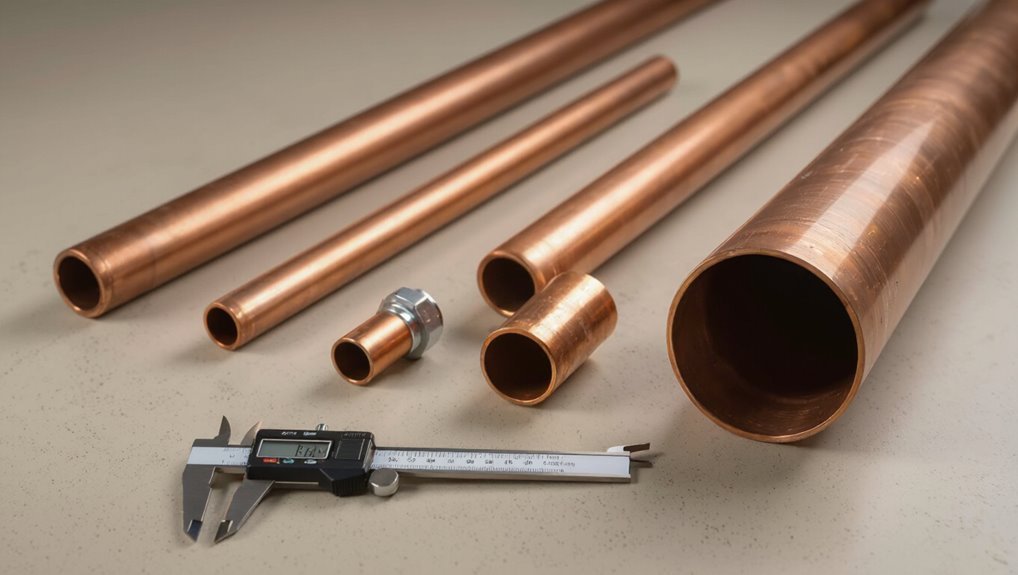
How Much for Copper Pipe? Cost Guide, Sizes & Buying Tips
Copper pipe costs vary significantly based on type, size, and format. Here’s a quick cost breakdown per foot:
- 1/2″ Pipe: $1.50–$3
- 3/4″ Pipe: $2–$4
- 1″ Pipe: $3.50–$6
- 2″ Pipe: $8–$15
Key Takeaways:
- Type M is the most affordable option, while Type K is the most expensive.
- Purchasing coils or longer lengths can reduce the per-foot cost.
- Additional costs for fittings, solder, and labor should be considered.
- Prices are influenced by regional copper markets and bulk purchasing.
For further guidance on sourcing, waste allowances, and installation choices, consider consulting local suppliers.
Quick Cost Cheat Sheet: Typical Copper Pipe Prices
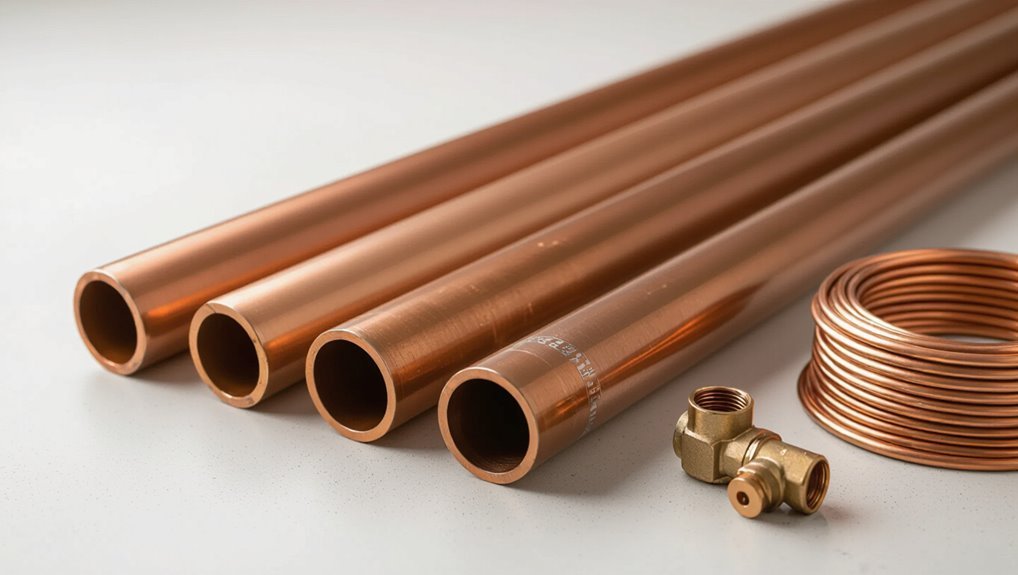
A concise cheat sheet lists typical copper pipe prices by type and diameter, helping homeowners and contractors estimate material costs quickly.
It separates K, L, and M types and notes that Type K is costliest, Type M least expensive. Prices vary with diameter: 1/2″, 3/4″, 1″, and larger sizes are indexed.
Costs reflect soft versus rigid tubing and per-foot versus per-piece units. Regional supply, market copper rates, and bulk discounts influence final numbers.
The sheet recommends confirming local retailer quotes and accounting for fittings and solder when budgeting to avoid underestimation.
What People Mean by “How Much for Copper Pipe?” (Common Intents)
Readers asking “How much for copper pipe?” typically mean either the price per foot for the material or the total cost for a specific project.
The per-foot figure helps compare tube types and sizes, while the project range accounts for length, fittings, labor, and installation complexity.
Presenting both metrics clarifies budgeting for small repairs through whole-house repiping.
Price Per Foot
When people ask “how much for copper pipe?” they usually mean the price per foot for common sizes and types. The price per foot varies by alloy (Type M, L, K, DWV), diameter, and whether it’s rigid or soft. Market copper prices influence retail and contractor rates; lengths sold include 3-foot, 6-foot, and 10-foot sticks or coils. Buyers compare per-foot costs to estimate material needs before project-level expenses.
- Type M — thinner wall, lowest per-foot cost.
- Type L — mid-range, most common for water.
- Type K — thickest, highest per-foot cost.
- Coils — better per-foot for long runs.
Project Cost Range
Estimating a project’s total cost requires converting per-foot prices into real-world quantities and accounting for fittings, labor, and extras like insulation or mounting brackets.
Typical small repairs or short runs (5–20 feet) often cost $50–$300 including parts and basic labor.
Moderate jobs, such as replacing sections or installing a new branch (20–100 feet), commonly range $300–$1,200 depending on fittings, wall access, and permit needs.
Whole-system repipes for bathrooms or kitchens (100–500 feet) can escalate to $1,200–$6,000 or more when factoring demolition, specialty fittings, and higher labor rates.
Regional variation alters these ranges.
Cost Per Foot for Common Copper Diameters (1/2″–2″)
A clear breakdown of cost per foot for common copper pipe diameters (1/2″–2″) helps contractors and homeowners compare material prices and plan budgets; prices typically rise with diameter due to increased material weight and, in some cases, differing wall thicknesses or alloy grades.
Typical retail ranges per foot reflect market fluctuations and finish options. Cost examples (approximate):
- 1/2″ — $1.50–$3.00
- 3/4″ — $2.00–$4.00
- 1″ — $3.50–$6.00
- 2″ — $8.00–$15.00
Regional supply, bulk discounts, and scrap copper prices will alter these figures.
How Pipe Type (Type K, L, M) Affects Price
Beyond diameter-driven price differences, the wall thickness and planned application of copper pipe types K, L, and M markedly influence cost. Type K, with the thickest walls and highest pressure tolerance, commands the highest per-foot price and is preferred for underground mains and where durability is critical.
Type L balances strength and cost, making it a mid-priced choice for interior plumbing and HVAC lines. Type M, being the thinnest and least expensive, suits low-pressure residential water supply where code permits.
Availability and contractor preference also affect market price, since demand for certain types can raise retail and bulk costs.
How Wall Thickness and Gauge Change Material Cost
Wall thickness directly influences the amount of copper used, so thicker walls raise material cost per foot.
Gauge, which standardizes wall measurement, allows buyers to compare prices across pipe types and sizes.
Together, wall thickness and gauge determine both structural performance and the unit price paid.
Wall Thickness Impact
With increasing wall thickness, the volume of copper per linear foot rises, directly raising material cost. Thicker walls improve strength, longevity, and pressure rating, but also increase weight and unit price. Selection balances performance needs against budget constraints; contractors and specifiers calculate cost per usable foot rather than nominal diameter alone.
- Thinner walls reduce material expense but limit pressure tolerance and durability.
- Moderate thickness often offers best cost-to-performance for residential plumbing.
- Heavy-wall pipe suits high-pressure, industrial, or long-life applications despite premium cost.
- Lifecycle and installation factors influence whether thicker material justifies higher upfront expense.
Gauge And Price
Compare copper gauges to understand how small changes in wall thickness affect price per foot: as gauge numbers fall (indicating thicker walls), material volume and weight rise, raising raw-material cost and often the finished-unit price.
Thicker-gauge tubing increases costs not only through more metal but via higher manufacturing effort and tighter quality controls.
Buyers selecting heavier gauges expect better durability, pressure tolerance, and longevity, justifying premium pricing.
Conversely, thin-wall gauges reduce cost and weight but may demand replacement sooner.
Estimating project budgets requires matching required mechanical performance to gauge choice, balancing upfront expense against lifecycle value and installation considerations.
Rigid vs. Soft (Flexible) Copper: Price and Use Cases
Between the two main forms of copper tubing—rigid (hard) and soft (flexible)—each offers distinct cost profiles and practical uses: rigid copper is pricier per foot and favored for exposed, long straight runs and durable mains, while soft copper is typically cheaper, easier to bend for tight spaces or retrofit work, and reduces the need for fittings.
Rigid provides superior structural support and a neater appearance; soft speeds installation in cramped areas.
Consider project scale, accessibility, and aesthetic priorities when choosing.
- Rigid: durable, visible runs, higher material cost
- Soft: flexible, fewer fittings, lower cost
- Use: mains vs. branch runs
- Install: requires different tools and supports
Price Differences by Soldered vs. Brazed Joints
Soldered and brazed copper joints differ in strength and appropriate applications, which affects material selection and long-term performance.
Brazing typically yields higher-strength joints but requires more expensive filler metals and greater installer skill, increasing labor costs. Soldering uses simpler fluxes and lower-cost alloys, making it cheaper up front but potentially less suitable where higher joint strength is required.
Joint Strength Differences
Evaluating joint strength reveals why brazed connections typically command higher prices than soldered ones: brazing produces a metallurgical bond with higher tensile and shear strength, greater corrosion resistance, and improved performance at elevated temperatures, while soldered joints—often adequate for low-pressure, residential water systems—use lower-melting filler metals that yield weaker mechanical properties and reduced long-term durability.
- Tensile strength: brazed joints exceed soldered joints by a wide margin.
- Shear resistance: brazing sustains higher lateral loads.
- Corrosion resistance: brazed interfaces resist galvanic and crevice corrosion better.
- Temperature tolerance: brazed assemblies perform reliably at higher operating temperatures.
Skill And Labor Costs
Having established that brazed joints deliver superior mechanical and corrosion performance compared with soldered joints, attention turns to how those differences affect skill requirements and labor costs.
Brazing demands higher operator skill, tighter fit-up, and more powerful heat sources, increasing hourly rates and job time for less experienced crews. Soldering is quicker, uses lower temperatures, and is common among general plumbers, lowering labor charges for routine installations. For complex systems or critical applications, contractors charge premiums for brazing expertise and certification. Project estimates should itemize joint method, anticipated labor hours, and any apprenticeship or specialty surcharges to compare total installed cost.
Flux And Filler Metals
In comparing soldered and brazed joints, the choice of flux and filler metal markedly affects material cost and procurement complexity. Soldering uses lower-cost lead-free solders and mild fluxes suitable for potable systems; brazing requires higher-melting alloys (silver or copper-phosphorus) and specialty flux resistant to elevated temperatures. Supply availability, safety handling, and inventory tiers drive price variance. Maintenance and compatibility with pipe alloys further influence selection.
- Solder: inexpensive, common, simple flux.
- Silver brazing: costly, superior joint strength.
- Copper-phosphorus: midrange, sometimes fluxless.
- Procurement: specialty alloys raise project budgets.
Cost Breakdown for Common Copper Fittings and Connectors
When comparing copper fittings and connectors, cost varies by type, size, and connection method—soldered fittings are typically least expensive, crimp and compression fittings cost more, and press-fit options command the highest prices; additional factors such as alloy grade, wall thickness, and required certifications further influence retail and contractor pricing. Typical pricing spans small couplings to multi-port manifolds. Labor and tool amortization alter effective cost for installers. Project scope dictates bulk vs. retail purchasing; specialty fittings (dielectrics, stop valves) add premium. Below is a concise cost/feature snapshot.
| Fitting Type | Typical Unit Cost | Notes |
|---|---|---|
| Coupling (1/2″) | $0.50–$2.00 | Basic joins |
| Elbow (1/2″) | $0.75–$3.00 | Flow direction |
| Compression | $3–$8 | Reusable options |
| Press-fit | $8–$20 | Quick install, higher cost |
Solder, Flux & Brazing: Extra Material Costs
Typically, solder, flux, and brazing rods represent a small but nontrivial portion of total copper-pipe material costs, with choices driven by joint type, pipe size, and service conditions (potable water, gas, or HVAC).
Selection affects performance, joint strength, and code compliance.
Common items and cost factors include:
- Lead-free solder — required for potable systems; sold by spool weight.
- Flux — paste or liquid; activity level matches solder alloy and cleanliness.
- Silver brazing rods — used for higher-temperature or gas/HVAC joints.
- Miscellaneous — cleaning tools, paste dispensers, and safety gear add marginal expense.
Budget accordingly by matching materials to application and code.
Labor Rates: Average Hourly Costs for Copper Installation
Typical plumber hourly rates for copper pipe installation commonly range from moderate to high depending on region and experience.
Labor costs are influenced by factors such as job complexity, pipe diameter and length, required fittings and joints, access or demolition needs, and local labor market conditions.
Understanding these variables helps estimate total installation labor more accurately.
Typical Plumber Hourly Rates
Plumbers generally charge between $45 and $150 per hour for copper pipe installation, with rates influenced by geographic location, technician experience, and job complexity.
Local market conditions and emergency callouts shift typical pricing bands; installers often bill by the hour for repair, retrofit, or new runs.
Residential and commercial contexts yield different averages, while quotes may bundle materials and labor separately.
Customers should request itemized estimates and compare firms for consistent hourly practices.
- Entry-level technicians: lower end of range.
- Experienced journeymen: mid-range.
- Master plumbers: upper range.
- Specialist contractors: premium rates.
Factors Affecting Labor
After outlining common hourly ranges, attention turns to the specific factors that determine where a given copper installation falls within that spectrum.
Labor rates hinge on project complexity, pipe diameter and length, required fittings and soldering, and accessibility within walls or crawlspaces.
Local licensing, insurance, and union affiliation drive baseline pay.
Emergency or after-hours service carries premiums.
Experience level and specialization—residential vs. commercial—affect hourly expectations.
Permit requirements, inspection time, and code compliance add indirect labor.
Material handling, lead times, and site cleanup factor into billed hours.
Seasonal demand and regional cost of living finalize rate variance.
How Long a Pro Job Takes: Small Bathroom Example
For a small bathroom—sink, toilet and shower—an experienced plumber team can complete a full copper repipe in roughly one to two days depending on access and fixture layout. The crew begins with inspection and shutoff, then removes old lines as needed, runs new copper, tests joints, and reinstalls fixtures. Time varies with wall access, presence of vanities, and unforeseen corrosion.
Typical schedule:
- Assessment and prep (1–2 hours)
- Removal of old piping (2–4 hours)
- Installation of new copper runs (3–6 hours)
- Testing, cleanup, and fixture reconnection (1–3 hours)
Efficient crews minimize disruption and finish within the stated window.
Cost to Repipe a Small Bathroom With Copper (Materials + Labor)
A concise cost overview separates the materials cost breakdown, including copper tubing, fittings, and valves, from the labor time estimates required for removal, installation, and testing.
Typical labor for a small bathroom ranges from a few hours to a full day depending on wall access and fixture complexity, which directly affects total project pricing.
Combining exact material totals with hourly labor yields the realistic budget homeowners should expect for a full repipe.
Materials Cost Breakdown
Several key material components determine the cost to repipe a small bathroom with copper: lengths of Type L or M copper tubing, fittings (elbows, tees, couplings), valves and stop controls, solder and flux or push-fit adapters, and mounting supplies such as hangers and insulation.
Material costs typically break down by quantity and grade: copper tubing is priced per foot, fittings per piece, and valves as individual units.
Additional small items add up. Typical categories include:
- Copper tubing (Type L or M per foot)
- Fittings (varied sizes)
- Valves, stops, and adapters
- Solder, flux, hangers, insulation
Final material totals depend on layout and local prices.
Labor Time Estimates
During a typical small bathroom repipe with copper, labor time is driven by access, wall and floor removal, and the complexity of routing new runs to fixtures.
A straightforward job—open access, minimal demolition, and direct runs—often requires one to two plumber-days: removal of old piping, measuring, cutting and fitting new copper, soldering or crimping joints, pressure testing, and reinstating minor finishes.
Restricted access, concealed chases, or multiple fixture relocations extend work to three or more days and may need an assistant or specialist for soldering in tight spaces.
Time estimates exclude permit processing and finishing trades.
Total Project Pricing
For a small bathroom repipe using copper, total project pricing combines material costs (pipe, fittings, valves, and solder/crimp supplies), labor charges based on plumber-days, and any job-specific allowances for access or demolition.
The estimator aggregates line-item costs, applies contingency for unforeseen corrosion or routing complexity, and factors permit and disposal fees.
Regional labor rates and copper market pricing shift totals; a clear scope limits surprises.
Typical mid-range projects present predictable ranges when documented.
- Materials: tubing, fittings, valves, solder/crimp
- Labor: plumber-days, helper time
- Access/demolition: wall/fixture work
- Permits/contingency
Cost to Repipe an Entire House With Copper: Example Estimates
When calculating the cost to repipe an entire house with copper, homeowners should expect wide variation driven primarily by home size, labor rates, and the type of copper used.
A small 1,000 sq ft home might run $3,000–$6,000 for copper supply and professional installation, mid‑size 2,000 sq ft homes often range $6,000–$12,000, and larger homes or multi‑story properties can exceed $12,000–$20,000.
Costs reflect joint type (sweat, compression, or press), wall access complexity, required permits, and fixture counts.
Unexpected issues—corrosion, asbestos, or structural repairs—raise labor time and total price.
Always obtain multiple detailed bids.
Buying Bulk vs. Small Quantities: Where You Save
Buying copper pipe in bulk typically lowers the per-foot material cost compared with small-quantity purchases, but savings depend on factors such as pipe diameter, type (K, L, or M), and supplier discounts.
Buyers weighing bulk versus small orders should consider storage, project timeline, and waste from offcuts.
Bulk orders favor larger projects where inventory turnover justifies lower unit prices; small purchases suit repairs and tight storage.
Key considerations include:
- Volume discounts versus capital tied up
- Minimum order fees or freight charges
- Risk of damage or obsolescence in stored stock
- Waste reduction and precision for small jobs
Where to Buy Copper Pipe: Wholesale, Online, Local Suppliers
Across supply channels—wholesale distributors, online marketplaces, and local plumbing suppliers—each offers distinct advantages in price, availability, and service for sourcing copper pipe.
Wholesale suits contractors needing large volumes at lower unit cost and often provides trade accounts, faster bulk pricing, and predictable supply.
Online marketplaces deliver broad selection, convenient comparison shopping, and access to specialty sizes, but buyers should account for shipping and return policies.
Local suppliers provide hands-on inventory, immediate pickup, and expert advice for small projects or urgent needs.
Choosing depends on order size, required lead time, needed technical support, and willingness to balance price versus convenience.
Reading Prices: Per Coil, Per Stick, and Per Roll Explained
In comparing copper pipe prices, suppliers commonly quote costs “per coil,” “per stick,” or “per roll,” each reflecting different packaging, lengths, and usage contexts; understanding these units lets buyers accurately compare unit prices and order quantities.
Coils are flexible soft copper sold by linear foot per coil; sticks are rigid lengths, often 10-foot or 20-foot, priced per piece; rolls sometimes refer to protective wrapping or smaller bundled lengths for specialty tubing.
Consideration of waste, transport, and installation preferences affects choice.
- Coil — flexible, long runs.
- Stick — rigid, fixed lengths.
- Roll — bundled/specialty lengths.
- Unit price — compare per foot.
How to Estimate Total Material Cost for Your Project
When estimating total material cost for a copper piping project, the estimator should first measure required linear feet for each pipe size and configuration, then convert those lengths into the supplier’s sold units (coils, sticks, or rolls) to determine quantities.
Next, apply unit prices for each product type, accounting for fittings, valves, and specialized components separately. Include different grades or types (M, L, K, or tubing) at their respective rates.
Sum line-item costs to produce a material subtotal, then add applicable taxes, delivery fees, and supplier surcharges. Present the final figure with a clear itemized breakdown for transparency.
Calculating Waste and Cutting Loss (How Much Extra to Buy)
For copper piping projects, calculating waste and cutting loss requires estimating the extra material needed to cover offcuts, mistakes, and joints so the job is not delayed by shortages. A practical allowance typically ranges from 5–15% depending on complexity and fitter experience. Longer runs and many fittings increase scrap; tight bends and custom lengths raise cutting loss. Record measured lengths, number of joints, and expected scrap per cut to refine estimates. Use standard allowances for initial budgeting, then adjust after a trial section.
- Simple runs: add 5%
- Moderate complexity: add 8–10%
- High complexity: add 12–15%
- Small parts/spares: add fixed pieces (2–3)
Tools & Costs for DIY Copper Pipe Work
Typically, a DIYer assembles a handful of essential tools to install and maintain copper pipe: a tube cutter, deburring tool, adjustable wrench, soldering torch (or a compression tool for sweat-free joints), flux and solder, pipe cleaning brush, and measuring/marking tools.
Additional items include a propane or MAPP gas cylinder, heat-resistant gloves, safety goggles, emery cloth, and joint paste. Entry-level kits range $40–$120; quality torches and cutters push cost to $150–$300. Consumables (solder, flux, sandpaper) run $10–$30 per project. Renting specialty gear reduces upfront expense for infrequent work; tool selection affects speed and joint reliability.
Permits, Inspections, and Hidden Fees to Budget For
Including permits, inspections, and hidden fees in a copper pipe project budget prevents costly surprises and project delays.
Municipal permit costs, mandatory inspections, and administrative charges vary widely and can add 5–15% to total job costs.
Contractors may charge permitting handling fees; re-inspection or revision fees apply if work fails code.
Homeowner responsibilities include permit acquisition or verification and scheduling inspections to avoid hold-ups.
Typical hidden costs include disposal fees, access repairs, and impact fees for multi-unit buildings.
- Permit application and plan review fees
- Inspection and re-inspection charges
- Contractor permitting handling fees
- Disposal and access repair costs
Comparing Copper Pipe vs. PEX and CPVC on Upfront Price
Comparing upfront costs of copper, PEX, and CPVC highlights clear differences in material and labor expenses.
Copper pipe material typically costs more per foot than PEX or CPVC; fittings and soldering add expense.
PEX offers lower material price and simpler installation with fewer specialized tools, reducing labor hours.
CPVC sits between: cheaper than copper but stiffer than PEX, requiring solvent-weld fittings and moderate labor.
Project scale affects unit pricing—bulk purchases lower material cost.
Accessibility and code requirements can change labor time and permit needs, influencing final upfront expenditure despite base material price differences.
Comparing Lifetime Costs: Durability, Maintenance, and Health
Over the life of a plumbing system, material choice drives not just initial outlay but ongoing expenses related to durability, maintenance, and potential health impacts. Copper’s lifespan, resistance to UV and rodents, and recyclability affect long-term value; alternate materials may lower initial costs but change maintenance frequency and replacement timing. Corrosion, joint integrity, and water chemistry inform inspection needs and service expenses. Health considerations include leaching risks and treatment requirements. A lifecycle comparison should quantify expected years of service, average annual maintenance, likely repair events, and end-of-life disposal or recycling costs:
- Expected service years
- Annual maintenance costs
- Typical repair frequency
- Disposal/recycling value
When Copper Is Worth the Extra Cost (Durability & Water Quality)
Having weighed long‑term service life, maintenance patterns, and disposal factors, the analysis turns to specific scenarios where copper’s higher upfront cost is justified by durability and water‑quality benefits.
Copper is often preferable in buildings demanding reliable hot‑water delivery, where its thermal resilience reduces joint failures and heat‑related deformation.
It suits installations requiring strict microbiological control, since copper inhibits bacterial growth better than many plastics.
In areas with high mechanical stress or frequent cleaning, copper’s scratch and abrasion resistance prolongs serviceability.
For owners prioritizing potable water taste and minimal chemical leaching, the premium for copper can be a cost‑effective investment.
Corrosion, Lifespan, and Long-Term Replacement Risks
Copper pipe performance over time depends on specific corrosion mechanisms such as pitting, galvanic action, and erosion-corrosion, each driven by water chemistry and system conditions.
Evaluating these failure modes helps quantify expected lifespan and identify high-risk installations that may require earlier intervention.
A clear replacement-risk assessment balances projected deterioration rates, repair costs, and the operational consequences of unexpected leaks.
Corrosion Mechanisms Explained
Examine how electrochemical reactions, water chemistry, and mechanical wear combine to degrade copper tubing over time: dissolved oxygen, pH extremes, aggressive ions (chlorides, sulfates), and stray electrical currents accelerate localized and uniform corrosion, while erosion, galvanic coupling with dissimilar metals, and microbiologically influenced corrosion (MIC) produce pinholes and thinning that shorten service life.
- Electrochemical: anodic/cathodic sites form; current flow drives metal loss.
- Chemical: low pH and oxidizers increase dissolution; chlorides create pitting.
- Mechanical: high velocity flows cause erosion-corrosion and fretting.
- Biological: biofilms and sulfate-reducing bacteria catalyze localized attack, accelerating failure.
Replacement Risk Assessment
Evaluating long-term replacement risk for copper tubing requires quantifying how corrosion mechanisms, water chemistry, mechanical stresses, and system design interact to shorten service life.
Assessment combines predicted corrosion rates, historical failure data, and water analysis to estimate remaining useful life. Areas of galvanic contact, hard water scaling, low pH, and high dissolved oxygen increase localized attack and pinhole formation.
Mechanical stresses from vibration or poor support accelerate fatigue. Risk models prioritize sections by failure probability and replacement cost, informing inspection intervals and mitigation (anodes, dielectric fittings, water treatment).
Budget forecasts should include contingency for unexpected localized failures and escalating labor expenses.
Recycling and Resale Value of Removed Copper Pipe
Removed copper pipe retains measurable scrap value, and its worth depends on factors like alloy, cleanliness, and current market rates.
Buyers and sellers should assess condition, separate alloys (Type K, L, M, and C122), and remove contaminants to maximize returns.
Typical pathways include scrap yards, metal brokers, and recycling centers; documentation and weight accuracy affect payout.
Environmental disposal fees can be avoided by recycling, and reclaimed pipe often funds partial replacement costs.
Key considerations:
- Weigh materials accurately.
- Sort by alloy and fittings.
- Clean and remove nonmetal attachments.
- Compare quotes before sale.
How Regional Supply and Local Markets Change Prices
Regional variations in copper pipe pricing often stem from local supply availability, with scarcity driving premiums and surplus applying downward pressure.
Labor costs that differ by region further affect installed prices, as higher wages and specialty crews increase overall expense.
Seasonal demand and transportation constraints can cause short-term price swings that vary by market.
Local Supply Availability
In many areas, local supply levels and market structures directly affect copper pipe prices by shaping availability, delivery times, and retailer markups. Local distributors maintain varied inventories; scarcity raises spot premiums while abundant stock suppresses them. Smaller markets face limited SKU selection and higher shipping proportions, whereas metropolitan hubs offer volume discounts and quicker restock.
Seasonal demand, nearby industrial activity, and proximity to major suppliers influence turnover rates. Buyers weighing cost should compare regional dealers, consider consolidating orders, and plan lead times to avoid emergency premiums.
- Inventory depth
- Shipment frequency
- Distributor competition
- Seasonal demand
Regional Labor Costs
Factoring local wage rates and contractor availability is essential to understanding how regional labor costs influence the final price of installed copper piping. Labor rates vary by metro area, union presence, and local demand; high-density cities often carry higher hourly charges, while rural regions may add travel premiums. Contractor experience affects time-on-job and quoted estimates. Permit fees and local code complexity can raise labor hours. Comparing multiple bids and checking local trade rates helps predict installed costs. Visualizing market differences:
| Region Type | Typical Labor Impact |
|---|---|
| Urban | Higher hourly rates |
| Suburban | Moderate variation |
| Rural | Travel premiums and fewer contractors |
Seasonal Price Fluctuations
Seasonally, copper pipe prices rise and fall as local supply chains, weather conditions, and construction cycles shift demand and availability.
Markets react to regional factors: winter freezes slow installation, spring and summer boost building, and transport disruptions alter stock.
Traders, suppliers, and contractors adjust margins and lead times accordingly, affecting retail and project budgets.
Buyers monitoring timing can save on bulk purchases or schedule installs for lower-rate periods.
Key influences include:
- Local weather impacts delivery and labor capacity.
- Construction seasonality drives demand spikes.
- Transportation constraints raise short-term costs.
- Regional scrap and mining activity alters supply.
Seasonal Trends and Timing Your Purchase to Save
During colder months, demand for copper pipe often rises as heating projects and emergency repairs increase, while warmer seasons can see slower commercial purchasing and more planned installation work.
Buyers can time purchases: stock up in late spring or early summer when installers order less and retailers offer promotions to clear inventory. Contractors often negotiate better bulk pricing during slow seasons. Holiday and fiscal-year clearances sometimes yield discounts.
However, storage costs and theft risk should be weighed. For small projects, watching local supplier sales and buying slightly ahead of planned work balances savings against carrying costs and guarantees material availability when crews are scheduled.
How Global Copper Prices Affect What You’ll Pay
Market forces drive the price of copper pipe beyond local supply-and-demand quirks: global copper futures, mining output, and macroeconomic indicators such as industrial demand and currency movements set the baseline cost that distributors and contractors ultimately pass on to buyers.
Buyers see volatility reflected in material surcharges, lead times, and batch pricing. Import/export policies and freight rates further influence landed costs. Short-term spikes raise contractor quotes; sustained trends reshape inventory strategies.
Key factors include:
- Futures market swings that signal near-term price direction.
- Mine production changes reducing or increasing available metal.
- Currency strength altering import costs.
- Trade policies and tariffs.
Negotiation Tips and Warranties to Lower Your Risk
Because global price swings and supply-chain pressures can quickly change material costs, buyers should pair market awareness with firm negotiation strategies and clear warranty terms to reduce exposure.
Buyers can request price-lock clauses, volume discounts, and staged deliveries to align purchases with cash flow and market dips. Comparing multiple suppliers and documenting quoted terms prevents surprises.
Insist on written warranties covering defects, corrosion, and joint integrity, and verify warranty transferability and claim procedures. For large projects, seek supplier performance bonds or third-party inspections.
Clear contract language, defined remedies, and documented communications together lower financial and operational risk.
Common Mistakes That Increase Copper Piping Costs
Frequently, extra costs stem from preventable errors made during planning, procurement, and installation of copper piping. Oversights, mismatched materials, and poor sequencing raise expenses through rework, waste, and delays.
Common costly mistakes include:
- Ordering incorrect pipe types or sizes, forcing returns or replacements.
- Failing to account for fittings and connectors, leading to last‑minute purchases.
- Improper support and spacing, causing sagging, stress, and premature failure.
- Inadequate protection against corrosion or galvanic reaction, resulting in leaks and component loss.
Recognizing these errors early reduces unforeseen costs and improves project predictability without compromising system performance.
Cost-Saving Tips for Installers and DIYers
Installers and DIYers can markedly cut copper piping costs by planning tasks, sourcing materials strategically, and using efficient installation techniques.
Consolidating runs, measuring accurately, and prefabricating assemblies reduce waste and labor time.
Buying in bulk, comparing local suppliers and online vendors, and choosing standard sizes lowers material price.
Reusing suitable salvaged fittings and salvaging copper from decommissioned systems can be economical if compliant with codes.
Proper tools and training prevent costly rework; using quality flux, solder, and compression fittings speeds installation.
Accurate permits and inspections avoid fines.
Simple preventive maintenance guidance for end users prolongs system life and reduces long-term replacement expense.
Decision Checklist: Is Copper Pipe the Right Choice for Your Project?
When evaluating whether copper pipe is the right choice for a project, the decision should hinge on factors like budget, water quality, expected lifespan, and local code requirements. A concise checklist helps determine suitability and trade-offs.
- Budget: compare material and labor costs versus alternatives (PEX, PVC) and lifecycle expenses.
- Water quality: assess corrosion risk, pH, and mineral content that affect longevity.
- Application: evaluate pressure, temperature, and accessibility for repairs or future modifications.
- Regulations and resale: confirm code compliance, insurance implications, and whether copper enhances property value.
Conclusion
Copper pipe pricing balances durability, code requirements and budget, so homeowners and pros should weigh upfront material cost against long-term performance. From feathery-light 1/2″ lines to hulking 2″ mains, type, wall thickness and fittings drive price more than diameter alone. Smart buying, accurate measurements and proper installation cut surprises; negotiate bulk discounts, check warranties, and avoid common mistakes. When reliability matters, copper remains a near-mythic choice for plumbing that simply keeps working.