
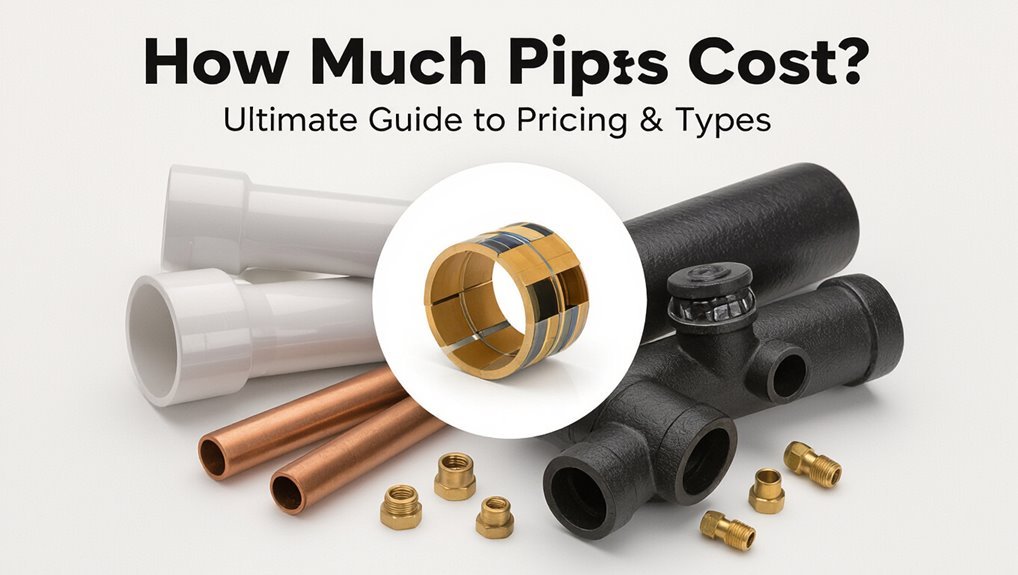
How Much Do Pipes Cost? Ultimate Guide to Pricing & Types
Key Takeaway: Pipe costs vary significantly based on material, diameter, wall thickness, and application.
Pipe pricing can range from a few cents to several dollars per foot for materials like PVC or PEX, while copper typically costs more per linear foot. More specialized materials such as commercial alloys, HDPE, and stainless steel are considerably more expensive.
Installed Costs: When factoring in installation, prices increase due to labor, fittings, excavation, and permits, especially for buried or large-diameter lines.
Additional Considerations: Lifecycle costs, corrosion control, and local labor rates can further influence overall expenses. For a detailed breakdown and estimating tips, continue reading.
Quick Pipe Prices and a Practical Buying Guide

When comparing pipe prices, buyers should focus on material, diameter, and designed use to quickly narrow options.
A pragmatic purchaser assesses project requirements: pressure rating, exposure, lifespan, and connection type.
Measurement accuracy prevents wasteful overspending; ordering extra for cuts and fittings is prudent but minimal.
Trade versus retail sources differ in pricing, warranties, and return policies.
Installation complexity and local code compliance influence total cost and should guide selection toward compatible sizes and joints.
Compatibility with existing systems avoids retrofit expenses.
Simple checklists and supplier quotes enable side-by-side comparisons to choose the most cost-effective, fit-for-purpose pipe.
Typical Pipe Price Ranges by Material (PVC, Copper, PEX, Galvanized)
The guide outlines typical price ranges for common pipe materials, starting with a PVC cost breakdown that highlights lengths, diameters, and fittings.
It then examines copper price factors such as alloy, annealing, and market-driven metal costs.
Finally, a concise comparison contrasts PEX’s flexibility and lower labor costs with galvanized steel’s durability and higher corrosion-related maintenance.
PVC Cost Breakdown
Several factors determine PVC pipe pricing, including diameter, schedule (wall thickness), grade (schedule 40 vs. schedule 80), and purpose (drainage, irrigation, or potable water).
Pricing reflects raw resin cost, manufacturing method, fittings availability, and certification needs.
Typical retail ranges vary by size and wall: small-diameter schedule 40 is cheapest; larger or schedule 80 jumps per foot.
Installation considerations alter effective cost, but material-only comparisons remain useful.
- 1/2″–1″ schedule 40: lowest unit price
- 1-2″ schedule 40: moderate increase
- 3″–6″ schedule 40: higher per foot
- Schedule 80: premium over 40
- Certified potable PVC: added markup
Copper Price Factors
Moving from PVC’s cost drivers to copper highlights a different set of pricing influences tied to metal markets and fabrication.
Copper pipe prices reflect raw copper commodity rates, which fluctuate with global supply, mining output, and investor demand.
Fabrication costs — annealing, drawing, and sizing — add labor and energy expenses.
Wall thickness, tubing type (K, L, M), and diameter determine material quantity.
Corrosion resistance and certification requirements can increase pricing for potable or specialized uses.
Market region, transportation, and recycling value of scrap copper also affect final cost.
Bulk purchasing and contractor sourcing often yield meaningful per-foot discounts.
PEX And Galvanized Comparison
How do PEX and galvanized steel compare when price is a deciding factor for plumbing projects? PEX typically offers lower material and installation costs, flexibility reducing fittings and labor. Galvanized steel is cheaper upfront than copper but incurs higher long‑term expenses due to corrosion, maintenance, and potential replacement. Selection hinges on budget, longevity expectations, and system requirements.
- PEX: low material cost per foot
- PEX: fast installation, fewer joints
- Galvanized: moderate initial cost
- Galvanized: higher lifecycle maintenance
- Decision: short‑term savings vs. long‑term reliability
Pipe Cost Per Linear Foot : How to Estimate
Estimating pipe cost per linear foot requires separating raw material prices from the labor and equipment expenses tied to installation.
Material cost differences—such as PVC versus copper or PEX—set the baseline price, while installation cost factors like trenching, fittings, accessibility, and local labor rates drive the final per-foot figure.
A clear estimate combines unit material costs with projected installation time and any site-specific add-ons.
Material Cost Differences
Although pipe material selection often depends on application and local code, it is the single largest factor influencing cost per linear foot. Material choice dictates raw price, durability, and lifecycle cost. Common options vary widely in initial expense and performance.
- PVC: low upfront cost, good for drainage and cold water.
- CPVC: higher than PVC, suitable for hot water.
- Copper: premium price, excellent longevity and heat resistance.
- PEX: moderate cost, flexible and easy to route.
- Steel/iron: variable cost, strong but prone to corrosion without protection.
Estimators should compare material prices against expected lifespan and maintenance.
Installation Cost Factors
Several factors beyond material price drive the installed cost per linear foot of pipe, including labor rates, site access, trenching or routing complexity, fittings and jointing methods, and required testing or permits. Estimation combines base material, productive labor hours, excavation or conduit work, specialty fittings, and inspection or pressure testing. Remote or congested sites increase mobilization and time. Regulatory or environmental controls add fees and mitigation. Accurate bids separate unit costs and contingency for unknowns like rock or utilities. Economies of scale lower per-foot pricing for longer runs; prefabrication reduces on-site labor and joint counts.
| Cost Element | Impact | Typical Range |
|---|---|---|
| Labor | High | Moderate–High |
| Excavation | Variable | Low–High |
| Fittings/Testing | Fixed per joint | Low–Moderate |
How Pipe Diameter Affects Price (1/2″ to 6″+)
Pipe diameter is a primary determinant of material and installation cost because larger pipes require more raw material, heavier fittings, and often different handling or support systems. Diameter influences unit price, transportation, labor, and connector complexity across sizes from 1/2″ to 6″+. Smaller diameters cost less per foot and use lighter fittings; larger diameters rise nonlinearly due to volume and handling needs.
- 1/2″–1″: low material, simple joins, easy install
- 1¼”–2″: moderate cost, more robust fittings
- 2½”–4″: higher material and transport fees
- 5″–6″: significant weight, specialized connectors
- 6″+: custom pricing, handling equipment required
Wall Thickness & Schedule (SCH‑40 vs SCH‑80) and Pricing
Often the wall thickness, expressed by schedule (e.g., SCH‑40 vs SCH‑80), determines both material cost and suitability for pressure or corrosive-service applications.
Thicker‑walled SCH‑80 pipes generally cost more per foot than SCH‑40 because they use more raw material and require tighter manufacturing tolerances.
For the same nominal diameter, SCH‑80 offers higher pressure ratings and greater resistance to mechanical damage and corrosion allowance, making it common in industrial and high‑pressure systems.
Buyers weigh initial material cost against lifespan and safety margins; specifying a heavier schedule can reduce long‑term replacement and maintenance expenses despite higher upfront pricing.
Residential Plumbing Costs : Average Total for a Home System
A summary of typical residential plumbing expenses frames the conversation around average installation costs alongside common replacement and repair prices.
Estimates for a whole-home system installation, including labor and materials, are presented to set homeowner expectations.
Separate figures for replacing pipe sections, fixtures, or addressing leaks clarify likely repair costs versus full-system investment.
Average Installation Costs
Typical full-home plumbing installations for a single-family residence generally range from several thousand to tens of thousands of dollars, depending on system complexity, materials chosen, labor rates, and regional code requirements.
Costs reflect pipe materials, fixture quality, labor hours, and accessibility challenges. Estimates often separate supply, waste, venting, and service lines. Consideration of permit fees and inspections is routine. Homeowners should obtain multiple bids and verify contractor licensing.
- Copper vs. PEX material price differences
- Fixture count and complexity impact
- Labor rates and crew efficiency
- Permit and inspection fees
- Accessibility and demolition needs
Replacement And Repair Prices
When full-home installation costs are known, homeowners next confront the separate but related category of replacement and repair expenses for an existing system.
Replacement and repair prices vary by scope: minor repairs like leak fixes or section replacements often range from $150–$800, while localized repiping for kitchens or bathrooms runs $1,000–$4,000.
Whole-house repiping typically totals $4,000–$15,000 depending on materials (PEX, copper, CPVC), access complexity, and labor rates.
Emergency calls, permit fees, and required fixture replacements increase costs.
Routine maintenance and early repairs reduce long-term expense by preventing larger failures and preserving system value.
Commercial Pipe Costs: Scale, Materials, and Labor Drivers
Across large commercial projects, pipe costs are driven less by single-unit prices and more by scale, material selection, and labor complexity. Project size changes procurement, storage, and handling logistics, influencing unit economics and contingency allowances. Regulatory compliance, testing, and coordination with trades raise indirect costs. Contractors factor mobilization, specialized equipment, and shift scheduling into labor rates. Material choices—stainless, carbon steel, copper, HDPE, or specialty alloys—affect longevity and joining methods. Risk allowances and warranty requirements further shape bids.
- Bulk purchasing discounts and lead times
- Welding, coating, and inspection needs
- Access and rigging complexity
- Code and certification requirements
- Temporary supports and testing protocols
Underground & Sewer Pipe Pricing: Materials and Install Factors
The section compares common underground and sewer pipe materials—PVC, HDPE, ductile iron, and clay—highlighting relative unit costs and lifespan differences.
It then outlines installation cost factors such as excavation depth, bedding and backfill requirements, traffic control, and local permitting.
Together these elements determine total project pricing and influence material selection for specific site conditions.
Material Cost Comparison
Compare common pipe materials by upfront price, lifespan, and installation needs to determine true cost for underground and sewer projects. A concise comparison highlights material durability, chemical resistance, replacement frequency, and procurement cost. Lifecycle perspectives reveal when higher initial expense reduces long-term spend. Typical tradeoffs include corrosion resistance versus brittle failure modes and weight versus handling complexity. Budget planning should reflect expected service life and ease of repair.
- PVC: low purchase cost, good chemical resistance, moderate lifespan
- HDPE: higher cost, flexible, long lifespan
- Ductile iron: mid-to-high cost, very durable
- Concrete: low material cost, heavy, long-lasting
- Clay: low cost, brittle, historical use only
Installation Cost Factors
How do site conditions, labor, and material choices combine to determine installation costs for underground and sewer piping? The discussion emphasizes terrain, depth, permits, pipe type, and crew rates. Hard rock or high groundwater raises excavation and dewatering expenses. Specialized fittings, corrosion protection, and trench safety add material and compliance costs. Labor availability and equipment rental influence schedules and overhead. Accurate estimates balance unit prices, contingency for unforeseen conditions, and lifecycle expectations. The buyer weighs upfront installation against maintenance and replacement probabilities to choose cost-effective systems.
| Site Factor | Cost Impact | Mitigation |
|---|---|---|
| Soil Type | High | Pre‑tests |
| Depth | Higher | Trenchless options |
Rigid vs Flexible Piping: PEX vs Copper Cost Comparison
Many homeowners and contractors must decide between rigid copper and flexible PEX when balancing durability, installation complexity, and upfront material costs. Copper commands higher material and labor costs but offers proven longevity and resistance to UV and rodent damage.
PEX is cheaper, faster to install, and tolerates freeze expansion better, though long-term performance concerns and temperature limits may apply. Cost comparisons hinge on pipe length, local labor rates, and application (hot water vs. underground). Consider lifecycle cost rather than purchase price alone.
- Copper: higher material cost
- PEX: lower installation time
- Longevity: copper favored
- Flexibility: PEX favored
- Application-dependent choice
Pipe Fittings & Connectors: What Adds to the Bill
Choosing between copper and PEX affects more than pipe cost; the fittings and connectors required for each system can materially alter the final bill. Copper often needs soldered or compression fittings and specialized elbows, tees, and adapters; labor for sweating joints raises installation time and cost.
PEX uses crimp, clamp, or push-fit fittings that are faster but may cost more per unit. Adaptor fittings, manifolds, and specialty connectors for appliances or expansion accommodate different materials and add expense.
Quantity, accessibility, and code-required backflow or dielectric connectors further influence totals. Accurate budgeting requires counting types, sizes, and expected labor for each fitting.
Valves, Supports & Accessories : Typical Markups
The section outlines typical markup percentages applied to valves, supports, and accessories, noting common ranges used by suppliers and contractors.
It then identifies key factors that influence those markups, such as material scarcity, complexity of installation, and project scale.
Attention is drawn to how market conditions and specialty requirements can shift percentages up or down.
Typical Markup Percentages
A range of standard markup percentages is commonly applied to valves, supports, and accessories to cover procurement, handling, and profit margins. Typical trade practice segments items by complexity and value, yielding concise bands for quick estimating. Commonly observed percentages reflect inventory turnover, minimum order considerations, and dealer positioning.
- Small standard accessories: 20–40%
- Basic supports and hangers: 25–50%
- Commodity valves (non-specialty): 30–60%
- Specialty valves and engineered supports: 40–100%
- High-value custom assemblies: 50–150%
These bands serve as practical starting points for budgeting and proposal preparation without prescribing final pricing.
Factors Affecting Markup
Several factors influence markup on valves, supports, and accessories, each reflecting cost drivers, market dynamics, and project requirements. Suppliers adjust margins for material rarity, fabrication complexity, and certification needs; labor intensity and delivery urgency raise markups; volume discounts and contract stability lower them. Regional competition and commodity price swings also affect pricing. End-user specification strictness and warranty exposure prompt higher margins. Below is a concise comparison:
| Factor | Effect on Markup |
|---|---|
| Material & Certification | Increases due to cost and testing |
| Labor & Lead Time | Increases with complexity or rush |
| Volume & Contract Terms | Decreases with larger, stable orders |
Labor to Install Pipes: Hourly Rates and Job Totals
Labor to install pipes varies by skill level, region, and project complexity, typically charged either as hourly rates for plumbers and pipefitters or as flat job totals that bundle labor and basic materials.
Labor pricing reflects technician experience, emergency or weekend callouts, and accessibility of pipe runs. Estimates often separate diagnostic, removal, and installation time. Clients are advised to compare hourly versus flat bids based on project predictability.
- Apprentice: lower hourly, supervised work
- Journeyman: standard hourly, independent work
- Master plumber: premium hourly, complex tasks
- Flat job: predictable scope, single price
- Overtime/after hours: higher multiplier
Permits, Inspections & Code Upgrades That Raise Costs
When permits, inspections, and code-required upgrades are factored in, total project costs can rise substantially because jurisdictions mandate fees, paperwork, and sometimes corrective work to meet current standards.
Permit fees, plan review charges, and required inspection visits add fixed costs before labor or materials begin.
Code upgrades—such as backflow prevention, seismic anchoring, or switching to approved materials—can require retrofits and replacement components.
Delays from permitting timelines increase labor overhead and scheduling costs.
Failure to obtain proper permits risks fines and costly rework.
Budgeting should include permit estimates, probable upgrade scenarios, and contingency for inspection-driven changes.
Regional Price Differences: How Location Changes Cost
Across different metropolitan areas and rural regions, location exerts a strong influence on pipe project costs through variations in material prices, contractor rates, local taxes, and supply availability.
Regional differences manifest in labor premiums, freight charges, and seasonal demand, altering final estimates.
Local regulations and permitting timelines can extend schedules, increasing overhead.
Economies of scale in urban centers may lower unit costs, while remote sites incur markups.
Consideration of regional supplier networks and prevailing wage standards helps predict budgets accurately.
- Labor rate differentials
- Transportation and logistics surcharges
- Local tax and fee structures
- Material scarcity or abundance
- Regulatory and permitting impacts
Bulk vs Retail: Where to Save on Pipe Purchases
A comparison of bulk and retail purchases highlights where unit costs can be reduced through volume discounts and supplier deals.
Buyers must weigh minimum order requirements against actual project needs to avoid overbuying.
Shipping fees and storage capacity often offset bulk savings, so total landed cost should guide the choice.
Bulk Pricing Advantages
Many contractors and facility managers find that buying pipes in bulk substantially lowers unit costs compared with retail purchases, because wholesalers and manufacturers offer tiered pricing, volume discounts, and reduced per-item handling fees.
Bulk purchases also streamline procurement, reduce per-unit freight, and simplify inventory planning. Savings depend on material, diameter, and market conditions; negotiation often yields additional concessions such as extended payment terms.
Risks include storage needs and capital outlay, which require assessment against long-term project pipelines.
Typical bulk advantages include:
- Lower unit price per linear foot
- Reduced shipping cost per unit
- Fewer transaction fees
- Easier specification consistency
- Stronger supplier leverage
Minimum Order Considerations
When evaluating whether to buy pipes in bulk or at retail, minimum order requirements often determine which option yields true savings; suppliers set thresholds that affect unit price, freight responsibility, and inventory risk.
Buyers must compare per-unit discounts against funds tied up in excess stock.
Small contractors may prefer retail to avoid overcapitalization, while larger projects justify bulk minima.
Mixed orders, supplier consignment, or split deliveries can mitigate risk when minima are high.
Minimum quantities also influence return policies and warranty coverage.
Clear tallying of project demand, cash flow, and supplier flexibility reveals whether meeting minimums is economical versus retail purchases.
Shipping And Storage Costs
Regarding shipping and storage costs, buyers should weigh per-unit freight discounts for bulk shipments against the added expense and risk of long-term on-site or warehouse storage. The analysis compares bulk ordering, retail buys, and hybrid strategies to minimize total landed cost while preserving project flexibility.
- Bulk: lower freight per unit, higher immediate capital and storage need
- Retail: higher per-unit price, minimal storage and faster turnover
- Consolidation: combine orders to optimize truckloads
- Off-site warehousing: reduces on-site clutter, adds handling fees
- Just-in-time delivery: lowers storage but risks schedule disruptions
Decision hinges on cash flow, schedule certainty, and site capacity.
New vs Reclaimed Pipe: Cost, Risks, and When to Use Reclaimed
How should a project team decide between new and reclaimed pipe? Teams weigh purchase price versus unknown histories: new pipe offers predictable specifications, warranties, and traceability; reclaimed pipe reduces material costs and environmental impact but may carry corrosion, hidden damage, or incompatible grades.
Inspection, testing, and certification requirements increase reclaimed handling costs. Regulatory, safety, and liability standards can restrict reclaimed use for potable or pressurized systems.
Reclaimed is suitable for noncritical, low-pressure, or aesthetic applications where documentation and testing confirm suitability. Decision criteria include budget constraints, risk tolerance, required certifications, and availability of reliable inspection data.
Longevity & Lifecycle Cost: Price Per Year by Material
Typically, evaluating pipe options requires comparing upfront cost plus expected service life to calculate a price-per-year metric that reflects true long-term value. The assessment translates material cost and projected lifespan into an annualized figure to guide selection for budget and performance priorities.
- Steel: higher upfront, long life when supported by maintenance; moderate price-per-year.
- Copper: mid-to-high initial cost, durable for decades; stable annualized cost.
- PVC: low purchase price, shorter useful life under stress; lowest price-per-year in benign applications.
- HDPE: moderate cost, excellent longevity; competitive annual cost.
- Cast iron: high durability, higher initial expense; favorable over very long service life.
Corrosion, Chemical Compatibility & Environment Costs
Evaluating corrosion, chemical compatibility, and environmental impacts is essential because they directly influence maintenance needs, service life, and total ownership cost. Material selection must match fluid chemistry, temperature, and pressure to prevent rapid degradation; incompatible combinations raise failure risk and replacement frequency.
Corrosion control—coatings, cathodic protection, inhibitors—adds upfront and ongoing expense but extends intervals between interventions. Environmental factors such as soil acidity, salinity, and exposure to UV or pollutants affect degradation rates and disposal requirements. Regulatory compliance for hazardous fluids increases handling and decommissioning costs. Accurate assessment of these factors reduces unexpected repairs and lifecycle expenditures.
Managing Price Volatility and Supply Delays
Beyond material and environmental considerations, project budgets and schedules are also affected by market dynamics and logistics that can alter unit costs and delivery timing. Risk mitigation requires proactive procurement, flexible specifications, and realistic lead times. Contingency budgeting and supplier diversification reduce exposure to spikes. Communication with manufacturers clarifies backlog status and potential substitutions. Inventory strategies balance carrying costs against project urgency.
- Lock pricing with short-term contracts where feasible
- Identify multiple approved suppliers and alternate materials
- Schedule orders earlier than nominal lead times
- Budget a volatility contingency based on market indices
- Monitor freight and customs risks continuously
Comparing Contractor Quotes: A Checklist to Spot Hidden Costs
How can a procurement team quickly distinguish genuine value from a low headline price? A concise checklist helps: verify itemized labor, material grades, fittings and seals, transport and handling, permit and inspection fees, warranty scope and exclusions, and change-order rates.
Confirm schedule allowances for delays and penalties, subcontractor markups, and disposal or site-prep charges. Require unit pricing and three reference projects. Flag vague terms like “miscellaneous” or “contingencies” and demand caps. Compare total lifecycle costs, not only installation. Document clarifications in writing and reserve payment milestones tied to verifiable deliverables to avoid hidden expenses.
DIY or Hire a Pro: Rules of Thumb and Cost Trade‑Offs
When homeowners or facility managers weigh whether to tackle pipe work themselves or hire a professional, they should balance upfront costs against time, skill, risk, and long‑term reliability.
Decisions hinge on project complexity, permit needs, and potential damage costs.
Simple repairs and visible sections favor DIY when competence exists; concealed systems, gas lines, and code‑sensitive work typically require pros.
Consider warranties, insurance, and diagnostic capability.
Trade‑offs include immediate savings versus probable future expenses from mistakes.
- Complexity: easy versus technical tasks
- Permits and code compliance
- Time and opportunity cost
- Liability and insurance coverage
- Warranty and longevity
Quick Cost Estimator: Estimate Materials & Labor Total
Estimate total costs by summing required materials and realistic labor charges, adjusted for project scope and local rates. The estimator lists pipe type, fittings, and ancillary supplies, then multiplies by unit counts. Labor should reflect hourly rates, travel, and complexity multipliers for access or code work. Add contingency (typically 10–20%) for unforeseen issues. Use the table below to organize line items quickly and compare scenarios.
| Item | Quantity | Estimated Cost |
|---|---|---|
| Pipes & fittings | ||
| Labor hours | ||
| Contingency (10–20%) |
Conclusion
Across common residential materials, pipe costs vary widely: PVC often under $1/ft, copper averages $2–$10/ft, PEX $0.50–$3/ft, and large galvanized or specialty lines can exceed $20/ft. One striking statistic: plumbing materials and fittings can account for up to 40% of a small repair bill, underscoring why accurate material estimates and careful contractor comparisons can cut unexpected costs and delays in renovation or emergency work.