How Long Does Pipe Glue Take to Dry? Quick Drying Times & Tips
Key Takeaway: Pipe glue, or solvent cement, typically takes anywhere from a few minutes to a day to dry, depending on the type of pipe and environmental conditions.
- PVC: Sets in 2–10 minutes, handleable in 15–30 minutes, fully cures in about 24 hours.
- CPVC: Sets in 2–15 minutes, may require 24–48 hours for full cure.
- ABS: Bonds quickly, handleable in 5–15 minutes, serviceable within a few hours.
Environmental conditions and joint sizes can affect these times. For faster curing, consider these factors for optimal results.
Pipe‑Glue Drying & Curing Times (Quick Chart for PVC, CPVC, ABS)
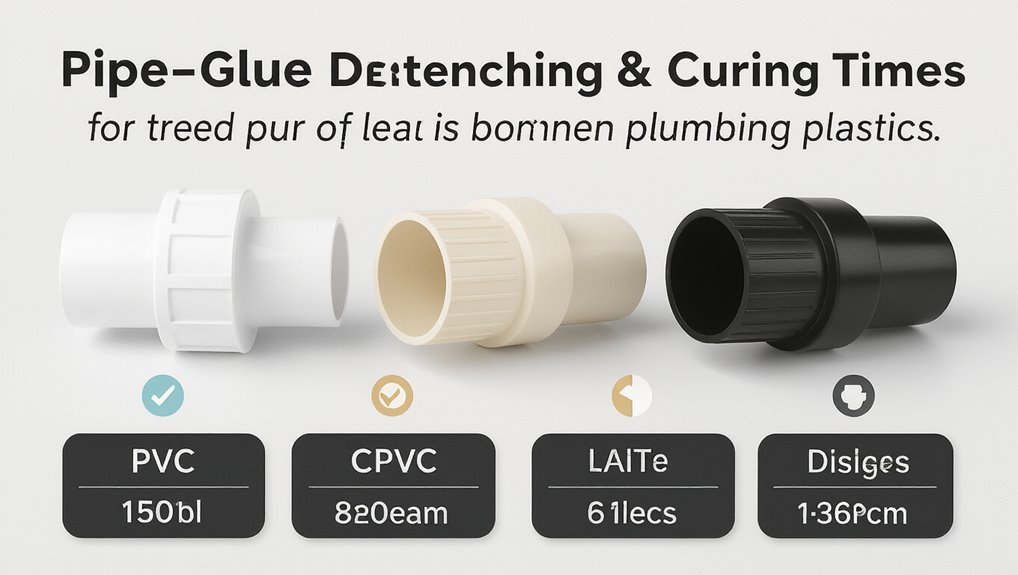
For quick reference, a concise chart summarizes typical drying and full cure times for solvent cements on common plastic pipes: PVC generally sets in 2–10 minutes and reaches full strength in 24 hours; CPVC often grabs in 2–15 minutes with a 24-hour cure; ABS usually bonds in 5–15 minutes and cures in 24 hours under normal conditions.
Factors altering these ranges include temperature, humidity, joint size, and solvent cement formulation. Cold or humid environments extend set and cure times; warm, dry conditions shorten them.
Properly prepared surfaces and correct application promote expected cure performance. Users should follow manufacturer specifications for best results.
Drying vs. Curing : What Those Times Mean
The article distinguishes drying time—the interval until the adhesive surface appears set—from curing time, which is the longer period required for the joint to reach full strength.
It then explains how temperature, humidity, solvent type, and joint fit alter both schedules.
Practical guidance is provided for testing and scheduling work around those factors.
Drying Time Defined
How long does “dry” actually mean when applied to pipe glue? Drying time refers to when the adhesive surface no longer feels wet and can be handled gently without disturbing the joint. It indicates initial set and safe handling, not full strength. Drying depends on adhesive type, joint fit, temperature, humidity, and ventilation. Users should note manufacturer “handle” times versus final performance. The table below clarifies common observable stages versus practical actions.
| Observable Stage | Typical Action |
|---|---|
| Surface tacky | Avoid movement |
| Surface dry | Gentle handling |
| Light stress | Minimal load |
| Normal use | Routine operation |
| Full cure | See curing info |
Curing Time Explained
Understanding drying time sets expectations for when a glued pipe can be handled, but curing time defines when the bond reaches its designed strength and durability.
Curing is a chemical process where adhesive components fully react, not merely surface evaporation. Full cure determines pressure rating, resistance to chemicals, and long-term joint integrity.
Manufacturers specify cure durations—often hours to days—under ideal conditions; partial strength may suffice for light handling earlier.
Testing or following specified wait times guarantees safety and performance.
Distinguishing drying from curing prevents premature use that could cause leaks or failure despite a dry appearance.
Factors Affecting Times
Under varying conditions, drying and curing times diverge because they depend on different physical and chemical processes: drying is driven mainly by solvent evaporation and surface film formation, while curing involves a chemical cross-linking or polymerization that develops full bond strength.
Ambient temperature, humidity, and airflow alter evaporation rates and consequently surface set. Adhesive formulation, solvent type, and filler content determine both evaporation and reaction kinetics.
Joint size and gap influence solvent retention and cure depth. Substrate material and cleanliness affect wetting and chemical bonding.
Pressure during assembly promotes film contact, reducing voids and accelerating effective cure throughout the joint.
Typical Dry and Cure Times for PVC, CPVC, and ABS
Typically, PVC, CPVC, and ABS solvent-welds exhibit different dry and cure profiles due to material composition and solvent action.
PVC joints often become handleable within 15–30 minutes and reach functional strength in 2–4 hours, with full cure commonly by 24 hours for standard schedules.
CPVC, designed for higher temperatures, typically skins over in 10–20 minutes and attains pressure-capable strength in 2–6 hours, with full cure around 24–48 hours depending on wall thickness.
ABS usually sets fastest, often handleable within 5–15 minutes and serviceable in 1–2 hours, achieving full cure generally within 24 hours under normal conditions.
What Speeds or Slows Drying: Temperature, Humidity, and Joint Prep
Those baseline cure ranges shift when environmental conditions and preparation vary.
Temperature strongly affects solvent evaporation and chemical fusion: warmer air accelerates set and cure within manufacturer limits, while cold slows reaction and extends handling time.
High humidity can retard evaporation for some formulations and promote longer tackiness; very low humidity speeds surface drying but may mask incomplete fusion.
Joint preparation matters equally: clean, dry, and properly beveled surfaces yield consistent solvent welding and predictable cure; grease, dirt, or residual moisture impede penetration and prolong cure.
Bond size and fit tolerance also influence effective drying by altering solvent retention and airflow.
How to Safely Speed Up Drying Without Weakening the Joint
Practically always, accelerating pipe-glue drying requires balancing faster solvent evaporation with maintaining proper chemical fusion so the joint isn’t weakened.
To speed cure safely, increase ambient temperature moderately (within manufacturer limits) and improve ventilation to remove solvent vapors, but avoid direct heat sources that can overheat or deform plastics.
Use warm, dry air rather than open flames or heat guns.
Make sure correct solvent cement type and apply proper thickness—too thin dries superficially; too thick traps solvent.
Clean, well-fitted surfaces reduce required cure time.
Follow manufacturer cure charts; when in doubt, allow additional dwell time rather than forcing premature use.
When a Joint Is Ready for Pressure Testing, Backfill, or Service
Determining when a glued pipe joint is ready for pressure testing depends on the manufacturer’s specified set and cure times and the ambient temperature.
Only after the joint has reached the minimum set time should low-pressure testing begin, progressing to full working pressure only when the joint shows no leaks.
Backfill and return to service should wait until the joint has achieved its recommended cure strength to avoid movement or stress that could compromise the bond.
Ready For Pressure Testing
When the solvent-cemented joint attains sufficient cure to hold dimensions and resist internal pressure without leakage, it is considered ready for pressure testing, backfill, or service.
Readiness depends on pipe material, ambient temperature, cement type, and joint size. Manufacturers provide minimum cure times; deviations require conservative extension.
Prior to testing, visually inspect joints for proper alignment and excess adhesive removal. Gradually apply test pressure to avoid shock, monitor for drops, and check seals. Record results and hold pressure for the recommended duration.
If leakage appears, depressurize, dry, and repair or replace the joint before repeating tests.
- Confirm manufacturer cure time
- Inspect and prep joints
- Apply gradual test pressure
Safe To Backfill
After confirming cure times and successful pressure testing, attention shifts to backfill readiness. The joint must meet manufacturer cure specifications and hold test pressure without leaks; only then is it considered stable. Ambient temperature, pipe material, and adhesive type influence when the assembly can endure soil compaction and external loads.
Inspect joints visually for solvent-weld uniformity and recheck fittings after the pressure hold period. When criteria are satisfied, backfill in layers, compacting lightly around the pipe to avoid displacement.
Final service can commence after prescribed post-backfill waiting times elapse, ensuring long-term integrity and leak prevention.
Conclusion
Like mortar setting between stones, pipe glue binds hidden networks that carry life’s flows. Time marks both surface dryness and inner strength; patience is the steady gardener tending roots. Temperature and humidity are weather, joint prep the soil—each influences the unseen cure. Rushing can fray the weave; cautious acceleration fosters resilience. When recommended cure is met, the seal becomes a quiet bridge, ready to bear pressure and shield what runs within.