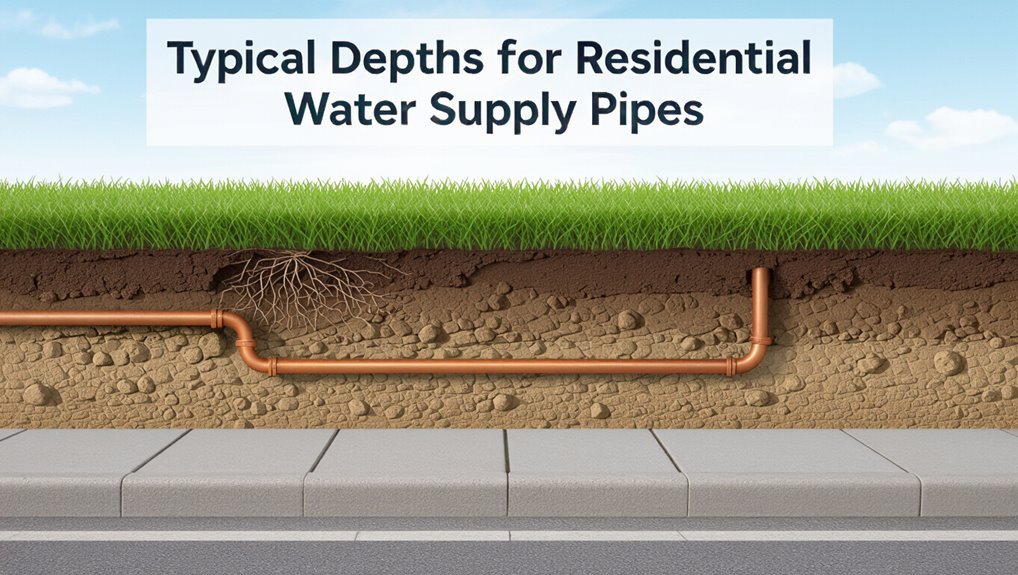
How Deep Are Water Pipes Buried? Essential Guide for Homeowners
Key Takeaway: How Deep Are Water Pipes Buried?
Water pipes are typically buried below the frost line to prevent freezing and damage.
- Mild Climates: Service lines are often buried 12–48 inches deep; municipal mains are usually 48–84 inches deep.
- Colder Regions: Depths commonly range from 36–72 inches.
- Factors Influencing Depth: Local codes, soil type, and load exposure can affect the required depth.
- Responsibility: Utilities control municipal mains, while homeowners manage on-property laterals.
- Important Steps: Permits and utility locates are necessary for any changes to the piping.
This guide provides essential information for homeowners regarding the burial depth of water pipes in various climates and conditions.
Quick Answer: Typical Buried Water Pipe Depths
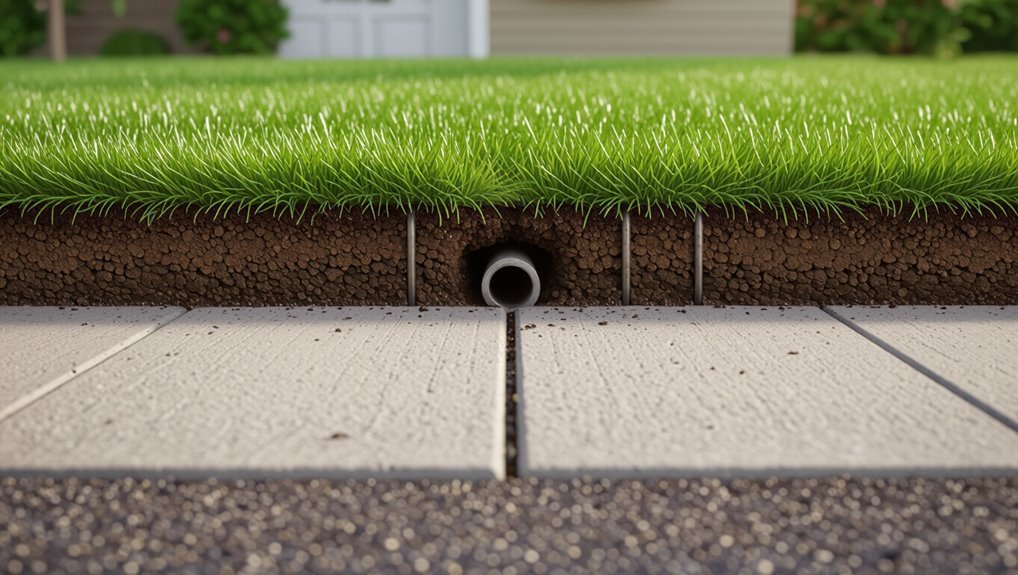
Although burial depths vary by climate, soil and local code, most residential water mains and service lines are installed below the frost line—commonly 12 to 48 inches in milder regions and 36 to 72 inches in colder areas—while meters and valves may sit shallower or within insulated vaults.
Typical municipal mains often lie deeper beneath streets, sometimes 48 to 84 inches, to accommodate traffic loads and utilities.
Service lateral depths vary by property and routing, frequently 24 to 60 inches. New installations follow local standards; retrofit depths depend on existing infrastructure.
Homeowners should reference utility maps and local authority guidance for precise depths.
Why Depth Matters: Freeze, Damage, Code, and Liability
Because buried depth directly influences exposure to freezing temperatures, mechanical stresses, regulatory compliance, and legal responsibility, choosing the correct installation depth is a primary concern for utility designers and property owners.
Proper depth reduces freeze risk, prevents pipe movement from surface loads or soil settling, and limits abrasion or crushing from construction activity. Compliance with codes protects water quality and avoids fines; adherence to local standards also mitigates liability after failures.
Insufficient depth increases repair frequency, emergency costs, and potential downstream damage claims. Consequently, depth decisions balance performance, safety, legal obligations, and lifecycle maintenance costs, guiding installation and inspection practices.
How Frost Line and Climate Set Minimum Depths
The depth at which soil freezes each winter—the frost line—serves as the baseline for minimum burial depths, since pipes must sit below this zone to avoid ice-related expansion and rupture.
Regional climate determines frost depth: colder areas mean deeper frost lines, warmer climates may have negligible freeze.
Soil type, snow cover, and ground moisture modify freeze penetration, so identical latitudes can differ.
Designers combine frost-line maps with site conditions to set conservative depths that protect pipes year-round.
Where seasonal frost is shallow, additional insulation or heat tracing can permit shallower installation without risking freeze damage.
Local Plumbing Codes and Permit Rules to Check First
After determining frost-line requirements for pipe depth, attention turns to local plumbing codes and permit rules that legally govern burial depth, materials, and inspection.
Municipal or county codes specify minimum cover, approved pipe types, joint methods, and separation from other utilities; they may reference state plumbing standards.
Permit applications often require plans showing trench depth, slope, and backfill method.
Inspections at rough-in and cover stages verify compliance; failing inspection can require costly rework.
Homeowners should consult the local building department, obtain required permits before digging, and keep records of approvals and inspector sign-offs for future property transactions.
Who Controls Service-Line Depth: Private vs. Utility?
Responsibility for service-line depth is typically split between the property owner and the utility company, with each party accountable for different segments of the connection.
Utility companies usually set depth requirements and control the public portion up to the property line, while homeowners must follow local code requirements for on‑property piping.
Clear coordination and adherence to local permits determine who handles installation, maintenance, and compliance.
Property Owner Responsibility
When determining how deep a service line must be, responsibility typically falls into two categories: utility-owned mains and customer-owned service lines.
Property owners are generally accountable for the portion on their land from the meter or property line to the building. This includes ensuring freezing protection, proper bedding, and meeting local code depths.
Owners must obtain permits, arrange inspections, and hire licensed contractors. Liability for repairs and damage on private segments typically rests with the owner unless specified otherwise by agreement.
- Confirm property line vs. meter location
- Verify local code depth and frost line
- Obtain required permits
- Hire licensed contractors
- Maintain and inspect periodically
Utility Company Jurisdiction
Control over service-line depth frequently shifts at the property line or meter, but jurisdictional authority depends on whether the line segment is owned by the utility or the customer. Utilities normally set minimum burial depths for their owned mains and sometimes for service taps; homeowners control privately owned service lines inside the property. Responsibility affects repairs, upgrades, and compliance: utilities may require deeper burying to prevent freezing or damage, while owners balance cost and protection. Clear delineation avoids disputes; homeowners should confirm ownership records or contact the utility before excavation or replacement.
| Owner | Typical Responsibility |
|---|---|
| Utility | Main and public tap |
| Customer | Private service line |
Local Code Requirements
Local building codes and utility regulations together determine minimum burial depths for service lines, but authority over specific segments hinges on ownership and local ordinance language.
Responsibility often splits between the utility (main to curb or meter) and the property owner (meter to house). Enforcement, exceptions, frost-line adjustments, and permit requirements vary by municipality.
Contractors must consult plats, utility maps, and local codebooks. Clear documentation prevents disputes and liabilities.
- Utility controls to the meter or property line in many jurisdictions
- Owner responsible from meter to structure
- Permits may set deeper minimums
- Frost-line overrides standard depths
- Local ordinances can create exceptions
Buried Water Pipe Depths by Function (Service, Main, Lateral)
Although burial depths vary with climate and ground conditions, water pipe depth is primarily determined by the pipe’s function—service lines, mains, and laterals each have distinct typical depths to balance frost protection, maintenance access, and hydraulic requirements.
Service lines, connecting homes to the street main, are usually shallow enough for convenient repair yet deep enough to avoid freezing—commonly 18–36 inches in temperate areas, deeper in cold regions.
Distribution mains are buried deeper for durability and capacity, often 36–60 inches.
Laterals within subdivisions or between mains and services vary by local practice, typically aligning with either service or main depths for cohesion.
How Pipe Material Affects Burial Depth and Durability
Material selection influences how deep pipes must be placed relative to the frostline, with some materials requiring deeper burial to prevent freezing.
Durability varies by resistance to corrosion and environmental degradation, affecting expected service life and maintenance needs.
Flexibility versus rigidity also guides installation choices, since more flexible materials tolerate ground movement and shallower placement better than brittle options.
Pipe Material And Frostline
Different pipe materials—PVC, copper, PEX, steel, and ductile iron—interact with frostline considerations in distinct ways, influencing both required burial depth and long‑term durability.
Soil movement, thermal conductivity, and flexibility change how each material tolerates freeze‑thaw cycles; flexible PEX can resist minor shifting while rigid materials need deeper cover.
Local frost depth sets minimum cover, but chosen material can permit slightly shallower placement if protected with insulation or bedding.
Contractors assess thermal properties, expected loading, and service temperature to determine depth and protective measures for each material in a given climate.
- PEX: flexible, tolerates slight heave
- PVC: rigid, needs stable bedding
- Copper: conducts cold, needs depth
- Steel: strong, sensitive to movement
- Ductile iron: durable, prefers deep cover
Corrosion Resistance And Longevity
Many buried pipes face chemical and electrochemical attacks that shorten service life unless materials and site conditions are matched to resist corrosion.
Soil pH, moisture, salinity, and stray currents influence selection: ductile iron requires robust coatings and cathodic protection, galvanized steel is prone to coating breakdown, copper tolerates many soils but may suffer pitting in sulfide-rich ground, and polyethylene and PVC resist corrosion inherently.
Appropriate bedding, drainage, and protective sleeves extend longevity.
Design decisions also consider expected lifespan, maintenance access, and cost; choosing corrosion-resistant materials and preventive measures reduces failure risk and the need for premature replacement.
Flexibility Versus Rigidity
Because stiffness and flexibility govern how pipes respond to soil loads, thermal movement, and ground settlement, they are key factors in determining both burial depth and long-term performance.
Materials like ductile iron resist deformation but transmit stresses to joints, often necessitating deeper bedding or additional support. Flexible plastics (PEX, HDPE) accommodate minor shifts and can be buried shallower with protective backfill, though they may require UV-free handling and protection against puncture.
Designers weigh rigidity for structural stability against flexibility for movement tolerance, matching pipe choice to soil type, frost risk, load conditions, and maintenance access.
- Rigid: predictable load distribution
- Flexible: movement absorption
- Rigid: joint stress concerns
- Flexible: easier installation
- Match material to site conditions
How Soil Type and Drainage Change Recommended Depths
When determining burial depth for water pipes, soil texture and drainage characteristics greatly influence frost penetration, load-bearing capacity, and corrosion risk. Sandy, well-drained soils allow for shallower installation, while clay-rich or poorly drained soils typically require greater depth to prevent freezing and maintain structural stability.
Permeability affects frost heave: coarse, free-draining soils transmit heat less readily, reducing freeze risk, whereas fine-grained, waterlogged soils retain moisture and extend freezing depth.
Load considerations vary: cohesive clays can support heavier loads but may settle unevenly when saturated. Recommended depths should reflect local soil surveys and drainage patterns, plus appropriate bedding and backfill to stabilize pipes.
Signs a Buried Water Pipe Is Too Shallow or Failing
Visible water pooling above ground often signals a leak or an exposed line that is too shallow.
Uneven or sunken patches in the lawn can indicate washed-out soil from a failing pipe.
Corrosion, cracks, or displaced fittings observed during inspections further confirm pipe deterioration and the need for immediate attention.
Visible Water Pooling
How can standing water on a lawn or driveway signal a buried water pipe problem?
Visible pooling often indicates leaking or insufficiently buried pipes causing surface saturation. Water collects where soil is oversaturated, revealing patterns and persistence that point to subsurface issues.
Observing pooling helps prioritize inspection before more serious damage occurs.
- Persistent puddles appearing after minimal rain
- Localized wet spots with green, lush grass
- Clear, steadily replenished water without runoff
- Pooling near known pipe routes, meters, or valves
- Wet areas that persist despite dry weather
Prompt assessment can prevent erosion, foundation risks, and higher repair costs.
Unusual Lawn Sinking
Although subtle at first, localized sinking or depressions in a lawn often signal failing or shallow-buried water pipes undermining the soil structure. Observers note uneven settling, soft patches, or small funnels forming where soil is washed away by leaks or frost heave effects. These changes concentrate near linear depressions or along utility routes. Prompt investigation limits landscape damage and hazard. Professionals assess soil moisture, probe for voids, and test pressure to locate the cause without disturbing unrelated infrastructure.
| Observation | Possible implication |
|---|---|
| Small depressions | Minor leak or soil compaction |
| Linear sagging | Pipe alignment issue |
| Soft ground | Active leakage |
| Sudden sinkhole | Significant void beneath pipe |
Corrosion Or Damage Signs
Several telltale indicators point to corrosion or physical damage when a buried water pipe is too shallow or failing. Homeowners may notice persistent wet spots, rusty water, or reduced pressure; metallic clanking or odd odors can also appear.
Early recognition limits property harm and costly repairs.
- Discolored or iron-streaked water from taps
- Localized soggy ground or persistent puddles
- Sudden drops in water pressure or intermittent supply
- Metallic noises in pipes, especially during flow changes
- Visible soil subsidence or new cracks near pipe runs
How to Locate Buried Water Pipes Safely
Where exactly are underground water lines, and what steps should be taken before digging near them?
The homeowner should contact the local utility notification center to request line marking. Reviewing property plans and meter locations narrows expected routes.
Use noninvasive detection: electronic pipe locators, ground-penetrating radar, or acoustic devices operated by qualified technicians.
Visually inspect for surface indicators like valve boxes, curb stops, or prior repair patches. Maintain safe distances and follow marks; hand-digging only when within a marked tolerance.
Document findings and retain utility confirmations. When uncertainty remains, hire licensed plumbers or utility contractors to verify locations before any excavation.
Quick Checklist Before You Dig
Before breaking ground, one should call the local “Call Before You Dig” service to request utility locates.
Utility maps should be reviewed to confirm known line locations and depth estimates.
Once lines are identified, clearly mark underground utilities to guide safe excavation.
Call Before You Dig
A simple phone call or online request to the local utility notification center is the essential first step before any excavation; it guarantees buried water, gas, electric, and communications lines are located and marked to prevent dangerous strikes and costly repairs.
The homeowner waits for professional marking, notes the scope of work, and schedules digging only after clearance is provided. Response times and marking methods vary; follow any temporary flags or paint codes and respect clearance distances.
Documentation of the ticket helps with communication and liability.
- Call or submit ticket through the official one‑call number
- Provide precise address and project details
- Wait required notice period
- Do not rely on visible surface indicators alone
- Record the ticket number and inspector notes
Check Utility Maps
After the utility notification has been requested and markers are in place, consulting utility maps provides a more complete picture of underground infrastructure and helps confirm the marked locations.
Utility maps, provided by municipalities or utility companies, show pipe types, sizes, depths, and joint locations when available. Review legend details, scale, and last update date to assess accuracy.
Cross-check maps with on-site markers and visible features like valves or slabs. Note discrepancies and report them to the locating service before digging.
Preserve copies of relevant map excerpts for reference during excavation and adhere to any depth or clearance guidance indicated.
Mark Underground Lines
Once utility locations and maps are verified, the site should be clearly and permanently marked to guide all excavation activities. Marking reduces accidental strikes and clarifies safe dig zones.
Use durable paint, flags, or stakes consistent with utility color codes. Record markings on the site plan and photograph for teams and future reference. Confirm marks with the utility owner before heavy equipment arrives.
Keep a buffer around marked lines and respect private lines not shown on maps.
- Use standardized color codes and durable materials
- Place flags at regular intervals
- Note distances from structures
- Photograph and log markings
- Reconfirm marks before digging
When to Dig Yourself and When to Hire a Licensed Plumber
While minor shallow repairs can be handled by a homeowner with basic tools and knowledge, tasks that involve deep excavation, unknown pipe materials, gas lines, sewer mains, or city-owned connections should be left to a licensed plumber.
Homeowners may tackle visible leaks, shallow joint tightening, or replacing exposed fittings after locating utilities and turning off water.
Hire a professional when mapping is unclear, excavation exceeds safe depths, hazardous materials (lead/galvanized) are present, permits are required, or work affects public infrastructure.
Licensed plumbers offer diagnostic equipment, liability coverage, and code compliance, reducing risk of costly damage, fines, and safety hazards.
Replace or Lower a Service Line: Steps and Cost Estimates
Replacing or lowering a water service line requires planning, permits, and coordination with utility companies to guarantee the work is safe and code-compliant.
A licensed contractor typically excavates, isolates the supply, removes the old pipe, sets the new line at required depth, tests pressure, and restores the site.
Costs vary by length, material, depth, and local fees; expect a range from modest trench repairs to several thousand dollars for long runs or street cuts.
Timeframes span a day to a week with permitting.
- Obtain permits and locate utilities first
- Hire licensed plumber or contractor
- Choose material (copper, PEX, HDPE)
- Schedule inspections and pressure tests
- Restore landscaping and document work
Preventive Measures to Protect Shallow Pipes and Questions to Ask Your Plumber or Utility
Because shallow water service lines are more vulnerable to freezing, accidental damage, and ground movement, homeowners and contractors should adopt targeted preventive measures to reduce risk and prolong pipe life. Recommended actions include insulating exposed sections, installing heat tape where allowed, adding protective sleeves or bollards at crossing points, and improving drainage to prevent washouts. Regular inspection and prompt repair of small leaks avoids larger failures. Key questions for plumbers or utilities: depth confirmation, frost risk, preferred materials, warranty, permit needs, and liability for damage.
| Measure | Purpose | Question |
|---|---|---|
| Insulation | Freeze protection | Required depth? |
| Sleeves | Impact resistance | Material recommendation? |
| Heat tape | Localized thawing | Permit needed? |
| Drainage | Erosion control | Liability coverage? |
Conclusion
Homeowners should note that while requirements vary, many U.S. regions bury water pipes 12–48 inches deep; one striking statistic: in northern states frost lines often exceed 48 inches, meaning service lines must be buried much deeper than in the South to avoid freezing. This underscores why checking local codes, calling 811 before digging, and consulting a licensed plumber or utility are essential steps to prevent costly breaks, liability, and seasonal interruptions.