
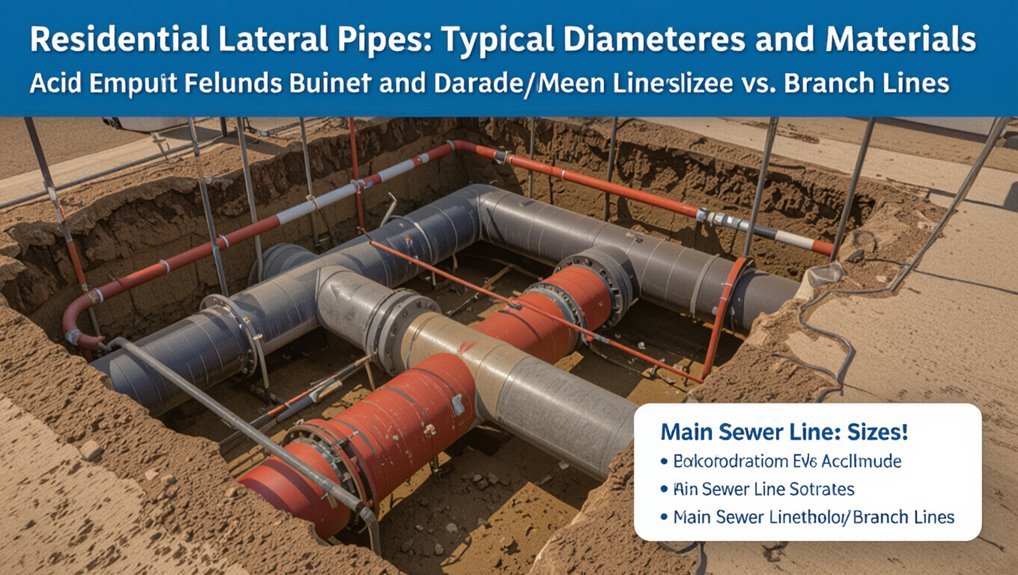
How Big Are Sewer Pipes? Size Guide for Homeowners & DIYers
Key Takeaway: Sewer pipe sizes vary based on their purpose. Most single-family homes use sewer mains that are 3–4 inches in diameter, with 4 inches being the modern standard. Smaller branch lines and fixture traps typically range from 1¼–2 inches. Municipal mains begin at 6–8 inches and increase for greater capacity.
For homeowners and DIYers, understanding sewer pipe sizes is crucial. Here’s a quick overview:
- House Drains and Laterals: 4 inches (standard)
- Branch Lines and Fixture Traps: 1¼–2 inches (for sinks and vents)
- Municipal Mains: Start at 6–8 inches, increasing as needed
The material of the pipes also influences flow, with PVC being the smoothest option compared to rougher clay and cast iron. Additionally, ensure proper slope, consider fixture units, and adhere to local codes, which may dictate the need for upsizing. For practical measuring tips, signs that a pipe may be too small, and replacement guidance, continue reading.
Quick Answer: Typical Sewer Pipe Sizes for Single-Family Homes
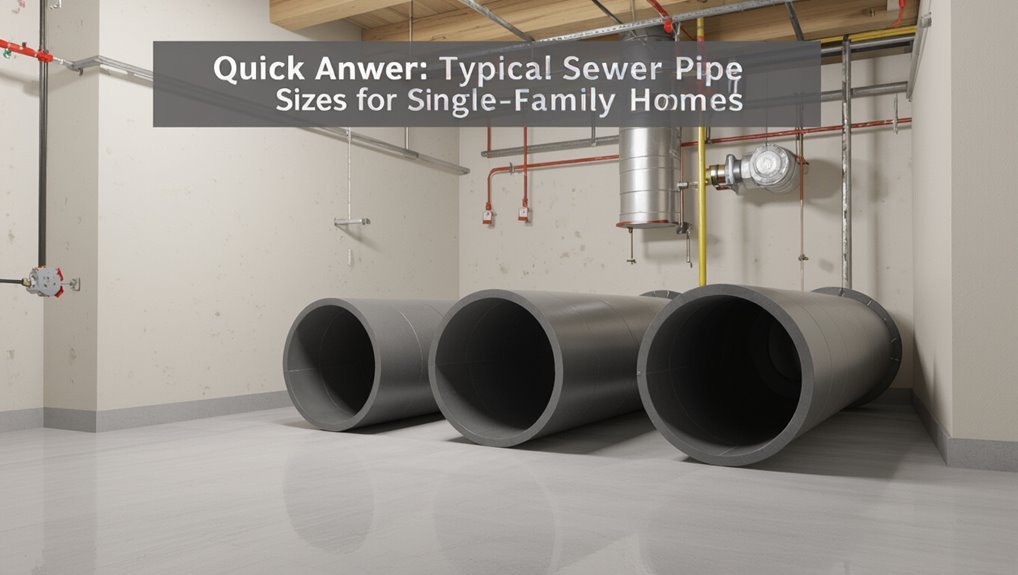
Typical sewer pipe sizes for single-family homes usually range from 3 to 6 inches in diameter, with 4 inches being the most common for main building drains and laterals. Smaller branch lines to fixtures often use 1¼ to 2 inches where permitted by code.
The guide notes that fixture drains, vent sizing, and slope requirements influence chosen diameters. Older houses may retain 3-inch mains; modern practice favors 4 inches for capacity and clog resistance.
Location, soil type, and local plumbing codes determine permissible sizes. Homeowners should reference code tables or consult a plumber when planning replacements or additions.
Main Lateral vs. House Drain : Which Size Matters?
The comparison between main lateral capacity and house drain standards determines flow performance and compliance for a property.
Engineers and plumbers assess lateral diameter, slope, and materials against local codes that define minimum house drain sizes and fixture unit loads.
Understanding both sets of requirements clarifies which pipe governs design decisions and prevents capacity shortfalls.
Main Lateral Capacity
A sewer system’s main lateral—the pipe carrying combined building flows to the municipal sewer—must be sized with different priorities than an individual house drain, because it handles cumulative peak flows, longer run lengths, and municipal loading factors.
Proper capacity prevents surcharge, backups, and regulatory violations. Design considers peak instantaneous discharge, slope and velocity, future development, and inspection access.
Typical municipal guidelines set minimum diameters and hydraulic load coefficients. Key factors include:
- Peak flow summation from all connected fixtures and units
- Required slope to maintain self-cleansing velocity
- Material roughness impacting Manning’s n
- Allowance for future load growth and maintenance access
House Drain Standards
Sizing decisions for house drains versus main laterals hinge on different performance priorities: the house drain must rapidly remove building waste at fixture-level peak loads while the main lateral must convey aggregated flows with future growth and municipal factors in mind.
House drains follow plumbing codes specifying minimum diameters by fixture count and fixture units; fixtures concentrated on short runs may require larger pipe to prevent siphoning and backups. Materials and slope guarantee self-cleansing velocity without noise.
Main laterals consider watershed, pipe capacity, and inspection access; municipalities often mandate larger mains and cleanouts. Proper sizing balances local code, hydraulics, and maintenance access.
Common Fixture Pipe Sizes (Toilet, Sink, Shower, Tub)
Typical household fixtures require specific drain diameters to function properly and meet code.
Toilets commonly use 3- or 4-inch traps and carriers, while sinks and showers are usually served by 1½- to 2-inch lines tied into larger stacks.
Identifying the correct sizes for each fixture simplifies planning and prevents common clogs and venting issues.
Toilet Drain Sizes
Although often overlooked, toilet drain sizing is essential for proper plumbing performance and to prevent frequent clogs or sewer gas issues.
Toilets typically connect to 3- or 4-inch soil stacks; 3-inch is common in older or compact installations, while 4-inch is preferred for modern homes and multi-toilet stacks. Proper slope and trapway size matter as much as pipe diameter.
Consider local code requirements and the toilet’s discharge rating when selecting pipe size.
- 3-inch: acceptable for single fixtures in some jurisdictions
- 4-inch: standard for most new installations
- Trapway size: affects flush performance
- Venting: guarantees proper drainage and prevents siphoning
Sink And Shower Pipes
After covering toilet drains, attention shifts to sinks and showers, which use smaller-diameter piping but have their own rules for capacity and slope.
Bathroom sinks typically connect to 1¼” or 1½” trap arms, while kitchen sinks commonly use 1½” to 2″ for higher flow.
Showers and tubs generally use 2″ drains to handle simultaneous flows and meet code-required fixture unit totals.
Proper slope (1/4″ per foot for 1½”–2″ drains) guarantees self-clearing velocity.
Venting, trap configuration, and combined fixture units determine required main branch sizes; installers follow local code charts to prevent backups and odors.
Measure an Existing Sewer Pipe : Simple, Accurate Methods
Measuring an existing sewer pipe requires only a few straightforward tools and careful technique to obtain accurate size data that informs repairs or replacements.
Begin by exposing a clean section of pipe or using an accessible cleanout. Use calipers or a flexible tape to record outside diameter (OD); subtract wall thickness if inner diameter (ID) is needed.
For buried runs, measure visible fittings or cleanouts and infer main size. Confirm with a camera inspection for irregular or noncircular pipes.
- Inspect accessible cleanouts first.
- Measure OD with calipers or tape.
- Estimate ID by subtracting known wall thickness.
- Use camera for confirmation.
How Pipe Material Changes Capacity (PVC, Cast Iron, Clay)
Different pipe materials—PVC, cast iron, and clay—affect sewer flow capacity through variations in internal roughness and hydraulic characteristics.
PVC’s smooth surface typically yields higher flow rates for a given diameter, while cast iron and clay present greater roughness and potential for buildup that reduce effective capacity.
Material choice also influences long-term durability and maintenance frequency, which in turn affects sustained flow performance.
Flow Capacity Differences
Pipe material considerably influences sewer pipe flow capacity because internal surface texture, joint tightness, and long-term roughness determine hydraulic resistance.
Materials differ in effective diameter, flow coefficient, and susceptibility to buildup, so capacity varies even for identical nominal sizes.
- PVC: smooth surface yields high Manning’s n and greater flow for a given slope.
- Cast iron: moderate roughness and rigid joints give reliable capacity but slightly reduced flow.
- Clay: older vitrified clay can have irregularities and tighter joints, lowering effective flow.
- Installation quality: alignment and joint condition interact with material to affect real-world capacity.
Durability And Roughness
Durability and internal roughness directly affect hydraulic performance and service life, because surface texture and resistance to wear determine how smoothly sewage flows over time.
PVC offers low roughness, resisting deposits and maintaining capacity; it is chemically inert and durable, with minimal slope loss.
Cast iron is strong and abrasion-resistant but can rust, increasing roughness and reducing flow unless lined.
Clay is abrasion- and corrosion-resistant initially but joints and cracks raise infiltration and friction over decades.
Choice of material influences Manning’s n value, cleaning frequency, and expected deterioration; selection balances initial capacity, longevity, and maintenance needs.
Local Code Minimums (Typical Rules & How Fixture Count Affects Size)
While local building codes vary, most jurisdictions set minimum sewer pipe sizes based on fixture unit counts and the direction of flow. These minimums guarantee adequate capacity and prevent blockages without oversizing the system.
Codes translate fixture units into required pipe diameters and slope, so a single bathroom often needs only a 3‑ or 4‑inch stack, while multiple fixtures add units cumulatively.
Branch and building drains follow tables; horizontal runs usually require larger diameters than vertical stacks. Inspectors use unit totals to verify compliance.
Typical considerations include:
- Fixture unit tables determine minimum diameter
- Horizontal run vs. vertical stack rules
- Cumulative counting of fixtures
- Minimum slope requirements
When to Upsize: Clog Symptoms, Capacity Rules, and Tests
After confirming code-based minimums and counting fixture units, a practitioner must recognize when a system still underperforms and merits a larger diameter. Indicators include frequent slow drains, recurring backups in multiple fixtures, sediment buildup, or persistent gurgling that cleaning and venting do not fix.
Capacity rules consider peak flow, slope, and Manning’s equation; if calculated flow approaches pipe capacity under design slope, upsizing is justified.
Practical tests: video inspection to locate restrictions, flow-run tests during peak use, and dye or smoke tests for hidden inflow.
Upsizing decisions weigh long-term maintenance reduction against excavation and material costs.
Trench, Slope & Clearance Rules That Affect Pipe Choice
Because trench depth, slope, and clearances directly govern flow performance and installation practicality, specifying sewer pipe must start with site excavation constraints and grade control.
Designers assess minimum burial depth to prevent freezing, maximum cover limits for load-bearing, and local codes that set vertical clearances from other utilities. Slope selection balances self-cleansing velocity with available fall.
Maintenance access and bedding width influence outside diameter choice and joint type. Consider:
- Minimum slope for pipe size to avoid solids settling
- Required trench width and bedding to support pipe
- Vertical clearances to water, gas, and electric lines
- Access for future inspection and repairs
DIY vs. Professional Replacement : What Sizes You Can Handle
Once excavation limits and grade requirements are established, the decision whether a property owner can tackle pipe replacement or should hire a professional hinges largely on pipe diameter, material, and site conditions.
Smaller diameters (1½–4 in.) in accessible trenches, with PVC or ABS, are often manageable for competent DIYers using hand tools and simple couplings.
Larger mains (6 in. and above), brittle materials (cast iron, clay), deep trenches, multiple connections, or proximity to utilities generally require contractors with excavation equipment, shoring, permits, and inspection coordination.
Risk tolerance, local code complexity, and warranty considerations also influence the choice between DIY and professional replacement.
Quick Reference Chart: Common Diameters and Typical Uses
A compact chart lists common sewer pipe diameters alongside their typical residential and municipal uses, enabling quick selection based on flow needs and fixture counts.
The reference condenses size, capacity, and typical placement for faster decisions without calculations. It clarifies when to upgrade and when a smaller line suffices, aiding permits and bids.
- 1¼–1½ in: individual fixture drains, venting, and short runs.
- 2 in: small appliance drains, single fixtures with higher flow.
- 3–4 in: main household waste lines, sewer laterals to street.
- 6–8 in+: municipal mains, high-capacity storm or trunk sewers.
Conclusion
In the end, the home’s arteries—those sewer pipes—speak of balance between size and function: too narrow and they choke, too large and they lie wasted like an idle riverbed. Homeowners who read the signs of slow drains and backups learn when to let professionals reroute the flow or when a DIY touch will suffice. Choosing the right diameter is less technical ritual than tending a small, practical ecosystem that keeps the house breathing smoothly.