How Much Should Water Drip to Prevent Frozen Pipes?
To prevent frozen pipes, let water drip at a slow, steady rate of about one drop per second from faucets that serve exterior-facing or unheated areas.
Key Takeaways:
- Drip Rate: One drop per second is sufficient.
- Faucets to Prioritize: Focus on taps located on exterior walls, in basements, garages, and near crawlspaces.
- Conditions: Increase the flow during prolonged or windy cold spells.
- Additional Measures: Combine dripping with insulation and targeted heat to further protect pipes.
This approach helps keep water moving, equalizes temperature along the pipes, and relieves pressure that can lead to bursts.
Quick Rule: How Much Water to Drip to Prevent Frozen Pipes
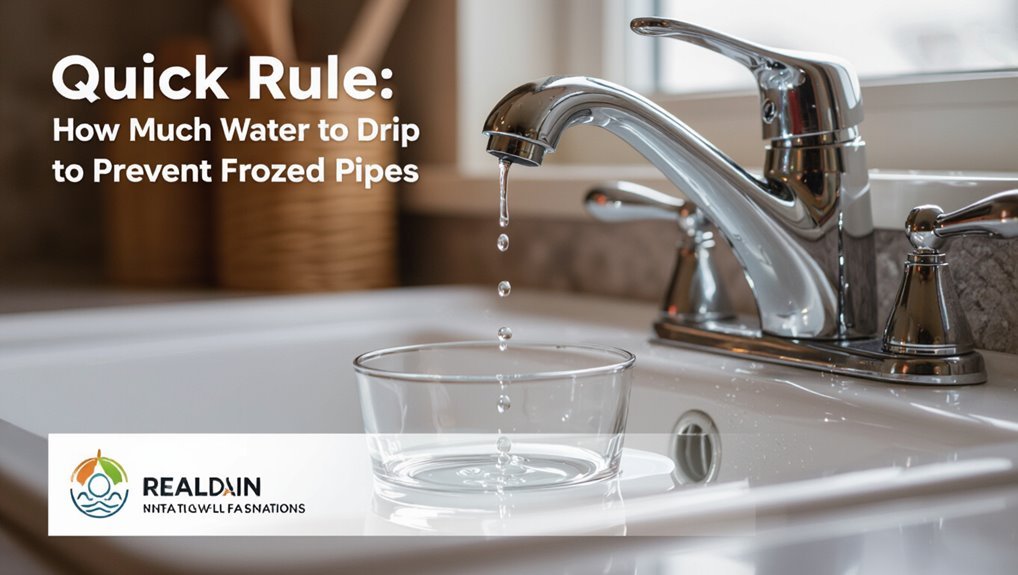
Frequently, a slow, steady drip from faucets connected to vulnerable pipes prevents freezing by keeping water moving and relieving pressure buildup.
Guidance recommends a trickle about the width of a pencil lead—roughly 1/8 to 1/4 cup per hour—for exposed or exterior-adjacent lines.
Prioritize faucets on exterior walls and at highest risk during prolonged cold.
Single-family homes may need fewer drips than complex systems; multifamily buildings require coordinated flow points.
Monitor municipal pressure and adjust if flow seems insufficient.
Combine dripping with insulation and localized heat for effective protection, and stop once sustained temperatures remain above freezing.
Why a Slow Drip Stops Pipes From Freezing
A slow drip prevents pipe freezing by keeping water in motion and reducing pressure build-up that can burst pipes when ice forms.
Moving water requires lower cooling time to reach freezing, interrupting ice nucleation along pipe lengths.
Flow also equalizes temperatures, drawing slightly warmer supply water into colder sections and preventing isolated cold pockets.
Small, continuous movement relieves pressure differentials that develop when ice obstructs passages, lowering rupture risk.
Additionally, dripping near vulnerable fittings and exposed runs helps identify blockages early by observing reduced flow.
This minimal, controlled flow conserves water while providing effective freeze mitigation when applied appropriately.
When to Start Dripping Taps (Temperature Thresholds)
Guidance on when to start dripping taps typically begins with outdoor temperature thresholds, commonly recommended when temperatures fall below freezing.
Wind chill and exposure can effectively lower the risk threshold for exposed pipes, warranting earlier action.
Home vulnerability factors—such as unheated spaces, pipe location, and insulation quality—should modify the timing for initiating a drip.
Outdoor Temperature Thresholds
When should homeowners begin dripping faucets to reduce the risk of frozen pipes? Guidance ties action to sustained outdoor temperatures: start when forecasted lows reach about 20°F (-7°C) or lower for several consecutive nights, or when brief dips near 20–25°F (-6 to -4°C) coincide with vulnerable plumbing locations.
Properties with poor insulation, unheated crawl spaces, or exposed pipes should act earlier, around 25–30°F (-4 to -1°C). Local climate history and pipe materials matter; copper freezes faster than plastic.
Confirm decisions using several days of reliable forecasts rather than single-night predictions to avoid unnecessary water use while ensuring protection.
Wind Chill And Exposure
How should wind chill and exposure influence the decision to start dripping taps?
Wind-driven cold increases heat loss from exterior walls and uninsulated plumbing, raising freeze risk at higher air temperatures than calm conditions.
Exposed pipes—those in crawlspaces, attics, garages, or along exterior walls—require earlier action; start dripping when forecasted wind amplifies low temperatures, often a few degrees above typical outdoor thresholds.
Continuous light flow reduces pressure build-up and adds minimal warmth.
Monitor wind advisories and combine with local temperature forecasts to set conservative drip start points, adjusting for prolonged gusts or rapid temperature drops to prevent freezing.
Home Vulnerability Factors
Against a backdrop of falling temperatures, the specific vulnerabilities of a house—pipe location, insulation quality, foundation type, and heating reliability—determine the temperature threshold at which taps should be dripped.
Pipes in unheated crawlspaces, exterior walls, or attics risk freezing sooner than interior runs. Poor insulation, gaps, and older single-pane windows lower the effective ambient temperature around plumbing. Homes with slab foundations may need earlier action when soil freezes; houses with reliable central heat can wait longer. Assessments should be conservative: begin dripping when forecasts predict persistent subfreezing lows for vulnerable layouts, or consult a professional for borderline cases.
Which Faucets and Fixtures You Should Drip
In cold weather, homeowners should prioritize dripping faucets that serve exposed or exterior-facing pipes, particularly those in unheated areas like garages, crawlspaces, basements, and exterior walls. Faucets near thermostatically weak zones, outdoor hose bibs, and sinks on exterior walls merit attention. Prioritize single-handle fixtures supplying multiple branches. Bathroom and kitchen sinks on outer walls, utility sinks, and laundry tubs often protect downstream lines. If multiple fixtures serve the same run, one slow drip at the most downstream tap can suffice. Monitor during extreme cold and adjust strategy based on building layout and pipe exposure.
| Fixture Type | Typical Location | Priority |
|---|---|---|
| Hose bib | Exterior wall | High |
| Laundry tub | Basement | High |
| Kitchen sink | Exterior wall | Medium |
| Bathroom sink | Interior wall | Low |
How Wide to Open the Tap for a Steady Drip
Guidance on how wide to open a tap for a steady drip helps balance water waste with freeze prevention. For a single faucet, a flow that produces one drip per second is typically sufficient to keep water moving without excessive consumption.
The discussion that follows explains how far to turn the handle to achieve that rate and how to check the drip visually.
One-Faucet Drip Rate
Often a barely perceptible stream is sufficient, a steady drip from a single faucet keeps water moving through vulnerable pipes and reduces freezing risk without wasting large volumes.
Guidance centers on consistency rather than force: a drip rate that maintains flow and prevents stagnation is the aim. Measuring a drip over a minute helps gauge adequacy.
Factors like pipe length, exposure, and indoor temperature influence required flow. One faucet usually suffices for connected lines when strategically located.
- Measure drips per minute to assess flow
- Prioritize faucets nearest exposed runs
- Check during prolonged cold spells
- Adjust if icing signs appear
How Much To Open
Begin by opening the tap just enough to produce a steady, visible drip—typically a quarter- to half-turn from fully closed on most household valves.
The goal is a consistent, singular droplet every few seconds rather than a stream.
Adjust incrementally: if flow splashes or runs, close slightly; if no drip forms, open a bit more.
For older fixtures or low-pressure systems, slightly wider opening may be required.
Check other nearby faucets for pressure balance.
During extreme cold, slightly increase flow.
Monitor periodically to guarantee steady dripping without waste; small adjustments achieve freeze protection while minimizing water use.
Measuring Drip Rate : Drops/Minute and Liters/Hour
Measure the faucet’s drip rate by counting drops per minute and converting that figure to liters per hour for practical planning. One person times drops for sixty seconds, repeats for accuracy, then uses a simple conversion: approximately 20 drops = 1 milliliter (varies by faucet).
From drops/minute to mL/hour multiply by 60, then divide by 1000 for liters. Record results to compare settings or different faucets. Use the measurement to estimate water use and adjust to minimize waste while preventing freezing.
- Count drops over a full minute for best precision.
- Average multiple trials.
- Apply 20 drops = 1 mL as a guideline.
- Convert mL/hour to liters/hour.
Recommended Drip Rates: Interior vs. Exterior Pipes
Recommended drip rates differ by location: interior pipes typically require a slow, steady trickle—often one to two drops per second—to keep water moving without wasting supply.
Exterior faucets generally need a slightly higher flow or an open hose bib to prevent standing water from freezing in exposed sections.
The discussion will compare specific rates and practical adjustments for each situation.
Interior Pipe Drip Rate
For interior plumbing, maintaining a slow, steady drip on at-risk fixtures helps prevent freezing while minimizing water waste. The recommended interior drip rate is usually a trickle — about one drip per second — sufficient to keep water moving and reduce pressure buildup without significant consumption.
Priority goes to fixtures on exterior walls, basements, and unheated spaces. Monitor pipes for slow flow and adjust if temperatures drop further. Combine drips with insulation and steady heating for best results.
- Target approximately one drip per second
- Focus on faucets nearest exterior walls
- Insulate vulnerable pipe runs
- Increase flow if prolonged subzero conditions
Exterior Faucet Drip
Targeting exterior faucets with a controlled drip reduces the risk of freezing in exposed lines while using only slightly more water than interior drips. The recommended rate for outdoor spigots is a steady trickle—approximately one drop per second or a flow around 1 to 2 gallons per hour—adjusted for wind exposure and insulation quality.
Valves and hose bibs should be opened slightly to maintain movement without flooding. When possible, use insulated covers and disconnect hoses to improve effectiveness. Monitoring overnight lows and increasing flow during extreme cold optimizes protection while conserving water. Regular checks confirm continued operation.
Adjusting Drip for Uninsulated, Exposed, or Crawlspace Pipes
When pipes run through uninsulated areas, exposed exterior walls, or crawlspaces, increasing the faucet drip slightly can prevent freezing by keeping water moving and releasing pressure buildup.
A steady, audible drip at multiple fixtures feeding vulnerable runs reduces ice formation risk; aim for a thin, continuous flow rather than a single gush.
Monitor indoor and outdoor temperatures, increase flow during prolonged subfreezing spells, and prioritize pipes with little insulation or airflow.
If possible, open cabinet doors to share warm air.
Check drains and low points for freezing signs and restore normal flow once temperatures stabilize.
- Target pipes with poor insulation
- Use multiple drips
- Raise flow during cold snaps
- Inspect and adjust routinely
Low-Water Options for Metered or Limited Supplies
Conserve flow by directing the smallest reliable trickle to vulnerable pipe runs and fixtures when water is metered or supply is limited; this reduces freeze risk while minimizing consumption. Use single open faucets nearest cold-water main and low-flow aerators to cut volume.
Prioritize pipes serving essential services: toilets, sinks, and exterior-facing lines. Stagger trickles on separate mains to avoid exceeding allowances.
Consider timed flow valves or manual periodic openings to maintain movement without continuous waste. Monitor meters to verify low usage.
Where potable restrictions exist, route nonpotable thaw water from safe sources rather than increasing domestic metered flow.
How to Combine Dripping With Insulation and Heat Sources
The text explains how a controlled drip can be paired with pipe insulation to reduce freeze risk while minimizing water use.
It then notes where targeted supplemental heat—such as heat tape, space heaters, or heated enclosures—can reinforce that protection.
Practical guidance follows on choosing insulation types and positioning heat sources to work with a drip strategy.
Combine Drip With Insulation
Paired together, a slow faucet drip and targeted insulation form a practical, energy-aware defense against pipe freezing. The drip maintains flow and reduces pressure buildup while insulation minimizes heat loss, lowering required drip duration and volume. Strategic placement focuses on exposed sections, bends, and junctions. Regular inspection guarantees insulation integrity and identifies cold spots needing attention. Combining methods optimizes energy use and reliability during cold snaps without excessive water waste.
- Insulate exposed pipes with foam sleeves or wrap
- Focus on vulnerable areas: crawlspaces, attics, exterior walls
- Seal drafts near plumbing runs
- Monitor and adjust drip during extreme cold
Use Supplemental Heat Sources
Alongside dripping and insulation, targeted supplemental heat provides localized warmth that reduces freeze risk without heating entire spaces.
Small electric heating tapes, thermostatically controlled pipe heaters, or portable space heaters placed near vulnerable runs raise surface temperatures where insulation or dripping alone may be insufficient. Heat should be rated for plumbing use, installed per manufacturer instructions, and protected from moisture.
Combine modest continuous dripping with timed or sensor-driven heat to economize energy while maintaining safety. Periodic inspection guarantees devices function and cords remain undamaged.
This layered approach—drip, insulate, and apply supplemental heat— minimizes freezing probability effectively and efficiently.
How Much Water and Money Dripping Wastes
Even a single dripping faucet can waste hundreds of gallons of water over a year, translating into noticeable extra expense on a household bill; when multiple leaks are present, cumulative losses and costs rise quickly, making prompt repair a simple, cost-effective conservation measure.
The seepage from intentionally dripping taps adds measurable volume and cost over time, especially where water rates, sewage charges, or heating of hot water apply.
Households should weigh prevention benefits against waste. The following points summarize typical impacts and considerations:
- Estimated gallons lost per drip rate and per month
- Monthly and annual cost examples by utility rate
- Energy wasted heating unintended hot water
- Comparison: repair cost versus ongoing waste
What to Do If a Pipe Still Feels Frozen
What should be done when a pipe still feels frozen after initial thawing attempts? One should stop forcing flow and assess signs: frost on pipe, bulging, or no water from multiple fixtures.
Shut off water at the main if a burst is suspected. Carefully apply gradual heat: use a hair dryer, heat gun on low, or warm towels, moving along the pipe toward the warmer end.
Avoid open flames. If thawing fails within a short time or damage appears, contact a licensed plumber.
Document location and condition for repair. Restore water slowly and check for leaks once flow returns.
Top Mistakes That Make Dripping Ineffective (And Fixes)
Misjudging the rate, duration, or location of a drip often renders the tactic ineffective; common errors include letting faucets drip too slowly, running them for too short a period, or failing to open the correct fixture for the affected pipe.
Remedies require matching flow, timing, and placement to plumbing layout.
Common fixes include:
- Dripping too weakly: increase to a steady slow stream so water moves past vulnerable sections.
- Stopping too early: maintain through nights and extended cold spells.
- Using the wrong fixture: open the tap nearest the exposed pipe or its supply line.
- Ignoring insulated valves: make certain valve positions allow flow through at-risk segments.
Quick Seasonal Checklist to Prepare Pipes Before Cold Snaps
Ahead of forecasted cold snaps, a concise seasonal checklist helps guarantee pipes are ready for freezing temperatures.
Inspect exposed pipes for insulation gaps; add foam or wrap where needed. Seal gaps in exterior walls, crawlspaces, and around utility penetrations to block cold drafts. Drain and shut off outdoor faucets, and store hoses. Test and service sump pumps and emergency valves.
Locate main shutoff and label it for quick access. Verify heating systems and thermostat settings, and consider programmable setbacks to maintain minimum temps.
Advise occupants to know how to safely open cabinets and run a slow drip during severe cold.
Conclusion
A steady, slow drip is a simple, effective safeguard against frozen pipes. For example, a rural homeowner in Minnesota opened a kitchen tap to a pencil-thin stream during a January cold snap; the steady flow kept the supply line ice-free and avoided costly repairs. By starting when temperatures drop near freezing, selecting vulnerable fixtures, and checking for cold spots, homeowners can prevent bursts and conserve water—dripping wisely protects plumbing with minimal waste.