How Long Do Cast Iron Pipes Last? Lifespan & Replacement Guide
Key Takeaway: Cast iron pipes typically last between 50 to 100 years, but their lifespan can vary significantly based on factors such as installation, soil chemistry, water quality, and maintenance practices.
Cast iron pipes can fail sooner, around 50 years, if they are buried in aggressive soils, while those that are protected indoors or made from modern lined cast iron may last up to 100 years. Common signs of failure include leaks, frequent clogs, slow drainage, and rust stains. It is advisable to conduct inspections, testing, and risk assessments before deciding on replacement options. The following sections will guide you on how to evaluate your specific situation.
How Long Do Cast Iron Pipes Last : Short Answer and Decision Checklist
In general, cast iron pipes typically last between 50 and 100 years. The short answer: many endure decades but performance varies with installation, water chemistry, soil conditions, and maintenance.
The decision checklist: inspect for leaks, persistent clogs, slow drainage, visible corrosion, and odor; review property age and records; assess pipe access and replacement cost; consider risk tolerance for sudden failure and potential water damage. Prioritize professional video inspection and material testing before deciding repair versus full replacement. When multiple checklist items indicate deterioration, replacement often proves more cost-effective and reliable than repeated spot repairs.
Typical Lifespan Ranges for Cast Iron Pipes
Often ranging from about 50 to 100 years, cast iron pipe longevity depends on factors like manufacturing quality, installation practices, water chemistry, soil acidity, and maintenance history.
Typical ranges reflect use and environment: older, poorly protected pipes installed early 20th century often fail nearer 40–60 years; mid‑century bell‑and‑spigot and hubless types commonly reach 60–80 years with moderate care; modern centrifugally cast and lined systems frequently achieve 80–100+ years when corrosion control and proper bedding are present.
Local conditions produce wide variance, so lifespan estimates should be confirmed by inspection, leak history, and remaining wall thickness measurements before replacement decisions.
Service Lines vs. Building Drains: Expected Lifespans
Service lines and building drains often show different longevity profiles, with service lines typically exposed to soil conditions and external corrosion while building drains face constant internal flow and chemical exposure.
Typical service line lifespan estimates range from several decades to over a century depending on soil acidity, moisture, and installation quality, whereas building drains often fail earlier due to abrasion, root intrusion, and progressive corrosion.
Key factors affecting longevity include material thickness, joint condition, water chemistry, load stresses, and maintenance history.
Service Line Lifespan Estimates
Many factors determine how long a cast iron service line will last compared with a building drain, but typical lifespans for service lines range from 50 to 100 years while building drains often exceed 75 to 100 years under similar conditions.
Service line longevity depends on soil chemistry, installation quality, depth, load stress, and external corrosion protection.
Regular inspection and targeted maintenance slow deterioration; localized failures often originate at joints or where tree roots intrude.
Replacement decisions weigh repair frequency, cost, and risk of sudden collapse versus planned replacement to prevent disruptions.
- Soil corrosion accelerants shorten life.
- Mechanical stress creates weak points.
- Preventive maintenance extends serviceability.
Building Drain Durability
Building-drain durability reflects a mix of material properties, installation practices, and operating conditions that typically allow building drains to outlast service lines. Building drains, located within protected structures, often experience less external corrosion and mechanical stress, yielding service lives frequently exceeding those of external service lines. Maintenance access, pipe sizing, and load patterns influence replacement timing but are distinct from soil and traffic impacts affecting service lines. Expected lifespans commonly range decades longer indoors, though localized failures still occur.
| Location | Typical Stressors | Relative Lifespan |
|---|---|---|
| Basement drains | Moisture, chemicals | Longer |
| Vertical stacks | Flow velocity | Longer |
| Branch lines | Blockage risk | Moderate |
Factors Affecting Longevity
Typically, longevity differences between service lines and building drains arise from distinct exposure conditions, material choices, and maintenance regimes. Service lines face soil chemistry, external corrosion, and shifting loads; building drains endure constant moisture, debris, and internal corrosion.
Expected lifespans differ accordingly, influenced by installation quality and local environment.
- Soil and external factors: aggressive soils and freeze-thaw cycles shorten service line life.
- Internal wear and maintenance: sediment, grease, and chemical drains accelerate building drain deterioration without routine care.
- Materials and connections: newer fittings, linings, or full replacements markedly extend usable life compared with original cast iron.
Lifespan by Pipe Function: Sewer, Storm, Sanitary, and Vent
Cast iron’s performance varies with function, and expected service life differs between sewer, storm, sanitary, and vent applications.
Sewer lines often face continuous abrasive flow and corrosive gases that can shorten lifespan compared with less-aggressive uses. Vent and storm pipes typically experience lower chemical stress and can remain serviceable longer when installation and drainage are properly managed.
Sewer Line Durability
For sewer systems, expected service life varies with the pipe’s function, installation quality, and environmental conditions. Cast iron sewer lines often last 60–100 years when properly installed and maintained.
Factors reducing longevity include corrosion from acidic soils, root intrusion at joints, and mechanical damage from ground movement or heavy loads. Regular inspection, proactive repairs, and timely replacement of severely corroded segments extend serviceable life.
Performance differs from sanitary and vent components due to continuous waste flow and solids abrasion. Prioritizing lining, joint sealing, and controlled loading mitigates risks.
- Inspection frequency
- Soil chemistry
- Load management
Vent And Storm Longevity
While sewer lines face continuous waste flow and heavy abrasion that shortens service life, vent and storm pipes encounter different stresses that shape their longevity. Vent stacks typically see dry conditions and minimal corrosive contact, so cast iron vents often last 80–100+ years if joints remain intact. Storm drains handle large water volumes, debris, and occasional sediment; they corrode from standing water, galvanic action, and freeze–thaw cycles, reducing life to 50–80 years depending on exposure and maintenance. Regular inspections, debris removal, and prompt joint repair extend service life for both functions.
| Pipe Type | Typical Lifespan |
|---|---|
| Vent | 80–100+ years |
| Storm | 50–80 years |
How Climate and Geography Change Expected Lifespans
Across different regions, climate and geography exert strong influence on the service life of cast iron pipes by altering corrosion rates, soil chemistry, and freeze–thaw stresses. Local rainfall, humidity, and groundwater salinity accelerate external corrosion; acidic or clay-rich soils promote electrolytic attack and coating deterioration.
Seasonal freeze–thaw cycles and frost heave increase mechanical strain and joint separation, while arid climates limit external corrosion but can concentrate salts. Coastal areas face chloride-induced pitting. Engineers and asset managers assess regional risk when projecting useful life and scheduling inspections.
- Corrosion intensity varies with moisture and salinity.
- Soil type dictates chemical attack and support.
- Freeze cycles drive mechanical failure.
What Extends Cast Iron Pipe Life
By combining proper materials selection, protective coatings, and proactive asset management, operators can materially extend the service life of cast iron pipes.
Routine inspections, condition-based monitoring, and prompt repairs reduce localized failure. Cathodic protection and internal linings limit electrochemical degradation and tuberculation. Improved joint materials and flexible couplings accommodate ground movement, lowering stress concentrations. Controlling flow velocities and minimizing abrasive particulates reduces erosion. Water chemistry management—pH adjustment and corrosion inhibitors—stabilizes internal environments.
Strategic rehabilitation, such as cured-in-place lining or spot replacement, preserves mains while deferring full replacement. Documentation and lifecycle planning enable targeted investments and predictable service extension.
How Cast Iron Pipe Age and Environment Affect Corrosion
As cast iron pipes age, interior and exterior metal thinning from sustained corrosion progressively reduces wall strength.
Variations in soil chemistry—pH, moisture, and corrosive ions—accelerate localized attack and can create uneven deterioration.
External environmental stressors such as load cycles, temperature changes, and stray electrical currents further influence corrosion rates and failure modes.
Age-Related Metal Thinning
Corrosion progresses in cast iron pipes through a predictable sequence of metal loss driven by time and exposure: microscopic pitting and uniform thinning advance into deeper general corrosion, reducing wall thickness and structural capacity.
Over decades, repetitive wetting, drying, and oxygen access accelerate thinning, creating weaker sections that deform under load.
Age-related loss is measurable with ultrasonic testing and visual inspection of excavated samples.
Thinning increases leakage risk, lowers collapse resistance, and shortens service intervals.
Management focuses on monitoring, targeted repairs, and planned replacement before critical wall loss occurs.
- Inspection frequency tied to measured thinning rate.
- Repair when localized loss exceeds safety margins.
- Replace at advanced uniform thinning.
Soil Chemistry Effects
Soil chemistry exerts a decisive influence on cast iron pipe degradation, with pH, redox potential, chloride and sulfate concentrations, and microbiological activity governing the rate and form of metal loss.
Acidic soils accelerate uniform corrosion by enhancing iron dissolution, while alkaline conditions can promote protective carbonate films.
Elevated chloride and sulfate levels encourage pitting and generalized attack; sulfates also enable sulfate-reducing bacteria to produce corrosive hydrogen sulfide.
Reducing environments limit protective oxide formation, increasing corrosion susceptibility.
Variability in moisture, aeration, and soil resistivity alters electrochemical behavior.
Understanding local geochemistry informs inspection frequency, cathodic protection needs, and replacement planning.
Environmental Stressors Impact
Against a backdrop of decades-long service, cast iron pipes display corrosion patterns shaped by both age-related material changes and environmental stressors.
Over time, microstructural embrittlement and thinning accelerate when exposed to fluctuating moisture, oxygen levels, and temperature cycles.
Stray electrical currents, acidic runoff, and biological activity further localize pitting and tuberculation.
Inspection frequency and targeted mitigation depend on understanding interacting factors: material degradation plus site conditions determine remaining service life.
Prioritization of repairs follows risk to function and environment.
Practical assessment combines condition mapping, soil and water testing, and monitoring of external stressors to inform replacement timing.
- Corrosion drivers: moisture, oxygen, stray currents
- Aging effects: embrittlement, thinning, pitting
- Assessment: mapping, testing, monitoring
How Water Chemistry (pH, Hardness, Chlorine) Speeds Corrosion
How do water chemistry factors accelerate deterioration of cast iron piping?
Low pH water (acidic) strips protective oxide layers, increasing uniform corrosion rates.
High alkalinity and hardness promote scale deposition, which can create differential aeration cells and localized corrosion beneath deposits.
Dissolved oxygen supports rust formation; fluctuating oxygen levels worsen pitting.
Free chlorine and chloramines, used for disinfection, oxidize iron and destabilize protective films, accelerating tuberculation and metal loss.
Elevated chloride or sulfate concentrations foster chloride-induced pitting and stress-corrosion-like attack.
Together, these chemical parameters determine corrosion type and speed, influencing maintenance intervals and replacement timing for cast iron mains.
How Soil Conditions and External Corrosion Shorten Life
External soil chemistry, including acidity, sulfate content, and moisture level, directly affects the rate at which cast iron pipe exterior surfaces corrode.
Similarly, external factors such as stray electrical currents, differential aeration, and abrasive backfill increase localized metal loss and coating damage.
Understanding these soil and external corrosion drivers is essential for predicting service life and selecting appropriate protection measures.
Soil Chemistry Effects
Corrosion risk from surrounding soils depends on a few measurable factors—pH, moisture content, redox potential, and the presence of chloride, sulfate, and organic acids—that together control electrochemical reactions at the pipe surface. Soil chemistry dictates corrosion mechanisms: acidic soils accelerate uniform corrosion, sulfates and chlorides promote localized attack, and high moisture or low redox potentials enable anaerobic bacteria that foster tuberculation.
Protective coatings and cathodic protection effectiveness vary with these conditions. Predictive soil testing guides maintenance and replacement timing by indicating accelerated deterioration zones.
- Identify pH, chloride, sulfate levels.
- Measure moisture and redox potential.
- Test for sulfide-producing bacteria.
External Corrosion Factors
Beneath the surface, soil conditions and surface damage critically accelerate deterioration of cast iron pipes by creating environments that favor electrochemical attack and localized loss of metal.
Variations in moisture, pH, oxygen availability, and chloride or sulfate concentrations influence corrosion rates; acidic, waterlogged, or saline soils promote uniform and pitting corrosion.
Stray electrical currents and galvanic coupling with dissimilar metals intensify localized attack.
Mechanical abrasion, coating defects, and displaced bedding remove protective films, exposing fresh metal.
Root intrusion and microbiologically influenced corrosion create uneven degradation.
Understanding these external factors guides material selection, protective coatings, cathodic protection, and targeted inspection schedules.
How Installation Quality and Joint Type Affect Longevity
When installed with care and the correct joint type, cast iron pipe systems achieve their designed service life. Proper alignment, adequate bedding, and controlled joint compression reduce stress concentrations and prevent premature movement. Selection between leaded, hub-and-spigot, or rubber gasket joints affects flexibility, sealing performance, and maintenance needs. Skilled installation minimizes micro-gaps and preserves protective coatings, while correct torqueing and testing confirm integrity before backfill.
- Inspect alignment and bedding to limit mechanical stress.
- Choose joint type based on expected ground movement and maintenance access.
- Verify seals and test assemblies to confirm leak-free connections.
What Causes Cast Iron Pipes to Fail Early
Even with correct installation and suitable joints, several mechanisms can shorten cast iron pipe service life. Corrosive soils and stray electrical currents accelerate external corrosion, while acidic or aggressive wastewater promotes internal pitting.
Galvanic coupling to dissimilar metals can localize attack at connections. Mechanical stresses from ground movement, traffic loading, or inadequate bedding cause cracks and joint separation.
Root intrusion exploits tiny flaws and accelerates deterioration. Chemical cleaning agents and repeated thermal cycling weaken the metal and joints.
Poor maintenance, neglected protective coatings, and prolonged exposure to standing water or sludge further reduce useful life, prompting premature replacement.
Common Visible Symptoms: Leaks, Stains, and Soft Spots
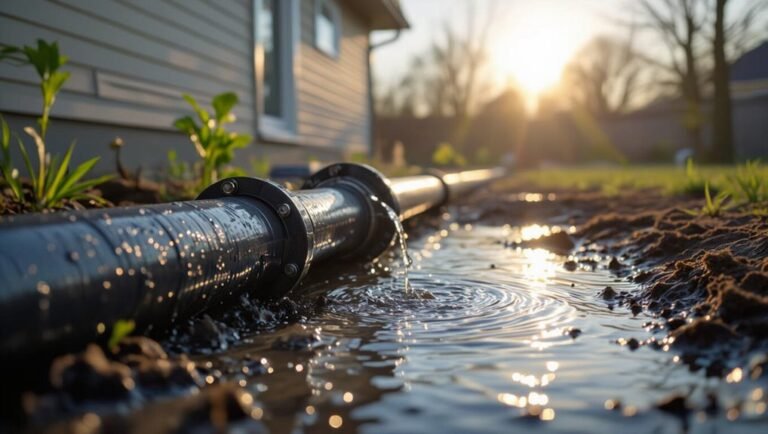
Frequently, visible signs provide the earliest clues that a cast iron pipe is failing: active leaks, discolored stains on walls or ceilings, and soft or sagging flooring where supporting soil has been washed away.
Observers should note water drip patterns, rust-colored streaks, and spreading dampness; these indicate corrosion breakthroughs or joint failures.
Soft spots signal soil erosion or concealed collapse beneath surfaces. Prompt inspection can limit structural damage and mold growth.
Typical homeowner responses include temporary containment, but professional assessment determines repair versus replacement based on extent and age.
- Active leaks
- Stains and efflorescence
- Soft or sagging flooring
Hidden Signs: Reduced Flow, Odors, and Backups
Reduced water pressure and slow drains can signal internal corrosion or sediment buildup in aging cast iron lines.
Persistent foul sewer odors in the home often indicate breaches or trapped waste within deteriorating pipe sections.
Together, these less visible signs often precede more serious problems like backups and collapse.
Reduced Water Pressure
A gradual drop in water pressure often signals internal deterioration of cast iron pipes rather than a problem with the municipal supply. Corrosion and mineral buildup narrow the bore, reducing flow to fixtures; persistent low pressure localized to one building usually indicates aging pipework.
Gradual decline, intermittent sputtering, and pressure differences between floors are measurable clues technicians use when evaluating pipe condition.
- Corrosion: internal rust accumulates, constricting diameter and flow.
- Mineral scale: hard-water deposits further reduce effective passage.
- Variable pressure: inconsistent readings suggest partial blockages or collapsing sections.
Foul Sewer Odors
When low water pressure points to internal narrowing, another common but less obvious symptom is the emergence of foul sewer odors within the building.
Persistent odors often indicate compromised cast iron joints, cracked pipes, or accumulated biofilm and scale that trap sewage gases. These smells may appear near drains, in basements, or intermittently throughout the structure, signaling compromised seals or slow-moving blockages allowing gases to escape.
Inspectors recommend smoke or dye testing and camera inspection to pinpoint leaks or defects. Addressing odors promptly prevents health risks, property damage, and more extensive pipe deterioration that shortens cast iron lifespan.
Immediate Steps If You Suspect Failing Cast Iron Pipes
Begin by shutting off water to affected fixtures and avoiding use of drains connected to the suspected cast iron lines to prevent further collapse or contamination.
Next, limit water use elsewhere and contain any visible leaks with buckets or towels to reduce property damage.
Contact a licensed plumber promptly to assess risk and advise on immediate containment or temporary repairs.
Document damage with photos for records and insurance.
- Prioritize safety: avoid electrical contact and ventilate areas with sewer smell.
- Preserve evidence: do not disturb failed sections before inspection.
- Notify insurer and obtain professional estimates.
How to Inspect Cast Iron Drains and Sewer Lines Yourself
Following immediate containment and documentation, a homeowner can perform a basic inspection of cast iron drains and sewer lines to gauge condition before a professional assessment.
Visual checks include exposed sections in basements, crawlspaces, and accessible cleanouts for rust flaking, pitting, or visible seams.
Note hairline cracks, active leaks, and misaligned joints; mark locations and take photos.
Run water through fixtures to detect slow drainage or gurgling that suggests blockages or corrosion-related narrowing.
Smell sewer gas at cleanouts or drains.
Avoid confined-space entry and do not dismantle buried sections.
Document findings and preserve evidence for the subsequent professional review.
When Should You Call a Plumber for a Professional Pipe Assessment?
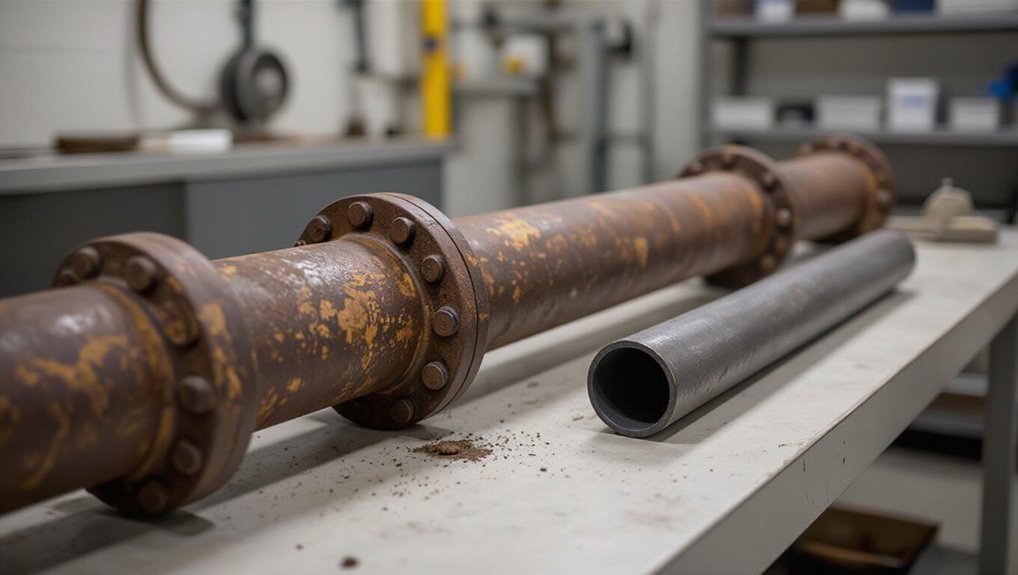
Visible rust, flaking metal, or holes on exposed cast iron pipes signal the need for a professional assessment.
Persistent slow drains, recurring backups, or repeated temporary fixes also warrant a plumber’s evaluation to determine underlying deterioration.
A pre-renovation inspection is recommended to identify hidden damage and avoid costly surprises during major work.
Visible Signs Of Corrosion
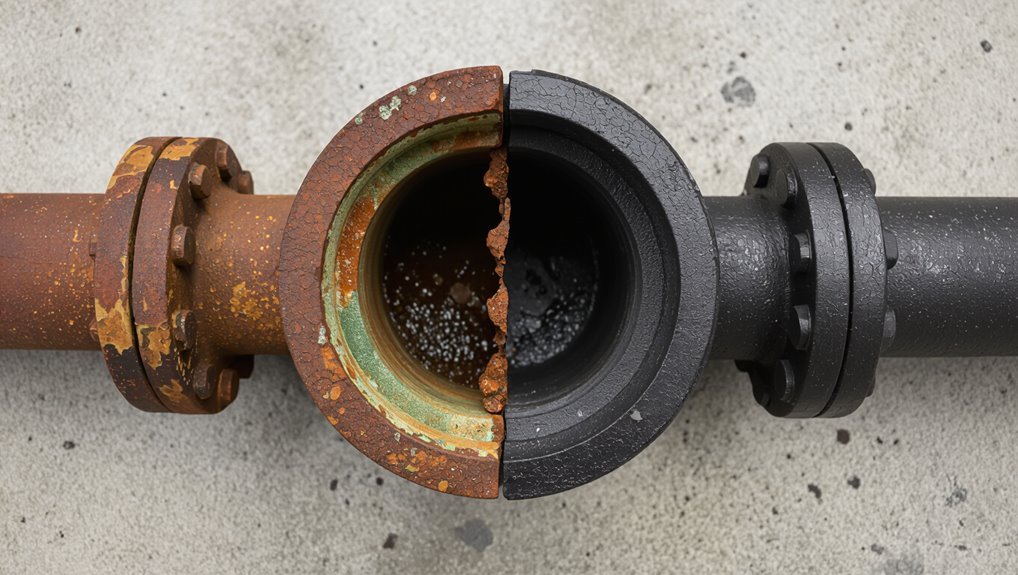
Corrosion on cast iron pipes often starts with small, discolored spots or a granular, rust-like surface that spreads along joints and seams; when these signs appear, they indicate metal loss that can compromise pipe strength and water quality.
Visible corrosion may include flaking or pitting, greenish stains from galvanic reactions, and mineral crusts around fittings. These symptoms warrant a professional assessment to evaluate structural integrity and contamination risk.
A plumber can determine whether spot repairs, lining, or full replacement is appropriate. Prompt action limits damage and avoids sudden failures.
- Flaking, pitting, or rust deposits
- Discoloration and surface crusts
- Corrosion concentrated at joints
Persistent Drainage Problems
Signs like pitting, flaking, or crusted deposits often precede more functional problems; when drains begin to slow, gurgle, or back up repeatedly, these symptoms can point to compromised cast iron that requires professional evaluation.
Persistent drainage issues — recurring clogs, simultaneous slow fixtures, foul sewer odors, or water pooling near soil stacks — warrant a plumber’s assessment to determine pipe integrity, root intrusion, or longitudinal corrosion.
A professional can perform camera inspections, evaluate joint failures, and recommend targeted repairs or section replacements. Early diagnosis prevents escalation, limits property damage, and informs cost-effective decisions about repair versus replacement.
Before Major Renovations
Before undertaking major renovations, homeowners should schedule a professional pipe assessment to verify that existing cast iron plumbing can accommodate new layouts and loads. A plumber evaluates pipe condition, capacity, venting, and hidden corrosion, advising repair, partial reline, or full replacement before demolition.
Early assessment prevents costly surprises, protects structural work, and assures code compliance.
- Inspect: camera scope to locate cracks, blockages, and remaining wall thickness.
- Capacity: confirm diameter and slope meet demands of added fixtures.
- Plan: recommend targeted repairs, sequencing with renovation trades, and obtain permits.
How Video Camera Inspections Determine Pipe Condition
Video camera inspections offer a direct, noninvasive method to assess a cast iron pipe’s internal condition by capturing high-resolution footage of joints, cracks, deposits, and corrosion patterns.
Trained operators feed a flexible camera through cleanouts or access points to document pipe diameter, wall loss, root intrusion, offsets, and active leaks.
Time-stamped video coupled with distance markers enables precise defect location and severity grading.
Recordings support objective decisions about monitoring frequency, prioritizing sections for intervention, and estimating remaining service life.
Reports often include stills, measurements, and recommended next steps without prescribing specific repair techniques.
Repair Options: Patching, Relining, and Section Replacement
After inspection, repair choices are weighed based on damage extent and remaining service life.
Small leaks can often be fixed with targeted patching, while larger or widespread deterioration prompts consideration of relining or full section replacement.
The relative costs, disruption, and expected longevity of relining versus replacement guide the final decision.
Patching Small Leaks
When small leaks appear in cast iron pipes, homeowners and plumbers often evaluate short-term patching as the quickest remedy before considering relining or section replacement; patching methods—epoxy putty, fiberglass wraps, or clamp-style saddle repairs—seal localized defects without extensive excavation, but their durability varies with pipe condition, exposure, and pressure.
Patching suits hairline cracks, pinhole corrosion, or temporary fixes pending scheduled replacement.
Proper surface prep and follow-up inspection determine effectiveness. Patches are typically less costly upfront but may require rework if corrosion spreads or joints fail.
- Cost: lower immediate expense, possible repeat repairs
- Scope: targets localized damage only
- Time: fast application, short service interruption
Relining Versus Replacement
In deciding between relining and full section replacement, owners and contractors weigh durability, cost, disruption, and long-term risk to choose the approach that best matches pipe condition and site constraints.
Relining preserves the existing cast iron host by inserting cured-in-place liners or epoxy coatings, reducing excavation, downtime, and immediate expense; it suits pipes with uniform corrosion, small cracks, or alignment stability.
Full section replacement removes and installs new pipe when structural failure, root intrusion, severe offsets, or recurring collapses exist; it demands excavation and higher short-term cost but restores original capacity and lifespan.
Decision hinges on inspection, cost-benefit, and projected service life.
When Is Relining Cast Iron a Good Long-Term Fix?
Under specific conditions, relining cast iron can provide a durable, cost-effective long-term solution: it is most appropriate for pipes with intact external structure but compromised internal surfaces due to corrosion or tuberculation, for sections with narrow-diameter runs that are otherwise inaccessible for replacement, and when building use or historical status makes invasive excavation impractical.
Relining restores hydraulics, seals pinhole leaks, and extends service life without disrupting occupancy.
Suitability depends on structural soundness, absence of severe bell-spigot separation, and contaminant concerns.
Benefits include lower cost and faster return to service, but requires professional inspection and compatible lining materials.
- Structural integrity check
- Contaminant assessment
- Lining material compatibility
When Is Full Replacement the Smarter Choice?
When pipe walls show widespread pitting, collapsed sections, or multiple long runs of severe corrosion, full replacement is often the only permanent remedy.
Decision-makers should weigh replacement costs against the diminishing returns of repeated repairs and the remaining useful life of the system.
A pattern of frequent backups or patch fixes signals that replacement will likely be more cost-effective and reliable over time.
Signs Of Irreversible Damage
How can a homeowner tell if cast iron pipes have passed the point of repair? Visible structural collapse, persistent internal corrosion despite spot repairs, and recurring blockages that resist snaking indicate irreversible failure.
When these signs align, replacement prevents repeated disruptions and hidden leaks.
- Multiple collapsed sections or pinhole perforations along runs, signaling loss of structural integrity.
- Advanced rust scale and thinning walls confirmed by camera inspection, showing material is beyond patching.
- Chronic backups with grease accumulation and root intrusion recurring within months after repair attempts.
Decisions should follow professional inspection documenting pervasive, progressive deterioration.
Cost Versus Repair Value
In weighing repair against full replacement, homeowners should compare upfront costs, long-term liabilities, and expected service life to determine which option offers better value.
Repair is typically cheaper short-term but may leave hidden corrosion, reduced flow, and limited remaining lifespan. Replacement demands higher immediate investment yet eliminates recurring patchwork, restores hydraulic capacity, and often includes warranty protection.
Decision factors include age, extent of deterioration, projected years of reliable service after each option, and resale impact. When repair costs approach or exceed half the price of replacement with limited future life, full replacement becomes the smarter financial choice.
Frequency Of Recurring Problems
Frequently, recurring leaks, blockages, or repair calls signal that patchwork has become a recurring expense rather than a sustainable solution.
The decision to replace rather than repeatedly repair depends on frequency, severity, and cumulative cost. If failures occur more than twice yearly, if blockages indicate pervasive corrosion or root intrusion, or if repairs escalate in complexity, full replacement becomes economically and operationally justified.
Replacement reduces downtime, restores flow capacity, and limits liability from sudden failures. Consider long-term value over short-term savings when system reliability and property protection are priorities.
- Frequency: multiple failures per year
- Severity: escalating damage
- Cost: cumulative repairs exceed replacement
Replacement Methods Compared: Trenching, Pipe Bursting, and Slip Lining
When evaluating options for replacing deteriorated cast iron pipe, three methods dominate: traditional open trenching, pipe bursting, and slip lining.
Trenching involves full excavation and removal, allowing complete replacement and alignment correction but causes significant surface disruption and longer restoration.
Pipe bursting fractures the old pipe while simultaneously pulling a new one into place, minimizing excavation and preserving surface features; it suits brittle, collapsible lines but requires adequate access and upstream/downstream clearance.
Slip lining inserts a slightly smaller pipe into the existing host, offering rapid installation with limited disturbance, though it reduces internal diameter and may need manhole adjustments for proper flow and connections.
Cost Ranges: Repairs vs. Full Cast Iron Replacement
Across projects and property types, cost differences between targeted repairs and full cast iron replacement can be substantial and hinge on pipe condition, access, method chosen, and local labor/material rates.
Targeted repairs—patching, section replacement, or relining—typically run lower upfront, often several hundred to a few thousand dollars, and suit localized failures.
Full replacement involves higher capital: trenching or trenchless full-line replacement commonly ranges from several thousand to tens of thousands, depending on length and obstacles.
Decision factors include remaining pipe life, warranty, disruption, and long‑term maintenance expectations.
- Short‑term savings vs. long‑term value
- Access complexity raises costs
- Material and labor variability
How to Prioritize Repairs by Urgency and Budget
Prioritize cast iron pipe work by evaluating immediate health and structural risks, then balancing those findings against budget constraints and expected remaining service life. Inspect for leaks, sewer odors, sewage backup, and structural collapse risk; these demand urgent action.
Moderate corrosion or isolated cracks may allow staged repairs, focusing on high-risk sections first. Estimate remaining service life using age, past repairs, and inspection data to guide whether patching or phased replacement is cost-effective.
Allocate emergency funds for immediate hazards, then plan capital expenditures over years for noncritical work. Document findings and timelines to inform homeowner or facility budgeting decisions.
Replacement Materials for Cast Iron: PVC, HDPE, and Copper (Pros & Cons)
For building owners and plumbers evaluating cast iron pipe replacement, common alternatives include PVC, HDPE, and copper, each with distinct performance, installation, and cost profiles.
PVC offers low material cost, easy joining, corrosion resistance, and suitability for most drain and vent runs, but has lower heat tolerance and potential chemical limits.
HDPE provides flexibility, fusion-welded seamless joints, high durability, and excellent resistance to ground movement, though requires specialty fusion equipment and skilled installers.
Copper delivers longevity, high-temperature tolerance, and antimicrobial properties, with higher material and labor costs and vulnerability to acidic soils.
- PVC: affordable, easy, limited heat tolerance.
- HDPE: flexible, seamless, needs fusion tools.
- Copper: durable, costly, soil-sensitive.
How to Choose the Right Replacement Material for Your Home
How should a homeowner select between PVC, HDPE, and copper when replacing cast iron? The decision rests on budget, pipe use, longevity expectations, and site conditions.
PVC offers low cost and ease for indoor drain lines; HDPE suits underground runs needing flexibility and corrosion resistance; copper delivers durability and heat tolerance for supply lines but costs more.
Assess water chemistry, expected lifespan, noise, and compatibility with existing fittings.
Consider installation complexity and future maintenance.
Consulting a qualified plumber for an inspection and cost estimate assures the chosen material matches performance needs and resale considerations.
Permits, Code, and Local Rules for Replacing Cast Iron Pipes
When replacing cast iron pipes, homeowners must navigate permits, building codes, and local regulations that govern materials, methods, and inspections; these requirements vary by municipality and can affect project scope, timelines, and costs.
Professionals advise early contact with the local building department to confirm permit types, inspection stages, and necessary documentation. Failure to comply can lead to fines, rework, or insurance denial. Permits guarantee safety, proper materials, and drainage standards are met.
- Confirm permit and inspection schedule with local authorities.
- Verify accepted replacement materials and connection methods.
- Retain documentation for warranty and insurance purposes.
How to Plan a Replacement Project: Timeline and Contractor Selection
After confirming permits, inspections, and approved materials with the local building department, homeowners should create a clear replacement plan outlining schedule, budget, and contractor responsibilities.
The plan phases: site preparation, demolition, pipe removal, installation, pressure testing, backfill, and final inspection, each with estimated durations and contingency days.
Include access requirements, temporary water shutoffs, and occupant notifications.
For contractor selection, verify licenses, insurance, specialty in cast iron work, references, and documented timelines.
Require written scopes, milestone payments tied to inspections, and warranty terms.
Maintain a project log and designate a single point of contact to streamline communication and decisions.
Questions to Ask Contractors and How to Compare Quotes
Which specific questions will reveal a contractor’s competence and reliability? A homeowner should request proof of licensing, detailed scope breakdowns, timelines, warranty terms, references from similar cast iron projects, and proof of insurance. Clarify change-order policies and cleanup responsibilities.
- Ask for itemized bids comparing labor, materials, permit fees, disposal, and contingency allowances.
- Request references, project photos, and a single-point contact; verify timelines and subcontractor use.
- Compare warranties, payment schedules, and included inspections; prefer fixed-price bids with clear exclusions.
Use consistent questions across bidders to make quotes directly comparable and reduce hidden costs.
Preventive Maintenance to Prolong Cast Iron Pipe Life
Selecting a trustworthy contractor is only part of responsible cast iron pipe ownership; regular preventive maintenance preserves their function and delays costly replacements.
Scheduled inspections detect corrosion, root intrusion, joint failures, and slow leaks before escalation.
Routine cleaning—mechanical rodding or hydro-jetting by professionals—prevents buildup and maintains flow capacity.
Applying targeted corrosion inhibitors and ensuring proper drainage and ventilation reduce internal and external deterioration.
Promptly repairing small defects, replacing worn seals, and protecting exposed sections with coatings or wraps extend service life.
Maintaining accurate service records and following manufacturer or contractor maintenance recommendations optimize timing and effectiveness of interventions.
How to Document Pipe Condition and Create a Replacement Roadmap
When documenting cast iron pipe condition and building a replacement roadmap, the owner should establish a standardized inspection protocol that records pipe age, material, diameter, wall loss, joint integrity, root intrusion, blockages, and previous repairs; consistency in data collection—using photos, CCTV footage, obstruction measurements, and corrosion scoring—enables objective comparison over time.
The protocol should schedule inspections by risk tier, store findings in a searchable database, and assign deterioration thresholds triggering actions.
Prioritize sections by safety, cost, and disruption, and model phased replacement with contingency budgets and timelines to minimize emergency failures and optimize capital planning.
- Risk-based inspection scheduling
- Centralized condition database
- Phased replacement plan
Conclusion
In a world where cast iron pipes stage slow, drippy rebellions, the homeowner watches like a resigned audience member. Pipes, wearing rust like awkward tuxedos, tally decades with stubborn pride until geography, usage and time cue their finale. The satirical scene closes with a clipboard-wielding contractor offering a replacement roadmap as if it were a playbill—practical, inevitable, and oddly comforting—reminding all that prevention and planning keep the show running longer.