
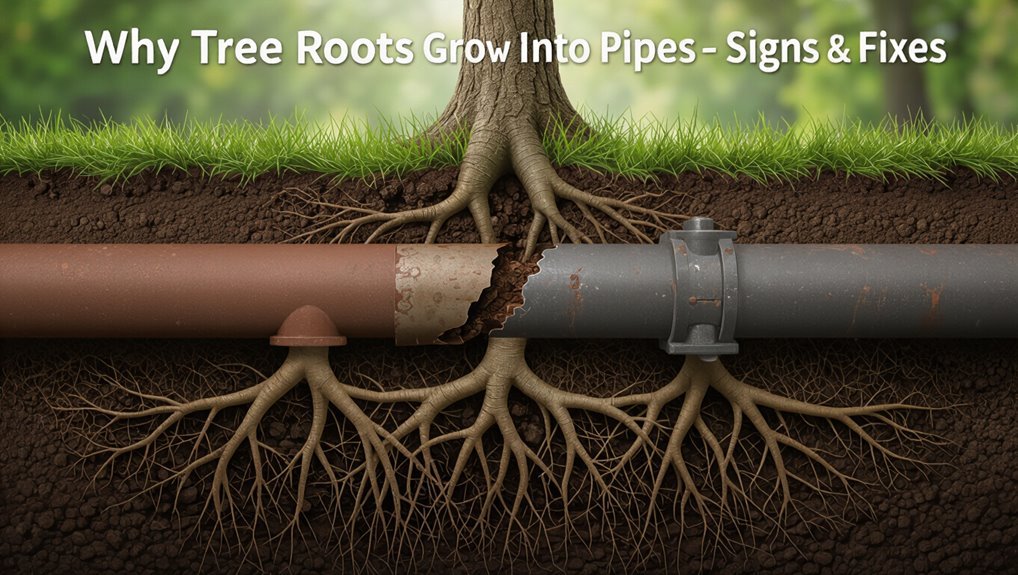
Why Tree Roots Grow Into Pipes €” Causes, Signs & Fixes
Tree roots grow into pipes primarily in search of moisture, oxygen, and nutrients, often targeting small cracks, loose joints, or leaks in aging or poorly installed plumbing. Certain tree species, such as willows, poplars, silver maples, and elms, are particularly aggressive in this behavior.
Key Takeaways:
- Causes: Roots are attracted to moisture and nutrients found in damaged pipes.
- Signs: Look for slow drains, gurgling sounds, foul odors, wet patches, or unusually lush grass above the pipes.
- Inspection: Use cameras to diagnose the issue.
- Fixes: Solutions may include cutting roots, hydro-jetting, chemical treatments, liners, or complete pipe replacement.
- Prevention: Consider using barriers and selecting appropriate plants to avoid future issues.
For more detailed information on diagnosis, costs, and long-term solutions, further exploration is recommended.
Why Roots Target Sewer and Water Pipes
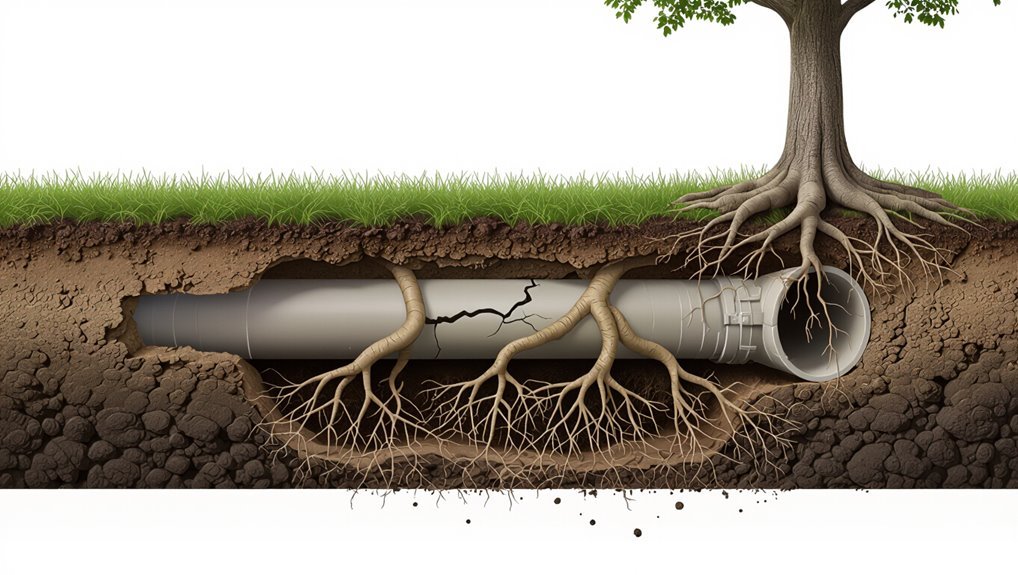
Roots seek out sewer and water pipes because those conduits provide exactly what roots need: moisture, oxygen, and dissolved nutrients concentrated in narrow channels.
Tree roots sense gradients and grow toward consistent water sources, especially in dry soils. Pipes offer predictable moisture and occasional nutrient-rich leaks or condensation.
Roots exploit small joints, cracks, and service connections where barriers are weakest. Species with aggressive, exploratory root systems are likelier to invade enclosed spaces.
Urban soil compaction and limited rooting volume push roots to locate linear, high-resource targets.
Understanding these behaviors informs prevention: proper pipe materials, joint integrity, and landscape planning reduce attraction.
What Makes Pipe Leaks a Magnet for Roots
Following the attraction of pipes for moisture and nutrients, leaking joints and hairline cracks concentrate those resources and create localized microenvironments that are particularly attractive to tree roots.
Roots sense moisture gradients and chemical cues, then grow toward persistent leaks where water and organic matter escape. Small fractures become entry points; steady seepage sustains growth and masks disturbances.
Over time, root mass enlarges the breach and accelerates collapse if unchecked.
- Persistent moisture creates a reliable water source for roots
- Escaping nutrients from sewage or irrigated water feed root growth
- Tiny openings offer easy physical access and protection
Soil and Pipe Conditions That Invite Root Intrusion
Attention to soil moisture, weakened pipe materials, and the chemical cues that roots follow clarifies why certain underground lines become targets for intrusion.
Saturated or consistently damp soils create persistent moisture gradients that roots exploit, while fractured or aging pipes emit scents and provide entry points.
Understanding these interacting conditions frames effective prevention and repair strategies.
Soil Moisture Levels
Soil moisture is a primary environmental cue that influences tree root behavior near buried pipes: consistently damp soil around a leaking or condensating pipe creates a moisture gradient that attracts roots seeking water, while overly dry surrounding soil can likewise concentrate root growth toward the pipe as an isolated moisture source.
Roots respond to gradients, extending toward steady moisture and exploiting localized wet pockets; periodic saturation and drying cycles encourage exploratory growth.
Management focuses on altering soil moisture patterns and isolating leaks.
Typical moisture-related scenarios include:
- Persistent wet trench from slow leaks promoting dense root mats
- Intermittent wetting causing roots to probe repeatedly
- Dry soil funneling roots to the sole moist zone
Pipe Material Weakness
Moisture patterns not only attract roots but also interact with pipe condition to determine how easily roots gain entry.
Older clay, concrete, cast iron and poorly joined PVC develop cracks, displaced joints, and hairline gaps under soil pressure and shifting loads. Corrosion, abrasion from grit, and freeze–thaw cycles weaken material integrity, reducing resistance to root penetration.
Flexible root tips exploit microfractures; fibrous growth widens openings over time. Surrounding soil compaction and chemical composition accelerate degradation.
Regular inspection, prompt joint repair, and choosing durable, properly bedded materials mitigate risk by maintaining continuous, impermeable pipe surfaces that discourage intrusion.
Root Attraction Cues
When underground pipes leak or emit condensation, roots detect the resulting gradients in moisture, oxygen, nutrients and temperature and grow directionally toward those signals.
Soil porosity, organic matter and hydraulic conductivity create channels that guide roots; damaged joints, crushed zones or sediment buildup concentrate resources and weaken barriers.
Roots exploit tiny openings, following persistent cues until intrusion occurs. Management focuses on eliminating attractants and repairing defects.
Key examples:
- Wet pockets from slow leaks create high-moisture microenvironments that sustain root tips.
- Aerated zones around perforations offer oxygen-rich respite encouraging growth.
- Nutrient-rich effluent fosters localized proliferation and thicker root masses.
Trees Most Likely to Cause Root Intrusion
Many common landscape trees develop aggressive, shallow root systems that seek water and exploitable gaps in pipes and joints.
Species frequently implicated include willows, poplars, cottonwoods, silver maples, and elms; their rapid growth and high water demand drive roots toward infrastructure.
Fruit trees and some ornamentals, such as honeylocust and ash, can also invade when planted near sewer lines.
Mature trees with wide, dense root mats pose greater risk than isolated saplings.
Soil type, irrigation practices, and proximity to buried utilities influence likelihood, but species selection remains a primary predictor of root intrusion potential in urban landscapes.
How Small Leaks Become Root-Entry Points
Roots sensing tiny soil moisture differences will exploit even the smallest compromise in underground pipes. Water slowly escaping joints or hairline cracks creates a persistent moisture gradient that attracts roots. Over time, roots press into softened seals, enlarging openings and establishing pathways into interior flows.
- A steady damp pocket near a joint draws exploratory root tips seeking water.
- Micro-leaks erode bedding material, reducing structural support and widening gaps.
- Organic matter carried by leaks fuels root growth, encouraging deeper penetration.
Such incremental invasion turns minor leaks into active entry points, escalating blockages and damage if unaddressed.
How Pipe Age and Material Affect Root Intrusion
Older clay and cast-iron pipes often develop cracks and joint separations over decades, creating attractive entry points for roots.
In contrast, modern PVC and ABS systems use continuous welded or sealed joints that reduce vulnerability to intrusion.
Material choice and installation age consequently critically influence the likelihood and severity of root-related damage.
Older Clay And Cast-Iron
Aging clay and cast-iron sewer lines present structural vulnerabilities that greatly increase susceptibility to intrusive growth. Decades of soil movement, corrosion, and joint deterioration create gaps and fractures that roots easily exploit.
Over time, mortar and bell-and-spigot seals fail, cast-iron corrodes, and brittle clay cracks, producing entry points. Vegetation senses moisture and navigates toward nutrient-rich flow, enlarging openings as roots thicken.
Repairs are more frequent and costly than for newer materials; inspection often reveals offset joints and internal collapse.
- Cracked clay pipes with separated joints invite small-root penetration.
- Corroded cast-iron develops pitting and holes.
- Tree roots widen weaknesses into major blockages.
Modern PVC And ABS
Modern PVC and ABS sewer lines, manufactured as continuous, smooth-walled pipes with solvent-welded or gasketed joints, offer far greater resistance to root intrusion than older clay or cast-iron systems.
Their nonporous surfaces and uniform fittings reduce entry points; properly installed joints remain tight for decades. However, age, ground movement, improper bedding, or poor connections can create offsets or fractures that attract roots seeking moisture.
Chemical degradation, UV exposure before burial, or mechanical damage during construction lower resilience.
Regular inspection, correct installation, and avoiding aggressive tree planting near laterals minimize risk, while repairs use patching, relining, or targeted replacement.
How Bad Joint Installation Encourages Roots
Poorly aligned or inadequately sealed pipe joints create gaps and offsets that invite root intrusion by allowing moisture and soil to seep into the pipe bedding. Roots detect these moisture-rich zones and exploit the openings, widening joints over time and accelerating structural failure.
Poor installation exposes seams and creates microchannels where roots can penetrate; minor deflections concentrate stress and promote joint separation. Observable consequences include blockages and localized collapses.
Typical scenarios:
- Shallow trenches with poorly compacted bedding that allow soil movement and joint misalignment.
- Misfitted or poorly glued couplings leaving hairline gaps.
- Excessive pipe bending at joints causing long-term stress and gaps.
How Seasonal Groundwater Changes Pull Roots to Pipes
While misaligned and leaky joints create localized moisture that roots exploit, broader seasonal shifts in groundwater levels act as a regional magnet pulling root systems toward buried pipes.
During wet seasons the water table rises, saturating soil layers and expanding the active rooting zone; roots proliferate upward and laterally to exploit newly available moisture.
In dry seasons the table falls, concentrating remaining moisture around deep, consistently damp conduits such as sewer or water lines.
Repeated seasonal cycling trains root architecture to track those reliable moisture corridors, increasing contact frequency and the chance that roots will enter weaknesses in pipe systems.
Early Signs of Root Intrusion You Can Spot at Home
When small changes in household plumbing performance occur, they can be the earliest indicators that tree roots are encroaching on buried pipes. Observant homeowners may note subtle, repeatable patterns before major damage appears.
Visible and audible cues often coincide with root activity near joints or fractures.
- Intermittent gurgling or bubbling in toilets and sinks after other fixtures are used.
- Slight, recurring odors near cleanouts, drains, or yard areas above sewer lines.
- Damp patches, sinkholes, or unusually lush grass directly over sewer runs, without obvious irrigation causes.
Promptly documenting these signs aids timely inspection and less invasive repair.
Slow Drains vs Other Clogs: Telltale Differences
Although both manifest as sluggish water flow, slow drains caused by distant sewer root infiltration differ in pattern and accompanying signs from common household clogs; the former typically produces gradual, system-wide backups, intermittent gurgling or odors, and damp or lush patches above buried lines, whereas ordinary clogs are localized, sudden, and often resolved by plunging or snaking a single fixture. Observers should note frequency, spread, and recurrence after clearing. Root issues recur and affect multiple fixtures; hair/grease clogs usually affect one. Consider professional inspection when slow, recurring, multi-fixture symptoms appear.
| Feature | Root Intrusion | Ordinary Clog |
|---|---|---|
| Scope | Multiple fixtures | Single fixture |
| Recurrence | High | Low |
Smells, Gurgles, and Other Signs You Shouldn’t Ignore
Foul odors near drains, bubbly or gurgling toilets, and unusually slow floor drainage are often early indicators of compromised sewer lines.
These signs may point to tree roots infiltrating pipes or causing partial blockages that trap gases and disrupt airflow.
Prompt inspection can distinguish root intrusion from other causes and prevent escalating damage.
Foul Odor Near Drains
A persistent sewage smell near a sink or floor drain often signals a problem in the plumbing system rather than a random nuisance. Rotten-egg or musty odors, accompanied by gurgling sounds or slow drains, point to trapped water seals, venting issues, or sewer line intrusion by roots or damage.
Inspection should focus on trap integrity, vent performance, and the main sewer run for root breaches. Remedies range from clearing dried traps to professional camera diagnosis and root removal. Left unchecked, odors indicate worsening leaks and contamination risk.
- Dry or broken P-traps emitting sewer gas
- Cracked or misaligned venting causing pressure imbalances
- Root-compromised sewer lines allowing gas and effluent escape
Bubbly Or Gurgling Toilets
Why does a toilet bubble or gurgle when another fixture is flushed? Air trapped by partial sewer line blockages, often from intrusive tree roots, forces bubbles back through toilet traps as water moves.
Gurgling signals compromised flow: roots narrowing pipes create pressure differentials and intermittent vacuum pockets that release through fixtures. Occasional noise may be harmless, but persistent or worsening gurgles accompany slow drains, odors, or sewage backups and indicate progressive root incursion.
Prompt camera inspection and targeted root removal or pipe repair prevent escalation. Ignoring gurgling risks costly collapses and sanitation hazards; homeowners should consult a plumber at the first recurring sound.
Slow Floor Drainage
When floor drains slow or back up, homeowners may first notice lingering odors, gurgling sounds, or standing water near basement and laundry-room drains.
Such symptoms often indicate partial blockage from intruding tree roots, sediment buildup, or damaged pipe joints. Early recognition limits damage and mold risk; a prompt camera inspection reveals root encroachment, cracks, or offsets.
Repairs range from targeted root cutting and spot pipe replacement to full line renewal. Regular maintenance prevents recurrence.
- Musty smells that return after cleaning
- Intermittent gurgles when other fixtures run
- Shallow pooling that drains slowly
DIY Drain Inspection: Tools and Step-by-Step Checks
Several simple tools and systematic checks allow a homeowner to assess drains for root intrusion before problems escalate. A flashlight, drain snake, basic wrench set, and a bucket suffice. Begin at cleanouts: open covers, inspect flow and smell, and note debris. Run water tests upstream and downstream, observing backups or slow drainage. Use a mirror or inspection camera if available to spot cracks, joints, or root material. Record locations and symptoms for monitoring. If resistance or plant tissue appears, avoid forcible removal that could worsen damage; document findings and plan next steps or professional consultation.
| Tool | Purpose | Check |
|---|---|---|
| Flashlight | Visual inspection | Look for cracks |
| Snake | Clear blockages | Test resistance |
| Camera | Internal view | Spot roots |
| Wrench | Access covers | Open cleanouts |
When to Call a Plumber : and What to Tell Them
Signs of persistent backups, gurgling sounds, slow drains despite snaking, or collapsed lines indicate it is time to call a plumber.
Callers should describe symptoms, their timing and frequency, any visible damage or sinkholes, recent DIY attempts, and the location and age of nearby trees and pipes.
Clear, specific information helps the plumber prioritize diagnostic steps and recommend camera inspection or excavation if roots are suspected.
When To Call
How can a homeowner know it’s time to call a plumber for tree-root-related pipe damage? Signs escalate from slow drains to backups and unusual lawn wetness.
Prompt professional assessment prevents major repair bills and health hazards. Contact a licensed plumber when visible symptoms persist or worsen despite basic measures.
- Persistent blockages in multiple fixtures
- Sewage odors, slow drains, or recurring backups
- Soft, soggy patches or lush grass above sewer lines
Provide location and symptom timeline; request inspection and camera scope. Early intervention limits excavation and preserves landscaping.
What To Describe
Homeowners should give the plumber clear, concise details about the problem’s location, onset, and progression to speed diagnosis and determine response options.
Report symptoms (slow drains, backups, gurgling, wet spots, sinkholes), affected fixtures, and whether multiple drains are involved.
Note timing patterns, recent landscaping, tree species and locations, and any previous repairs or camera inspections.
Provide access information, property maps, and utility marker locations.
Mention temporary fixes attempted, odors, water discoloration, and septic system status.
Prioritize safety concerns like erosion or exposed roots.
Clear facts help the plumber choose inspection tools, estimate cost, and recommend immediate steps.
What a Camera Inspection Reveals About Roots
A camera inspection commonly exposes the precise location and extent of root intrusion within a sewer line, showing whether roots have merely grazed joints or have grown thick enough to split pipe walls and obstruct flow.
The recorded footage documents root density, points of entry at compromised joints or lateral connections, and the resulting internal damage such as cracks, offsets, or collapsed sections. Technicians use time-stamped video to map affected segments and plan targeted repairs.
Typical camera findings include:
- Fine hair-like roots exploiting small gaps versus massive woody tangles filling the pipe
- Joint separations and cracks traced to root pressure
- Sediment buildup and recurring obstruction patterns
How Plumbers Diagnose Root Intrusion in Public Lines
Having established what a camera inspection reveals about roots inside private laterals, attention shifts to methods used when the line in question is a public main.
Plumbers coordinate with utilities and obtain permits before accessing mains. They use large-diameter CCTV rigs, sonar or acoustic leak detection, and flow/pressure monitoring to locate obstructions and breaches.
Dye testing and smoke testing can confirm surface connections and infiltration points. Mapping and GIS records identify nearby trees and root risk.
Results inform whether the issue lies under public responsibility and guide selection among replacement, targeted excavation, or coordination with municipal crews for long-term remediation.
Temporary Mechanical Root Removal: Methods and Limits
Mechanical cutting tools such as reciprocal cutters, rotary blades, and backhoes are commonly used to sever intrusive roots and restore flow in public lines.
These interventions provide immediate relief but are inherently temporary, as roots often regrow and can re-enter weakened joints or cracks.
Understanding the equipment’s capabilities and the limits of mechanical removal is essential for deciding when follow-up measures or pipe replacement are warranted.
Mechanical Cutting Tools
Workers employ powered cutting tools—rotary cutters, saws, and reciprocating blades—to sever intruding roots when temporary removal is required. Operators select tooling based on pipe diameter, root thickness, and access.
Cutting quickly clears blockages, restores flow, and allows inspection, but does not address source growth. Safety protocols, proper blades, and vacuum extraction minimize debris and pipe damage. Service technicians document cut locations for future monitoring.
Typical scenarios include emergency unclogs, preparatory work before lining, and trial removals to assess root vigor.
- Rotary cutters remove dense mats and hard woody roots.
- Reciprocating blades access tight bends.
- Saws handle large, thick roots.
Limits Of Temporary Removal
While powered cutting tools can quickly remove obstructing roots and restore flow, their effects are inherently short-term and constrained by biological and structural factors.
Mechanical removal severs roots but leaves crowns and feeder roots intact; regrowth from remaining tissues is rapid. Cut roots can stimulate vigorous sprouting as trees compensate, and repeated cuts stress pipes and joints, increasing collapse risk.
Access limitations, pipe bends, and material defects limit tool reach and effectiveness. Temporary fixes buy time for diagnosis and planning but do not address the root cause.
Long-term resolution requires barrier installation, pipe repair or replacement, and vegetation management.
Chemical Root Killers: How They Work and Safety Notes
Many chemical root killers use foaming or non-foaming herbicidal formulations—commonly copper sulfate or dichlobenil—to kill roots that invade sewer and drain lines by disrupting cellular processes and dehydrating plant tissue.
These products are applied into lines where they contact roots; effectiveness depends on exposure, root size, and repeat treatments.
Safety and environmental concerns guide use: runoff, groundwater, and non-target vegetation can be harmed.
Professionals recommend targeted application, following label directions, and considering long-term solutions rather than sole reliance on chemicals.
- Can reduce regrowth temporarily when roots are small
- Require cautious dosing and protective equipment
- May necessitate follow-up inspections
Hydro-Jetting Roots: Benefits, Risks, and When to Use It
When chemical treatments fail to stop persistent root intrusion or when immediate clearing is needed, hydro-jetting is often employed as a mechanical alternative that uses high-pressure water to scour roots and debris from inside pipes.
It rapidly restores flow, removes accumulated sediment and small roots, and can reach long runs and bends.
Risks include further damage to fragile, heavily cracked, or old clay and cast-iron pipes; incomplete removal of deeply embedded root crowns; and potential downstream blockages.
Appropriate use follows a camera inspection, operator skill, and pipe condition assessment.
Hydro-jetting suits sound pipes needing non-chemical, fast remediation.
When Pipe Lining (CIPP) Is the Best Fix
When roots have caused structural damage to a sewer line, cured-in-place pipe (CIPP) lining often provides a durable restoration without full replacement.
It is especially suited to long, continuous runs where accessing the entire length would be disruptive or costly.
Because CIPP requires minimal digging, it is frequently the preferred option in tight yards or under driveways and landscaping.
When Structural Damage Exists
Identify severe cracks, displaced joints, or collapsed sections as signs that structural damage to buried pipes has occurred and that trenchless pipe lining (CIPP) often provides the most effective, least disruptive repair.
When roots exploit major breaches, short-term spot fixes fail; CIPP restores structural integrity by creating a continuous, corrosion-resistant liner bonded to the host pipe.
Inspection precedes decision-making: CCTV locates damage, assesses length, and verifies flow capacity after lining.
Typical scenarios suited to CIPP include:
- Localized collapse where excavation would be extensive and disruptive
- Multiple displaced joints along a short run
- Severe cracking that compromises load-bearing capacity
For Long Continuous Runs
Beyond cases of localized structural failure, long continuous runs present a different set of considerations where cured-in-place pipe (CIPP) is frequently the preferred solution.
For lengthy sewer or drain stretches infiltrated by roots, CIPP restores integrity without replacing entire sections, creating a seamless, jointless liner that resists future intrusion.
It addresses continuous fractures, offsets, and pervasive root invasion while maintaining flow capacity and alignment.
Installation minimizes disruption along extended routes and often costs less than full excavation.
Proper inspection, cleaning, and liner selection guarantee long-term performance; periodic monitoring confirms early detection of any subsequent root regrowth or liner wear.
Minimal Digging Required
In many repair scenarios where access is limited or surface disruption must be minimized, cured-in-place pipe (CIPP) lining provides an effective, low-excavation alternative to full pipe replacement.
It seals cracks and roots without trenching, preserving landscaping, driveways, and sidewalks. Inspectors can assess damage with a camera, then insert a resin-saturated liner that hardens to form a seamless pipe within the old one.
Ideal when root intrusion is localized or repeated excavations are impractical, CIPP restores flow and prevents future root entry while reducing cost and downtime.
- Front-yard landscaping remains intact
- Driveway or pavement need not be broken
- Fast return to service and reduced surface repairs
Spot Repair vs Full Pipe Replacement: Decide Fast
When a sewer line shows damage from invasive tree roots, homeowners must quickly weigh spot repair versus full pipe replacement based on the extent of intrusion, overall pipe condition, and budgetary constraints. Spot repair targets discrete root breaches and saves cost when surrounding pipe is sound. Full replacement removes recurrent risk when decay, multiple leaks, or brittle materials exist. Decisions hinge on inspection data, projected longevity, and landscape impact. Fast choices minimize property damage and service interruption. The following table contrasts key considerations:
| Factor | Spot Repair | Full Replacement |
|---|---|---|
| Cost | Lower | Higher |
| Downtime | Short | Longer |
| Longevity | Moderate | Long-lasting |
| Landscape Impact | Minimal | Significant |
Trenchless Repair vs Open-Cut: Pros and Cons
Having decided between spot repair and full replacement, homeowners next compare trenchless methods with traditional open-cut work to weigh surface disruption, cost, and suitability.
Trenchless minimizes landscaping damage, speeds completion, and fits many root-intrusion cases, but it may not suit severely collapsed lines.
Open-cut offers direct access for complex excavations and complete pipe replacement where alignment or multiple joints fail, yet it disrupts yards and drives.
- Trenchless: limited digging, faster restore, less visible impact
- Open-cut: full access, thorough reconstruction, useful for complex failures
Decision depends on pipe condition, access, and landscape priorities.
Estimating Costs for Root-Related Pipe Repairs
The discussion now turns to estimating costs for root-related pipe repairs, focusing on the main repair cost factors such as pipe material, extent of damage, access difficulty, and whether trenchless methods are feasible.
It will also present typical price ranges homeowners can expect for common scenarios, from minor root cutting to full pipe replacement.
Clear comparisons of variables and costs will help readers weigh options and plan budgets.
Repair Cost Factors
Several key factors determine the cost of repairing pipes affected by tree roots. Location, severity, access, and pipe material influence choice of method and labor. Permits or landscape restoration add expenses. An accurate estimate considers diagnostics, chosen repair, and mitigation to prevent recurrence.
- Severity and length of root intrusion dictate whether spot repair, pipe lining, or full replacement is needed.
- Accessibility affects excavation requirements: easy access lowers labor and restoration costs; difficult sites increase them.
- Pipe material and age determine repair compatibility and likelihood of future failure, affecting long-term cost planning.
Typical Price Ranges
Many homeowners can expect a wide cost range when addressing pipe damage from tree roots, typically influenced by repair type, pipe material, and site conditions.
Minor root removal and localized patching often cost between $150 and $800.
Hydro-jetting or mechanical cleaning with root cutters commonly runs $200–$600 per service.
Pipe relining (trenchless) generally falls between $1,000 and $5,000 depending on length and access.
Traditional excavation and replacement usually ranges from $2,000 to $10,000 or more for extensive landscaping restoration.
Additional factors such as permit fees, emergency service, and tree removal can increase final expenses.
Preventing Roots From Coming Back After Repair
After repairing a damaged pipe, homeowners must apply targeted measures to prevent root regrowth into the line, combining physical barriers, chemical treatments, and landscape adjustments to protect the repair and reduce future intrusion.
A routine inspection schedule and localized root-killing treatments extend protection without broad environmental impact. Trenchless liners and root-exclusion sleeves create long-term physical defenses when installed correctly.
Proper soil grading near the repair discourages diversion towards the pipe, while replacing compromised joints removes immediate re-entry points.
- Install root barriers or sleeves around the repaired section.
- Apply root-specific herbicides as directed and monitor effects.
- Maintain inspections and promptly clear small intrusions.
Choosing Trees and Plants That Won’t Threaten Pipes
Which plants pose the least risk to underground pipes depends on root behavior, growth rate, and mature size. Select species with non-invasive, fibrous root systems and slow to moderate growth.
Small ornamental shrubs, native perennials, grasses, and groundcovers typically exert less pressure than large trees. Favor containerized hedges or specimens with compact root balls when space is limited.
Avoid fast-growing, water-seeking species known for aggressive roots. Use root barriers and raised beds as additional safeguards.
Regular inspection and pruning of roots near infrastructure further reduce risk. Consult local nursery guides for species proven safe in the region and soil type.
How Far to Plant Trees From Sewer and Water Lines
Determining how far to plant trees from sewer and water lines requires attention to the minimum safe planting distance, which varies by species and pipe type.
Consideration of the root growth zone helps predict lateral and deep spread over time.
Accurate soil and utility mapping informs placement to avoid future conflicts and costly repairs.
Minimum Safe Planting Distance
A practical rule of thumb places small ornamental trees at least 10 feet from sewer and water lines, medium trees 15–20 feet, and large species 25–30 feet or more, though exact distances depend on species root vigor, soil type, and pipe depth.
Distance recommendations balance root growth with infrastructure risk. Consider species selection, planting location, and future canopy spread.
Practical scenarios include:
- A small dogwood near shallow service lines in sandy soil may be safe at 10–12 feet.
- A fast-growing poplar requires 30+ feet from mains and lateral lines.
- Confined urban soils reduce safe distance; use barriers or containers when space is limited.
Root Growth Zone
After outlining minimum safe planting distances, attention turns to the root growth zone—the horizontal and vertical extent roots are likely to explore—and how that footprint relates to sewer and water lines.
Roots typically extend laterally one to two times canopy radius, sometimes farther in search of moisture and nutrients; depth reflects species, soil compaction, and water table, often concentrated in the upper 18–24 inches.
Proximity calculations should consequently consider mature canopy spread and shallow root tendencies.
Planners should favor species with non-invasive root habits and use adequate setbacks; periodic inspection of vulnerable lines reduces surprise infiltration and damage risk.
Soil And Utility Mapping
Soil and utility mapping combines subsurface soil profiles, existing utility location data, and root growth expectations to establish safe planting distances from sewer and water lines.
Practitioners analyze soil texture, drainage, and compaction to predict lateral root spread. Utility maps and locates prevent accidental conflicts; combined with species root traits they inform setback recommendations. Risk assessment yields planting zones and mitigation strategies.
- Typical setbacks: small trees 3–6 m, medium 6–9 m, large 9–12 m depending on soil and pipe depth
- Use of root barriers and preferred species reduces intrusion risk
- Regular reinspection updates maps as trees mature
How Root Barriers Work and Where to Install Them
When installed between vegetation and underground utilities, root barriers redirect or block root growth using dense physical materials or chemical treatments that preserve soil moisture and tree health on the protected side while denying roots access to pipes and structures.
Proper barriers are placed vertically alongside mains, service lines, and around vulnerable fixtures, extending deeper than typical root zones and overlapping at joints.
Materials include polyethylene panels, geotextiles, and root-repellent membranes; some systems combine a physical wall with localized herbicidal coatings.
Installation considers tree species, distance from trunks, soil type, and future root growth, ensuring barriers do not provoke excessive redirection toward other assets.
Routine Maintenance That Stops Root Intrusion Early
Regular inspections and targeted maintenance can detect and stop root intrusion before it damages pipes or structures.
Routine checks focus on early warning signs: slow drains, damp soil, fresh cracks.
Professionals combine visual inspection with periodic camera surveys and simple preventive measures to keep lines clear.
- Inspect accessible cleanouts and exposed joints quarterly for cracks or root threads.
- Schedule camera inspections annually or after persistent blockages to locate early penetration.
- Employ targeted root removal and spot repairs promptly to prevent escalation.
Consistent, documented maintenance reduces emergency repairs and preserves pipe integrity without relying solely on reactive fixes.
A Simple DIY Drain Maintenance Routine
Start by establishing a simple, monthly routine that keeps household drains functioning and reduces the chance of root intrusion escalating into pipe damage. A homeowner inspects visible traps, runs hot water, and clears hair or grease with a biodegradable enzyme cleaner. Monthly mechanical snaking of accessible lines prevents small obstructions from attracting roots. Record performed actions and observations for trend spotting. If resistance or recurring backups occur, consult a professional for camera inspection before roots worsen. Small, consistent efforts delay invasive growth and preserve pipe integrity while minimizing need for urgent repairs.
| Action | Frequency |
|---|---|
| Inspect & clear traps | Monthly |
| Enzyme cleaner & hot water | Monthly |
| Mechanical snake (DIY) | Monthly |
Documenting Root Damage for Contractors or Claims
Any homeowner preparing to hire a contractor or file an insurance claim should gather clear, time-stamped evidence of root intrusion and its effects on plumbing.
Photographs of exposed pipe breaks, video from a sewer camera showing roots, and dated repair estimates establish a factual timeline. Document locations, severity, and any property damage caused by backups or leaks.
Maintain copies of all communications with neighbors, arborists, and service providers. A concise packet speeds assessment and reduces disputes.
- Time-stamped sewer camera footage and close-up photos
- Written contractor inspections and cost estimates
- Records of backups, cleanup bills, and correspondence
How Homeowners Insurance and Warranties Handle Roots
After assembling documentation of root intrusion and repairs, homeowners should review how their insurance policies and product warranties address damage caused by tree roots. Policies vary: many standard homeowners insurance plans exclude gradual damage or maintenance-related failures, but sudden collapse from root pressure might be covered. Warranties on pipes or repair work typically cover workmanship for a limited period and exclude natural root intrusion unless a root barrier was specified. Claims require evidence, timelines, and invoices. Coordination between insurer and warranty provider can speed resolution; however out-of-pocket responsibility is common for prevention measures and long-term repairs.
| Coverage type | Typical stance | Action needed |
|---|---|---|
| Homeowners insurance | Narrow coverage | File promptly |
| Pipe warranties | Limited term | Present receipts |
| Contractor guarantees | Work-focused | Verify scope |
Municipal Rules and How They Affect Your Sewer Line
Because local ordinances and utility policies determine responsibility and permissible repairs, homeowners must understand municipal rules that affect their sewer line.
Municipal codes often assign maintenance zones, require permits for excavation, and limit contractor qualifications. Compliance affects timing, liability, and cost sharing with the city.
Records of sewer easements and public vs. private lateral boundaries clarify who pays for root-related damage. Failure to follow procedures can incur fines or void permits.
Typical municipal considerations include:
- Permit requirements for sewer repairs or replacements
- Easement and public vs. private lateral responsibility
- Approved contractor or inspection mandates
Prioritize Fixes: Repair, Replace, or Move the Tree
When evaluating root-related sewer damage, homeowners should weigh three clear options—repair the pipe, replace the line, or relocate the tree—based on the extent of damage, tree value and size, soil conditions, and long-term risk of recurrence.
Repair suits minor intrusions: trenchless spot repairs, chemical root treatments, or targeted cutting restore flow with minimal disturbance but risk repeat intrusion.
Replacement becomes prudent for recurring breaks, multiple joints compromised, or aging pipes; full-line replacement with modern materials offers durability.
Relocation or removal addresses source risk when trees are valuable, large, or adjacent to critical lines; professional arborists advise transplanting feasibility and timing.
Conclusion
Root intrusion into pipes is a common, avoidable problem that often stems from small leaks and inviting soil conditions. Studies show mature tree roots can extend up to 3–4 times a tree’s canopy radius, meaning a 30‑ft tree can send roots 90–120 ft underground, far beyond its drip line. Prompt detection, proper documentation, and targeted repairs or relocations minimize damage, insurance disputes, and costly replacements while protecting both plumbing and landscape.
