Can You Use Heat Tape on PEX Pipe? Safe Installation Tips & Rules
Yes, you can use heat tape on PEX pipe, but it must be specifically approved for PEX and installed according to both the manufacturer’s instructions and local electrical and plumbing codes.
Key Takeaways:
- Use self-regulating heat tape for better safety, as it minimizes hot spots.
- Install thermostats or limiters to prevent temperatures exceeding PEX ratings.
- Ensure proper insulation and ground-fault protection.
- Improper selection or installation can lead to damage and system failure.
Short Answer: Can You Use Heat Tape on PEX?
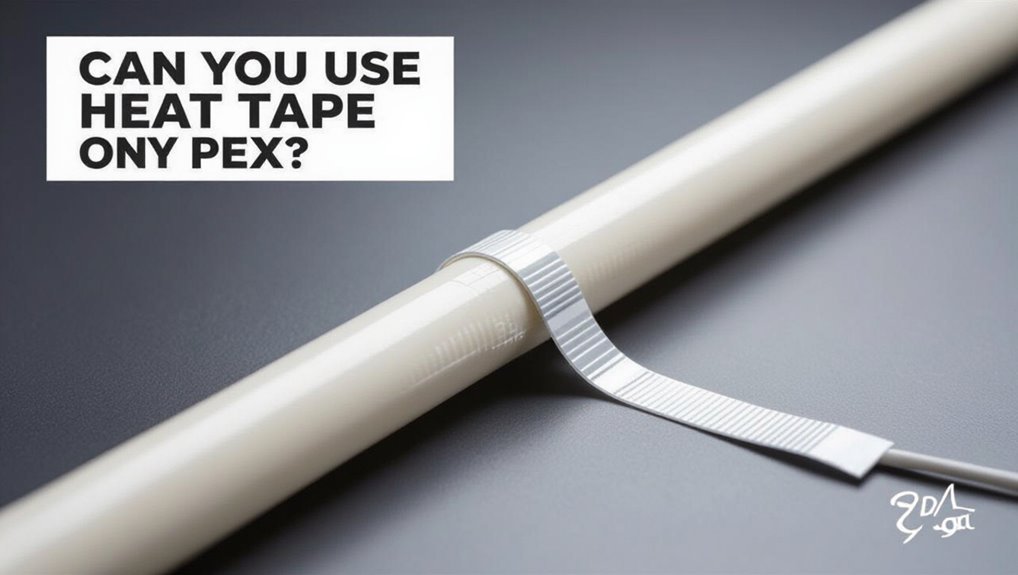
Can heat tape be used on PEX pipe? The short answer: yes, with conditions.
Guidance indicates heat tape compatible with plastic plumbing and specifically labeled for use on PEX should be selected. Installation must follow manufacturer instructions, avoiding overlapping tape, maintaining specified spacing, and not exceeding recommended temperatures.
Proper pipe insulation and secure attachment prevent heat loss and mechanical damage. Electrical connection and grounding should meet code.
When doubt or unusual installations exist, a licensed plumber or electrician should evaluate. Incorrect product choice or improper installation can risk pipe damage, fire hazards, or voided warranties.
How Heat Tape Works for PEX
Heat tape prevents freezing by converting electrical energy into controlled heat along the length of PEX pipe, either through resistive wiring or self-regulating conductive polymers.
Different designs maintain a steady surface temperature or adjust output in response to ambient conditions.
Power is supplied either from standard AC outlets or low-voltage sources, with choices affecting installation complexity and safety considerations.
How Heat Tape Works
Several types of heat tape use electrical resistance to generate warmth along a PEX pipe’s exterior, maintaining temperature above freezing or preventing thermal loss.
Heat tape transfers heat by a conductor or self-regulating polymer element bonded to a flat, flexible backing that contacts the pipe. Controls and sensors modulate output to avoid overheating.
Installation requires appropriate spacing, secure attachment, and compatible insulation covering the tape.
Typical functions include:
- Preventing freeze at vulnerable sections.
- Reducing recovery time for warmed fluid.
- Compensating for ambient heat loss.
- Allowing targeted, linear heat where insulation alone is insufficient.
Heat Tape Power Sources
Power for PEX-compatible heat tape comes from either standard electrical mains or low-voltage DC systems, each offering distinct trade-offs in installation complexity, safety, and performance. The mains option supplies consistent heat and simpler thermostats but requires proper grounding, GFCI protection, and adherence to local electrical codes. Low-voltage systems reduce shock risk and may suit exposed or damp locations; they demand a transformer and careful current sizing. Selection depends on run length, ambient conditions, and code constraints. Matching manufacturer recommendations to PEX temperature limits guarantees safe operation and prevents pipe damage.
| Source | Typical use |
|---|---|
| Mains AC | Long runs |
| Low-voltage DC | Short runs |
| Mains w/GFCI | Wet areas |
| Transformer-required | Retrofit situations |
What PEX Manufacturers Say About Heat Tape
When consulted about applying heat tape to PEX piping, major manufacturers consistently caution against using products that raise local surface temperatures above the pipe’s rated limits and recommend following installation instructions and temperature-monitoring controls.
Some allow specific certified heat-trace systems when installed per their guidelines, while others advise against any direct-contact heating unless the tape and PEX are explicitly listed as compatible.
Manufacturers typically advise installers to:
- Verify manufacturer compatibility lists and certifications.
- Use thermostat or limiter controls recommended by the PEX maker.
- Maintain required clearances and protective wraps where specified.
- Contact technical support for atypical installations or doubts.
Code and Safety Standards for Heat Tape on PEX
Discussion of code and safety standards begins with confirming that any heat tape used on PEX has explicit manufacturer approval for that application.
Installations must also meet local electrical and plumbing codes, which can vary by jurisdiction and may impose specific wiring, support, or temperature-control requirements.
Finally, most authorities require ground-fault protection where heat tape is installed to reduce shock and fire risk.
Manufacturer Approval Required
Manufacturers’ approval is a critical prerequisite before installing heat tape on PEX piping: codes and safety standards typically require that the heat tape be explicitly listed for use with the specific PEX product and installation conditions.
The manufacturer’s documentation must confirm compatibility, maximum surface temperature, and installation method. Without written approval, warranty and code compliance can be voided.
Key considerations include:
- Confirm heat tape model is listed for the PEX brand and pipe diameter.
- Verify maximum allowable temperature and power rating.
- Follow manufacturer installation instructions precisely.
- Retain approval documents for inspections and warranty claims.
Local Code Compliance
Because local codes and safety standards define permissible materials, methods, and documentation, installers must verify municipal and state requirements before applying heat tape to PEX piping.
Authorities may mandate specific listings, temperature ratings, installation clearances, and approved fastening methods. Inspection schedules, permit procurement, and recordkeeping vary; noncompliance can require removal or replacement.
Where codes conflict with manufacturer instructions, the more restrictive requirement typically governs, but documented justification and code official approval are advisable.
Compliance also includes adherence to fire, energy, and plumbing codes that reference electrical and piping standards.
Installers should obtain written confirmation when variances or deviations are necessary.
Ground-Fault Protection
When applying heat tape to PEX, ground-fault protection requirements intersect with local code obligations and manufacturer instructions and must be addressed before energizing any circuit.
Inspectors and installers should verify GFCI use, circuit type, and compatibility with wet or damp locations. Documentation must reference the device’s listing and wiring method.
Failure to provide GFCI where required risks shock and code violation.
- Confirm manufacturer mandates GFCI protection for that model.
- Install GFCI at the branch circuit serving exposed or outdoor runs.
- Use equipment listed for moist environments.
- Retain inspection records and labeling for compliance.
Heat‑Tape Types: Self‑Regulating vs Constant‑Watt (PEX Compatibility)
Although both self‑regulating and constant‑watt heat tapes are designed to prevent frozen pipes, they differ fundamentally in how they produce and control heat, and those differences determine their suitability for PEX.
Self‑regulating tape varies output with temperature: it reduces heat where warm, increases where cold, lowering hot spots and risk of overheating.
Constant‑watt tape emits uniform heat regardless of ambient conditions, which can create localized high temperatures.
For PEX, manufacturers typically prefer self‑regulating types because they minimize sustained surface temperatures and thermal stress.
Regardless, installers must follow the pipe and tape manufacturer instructions and applicable electrical codes to guarantee safe compatibility.
When to Use Heat Tape vs Insulation or Trace Heating
Selection of frost protection depends on pipe length, exposure, and required reliability: heat tape suits short, localized freeze points; insulation-first is recommended to reduce heat loss and limit heating needs;
electrically traced systems are more appropriate for long runs or continuous protection where uniform heat is required.
When To Use Heat Tape
How should one decide between heat tape, pipe insulation, or electric trace heating for PEX lines?
Heat tape suits short runs, exposed sections, or occasional freezes where quick, localized warmth prevents freezing. It is appropriate when access is limited and permanent trace heating is impractical.
Consider pipe material, manufacturer guidance, and wet locations; choose UL-listed products and follow spacing and power limits. Avoid continuous burial under insulation without proper wrapping.
For long mains or where constant temperature control is required, trace heating or integrated systems may outperform heat tape. Regular inspection and thermostat use improve reliability and safety.
- Short exposed runs
- Localized freeze risk
- Limited access
- Temporary or supplemental heating
Insulation First Approach
When deciding whether to add heat tape, prioritize passive measures first: properly sized pipe insulation and sealing drafts often prevent freezing without electrical heat.
The insulation-first approach evaluates R-value, pipe exposure, and ambient temperature before selecting active heating. Use closed-cell foam or fiberglass with vapor barrier on PEX, fitting snugly around fittings and supports.
Repair gaps, add pipe wrap in cavities, and improve ventilation or heat retention in unheated spaces. Reserve heat tape for localized, persistent freeze risk where insulation and sealing cannot maintain safe temperatures.
Document insulation type and thickness to inform future maintenance and any heat tape use.
Trace Heating For Long Runs
Although short, well-insulated runs are often protected by passive measures, long or exposed PEX runs require a different strategy: electrically traced systems provide uniform, controllable heat along the entire length where insulation alone cannot guarantee freeze protection.
Trace heating is selected when runs exceed practical insulation limits, traverse unheated spaces, or face prolonged subfreezing conditions. Design must match pipe material, ambient exposure, and power availability.
Benefits include consistent temperature maintenance and thermostat control; drawbacks include cost and installation complexity.
- Use trace for long, exposed runs.
- Prefer self-regulating cable for variable conditions.
- Insulate over the trace.
- Follow manufacturer and code.
Preparing PEX for Safe Heat‑Tape Installation
Before applying heat tape, the PEX section should be inspected and prepared to assure safe, effective operation. Surfaces must be clean, dry, and free of sharp edges or solvents. Insulation should be compatible with both PEX and heat tape and should not compress the tape. Ascertain adequate pipe support to prevent stress during thermal cycling. Verify ambient and surface temperatures meet the tape’s specifications. Confirm electrical grounding and circuit protection are available where required. Label the run for future maintenance. Use only manufacturer‑approved materials and follow local codes; do not proceed until all conditions are met.
| Task | Check | Action |
|---|---|---|
| Cleanliness | Visual | Remove debris |
| Insulation | Compatibility | Use rated type |
| Support | Stability | Add clamps |
Step‑by‑Step: Install Heat Tape on PEX
One clear set of steps guides the installer through attaching heat tape to PEX to guarantee reliable freeze protection and maintain pipe integrity.
The procedure proceeds methodically, observing manufacturer instructions and prior preparation. Follow these steps precisely:
- Verify the heat tape model suits PEX and the ambient conditions; disconnect power before handling.
- Lay the PEX straight, clean, and dry; position the tape along the pipe without twists or kinks.
- Secure the tape with approved fasteners at manufacturer-recommended intervals, avoiding metal clamps that can abrade the tubing.
- Insulate over the assembly as specified, restore power, and test operation and temperature control.
Wrapping Patterns and Spacing That Protect PEX
When arranging heat tape on PEX, proper wrapping patterns and consistent spacing determine both freeze protection effectiveness and tubing longevity; installers should choose a layout that balances heat delivery with minimized stress on the pipe. Common patterns include straight-run alongside the pipe, spiral wraps, and intermittent contact for long runs. Spacing should follow manufacturer guidance, typically close on exposed sections and wider in sheltered areas. Avoid tight overlaps that concentrate heat. Secure tape without compressing PEX and inspect connections at joints and fittings. Record pattern and spacing for future maintenance.
| Pattern | Typical Use | Note |
|---|---|---|
| Straight-run | Short runs | Minimal stress |
| Spiral | Long runs | Even heat |
| Intermittent | Sheltered | Saves power |
| Overlap | Not recommended | Risk of hot spots |
Power Supply and Electrical Considerations for PEX Heat Tape
The section addresses electrical requirements for heat tape on PEX, starting with ensuring the tape’s voltage rating matches the available circuit to prevent overheating or insufficient output.
It emphasizes the need for ground-fault protection and appropriate breakers or GFCI outlets where required by code.
Placement and accessibility of the power source are covered to avoid long extension runs and to maintain safe, code-compliant connections.
Voltage And Circuit Matching
Voltage compatibility and circuit capacity are fundamental for safe, effective installation of PEX heat tape. The installer verifies heat tape voltage rating matches the supply (typically 120V or 240V) and avoids mixing ratings on one run.
Circuit load is calculated to guarantee the branch can handle continuous draw; heat tape is a continuous-duty load. Panel labeling and breaker sizing are checked against manufacturer ampere requirements. Properly matched voltage and circuit prevent overheating, nuisance trips, and fire risk.
- Confirm tape voltage rating equals supply.
- Calculate continuous current draw.
- Size breaker and wiring accordingly.
- Follow manufacturer specifications.
Ground-Fault Protection
Because ground-fault protection reduces shock and fire risk by detecting unintended current paths, installers must guarantee PEX heat tape circuits incorporate appropriate ground-fault devices per local code and manufacturer guidance.
Ground-fault circuit interrupters (GFCIs) or equipment-grounding fault protection must be selected for the specific heat tape type and environment. Devices should match voltage, current, and whether continuous duty is required.
Testing and periodic verification of trip functionality are essential. Connections must remain accessible for servicing. Documentation of protection type and location should accompany the installation.
Local authority having jurisdiction may mandate supplementary measures such as bonded enclosures or residual-current monitoring.
Power Source Location
A dedicated, accessible power source must be located and specified for each PEX heat tape run to guarantee safe, reliable operation and compliance with electrical and manufacturer requirements.
The power location should minimize extension cords, maintain proximity to the tape end, and remain reachable for inspection and service.
Circuits must match heat tape voltage and amperage, and GFCI protection should be confirmed per local code.
Consider permanent junction boxes and labeled breakers to prevent accidental disconnection.
Avoid routing cords through confined, wet, or inaccessible spaces.
- Circuit matching
- GFCI verified
- Accessible junction box
- Clear labeling
Thermostats, Controllers, and Sensors for PEX Lines
Several types of thermostats, controllers, and sensors are used to regulate heat tape on PEX lines, each offering different levels of precision and protection. Devices range from simple mechanical thermostats to electronic controllers with ambient and pipe-contact sensors; selection depends on freeze-risk, pipe location, and power availability. Proper sensors prevent overheating and conserve energy. Controllers can include timers, temperature setpoints, and alarms. Integration with GFCI protection and manufacturer specifications is essential. Below is a concise comparison:
| Device Type | Typical Use |
|---|---|
| Mechanical thermostat | Basic freeze protection |
| Electronic controller | Precise temperature control |
| Pipe-contact sensor | Direct pipe monitoring |
| Ambient sensor | Area temperature sensing |
Common Installation Mistakes That Damage PEX (And How to Avoid Them)
Common installation mistakes can compromise PEX integrity and reduce system lifespan.
Typical issues include kinking during bending, overheating from improperly applied heat tape, and incorrect support spacing that allows undue stress.
Addressing each error with proper bending techniques, heat-tape placement and temperature control, and manufacturer-recommended hanger intervals prevents damage.
Kinking During Bending
Kinking occurs when PEX tubing is bent beyond its minimum bend radius, producing a sharp dent that restricts flow and weakens the pipe. Installers must recognize causes and correct techniques to prevent permanent damage.
- Inspect: check for kinks before securing lines; replace tubing with permanent dents.
- Support: use appropriate clamps and straps to maintain gentle curves and avoid stress points.
- Tools: employ bend supports or formers rather than forcing elbows by hand.
- Recovery: small reversible creases can be eased with controlled heat per manufacturer guidance; do not overheat or rely on heat to fix severe kinks.
Overheating With Tape
Overheating from heat tape application can degrade PEX tubing quickly when installers allow temperatures or exposure times to exceed manufacturer limits. Excessive heat softens the polymer, causes dimensional changes, and accelerates oxidation or embrittlement, leading to leaks or failure.
Common mistakes include wrapping tape too tightly, layering multiple tapes, using non‑thermostatic tapes in continuous high‑ambient conditions, and ignoring rated temperature ranges.
Prevention requires following heat tape specifications, using thermostatically controlled or self‑regulating products compatible with PEX, monitoring surface temperatures during commissioning, and inspecting for signs of heat damage.
Proper selection and disciplined installation minimize overheating risks and extend PEX service life.
Incorrect Support Spacing
One frequent cause of premature PEX failure is improper support spacing, where installers place hangers or straps too far apart or use incompatible supports, allowing sagging, undue stress at fittings, and abrasion against framing.
Properly spaced supports preserve alignment, limit movement from thermal expansion, and prevent point loads that deform tubing or loosen connections.
Recommended practices include following manufacturer spacing tables, using smooth saddle supports, and avoiding metal straps that cut into the pipe.
Consequences and mitigations are clear:
- Increased stress at fittings — add supports near joints.
- Sagging runs — reduce spacing.
- Abrasion risks — use protective sleeves.
- Thermal movement — allow expansion loops.
Preventing Overheating and PEX Softening
When applied to PEX, heat tape must be chosen and installed to keep surface temperatures well below the polymer’s softening point; otherwise the tubing can distort, lose mechanical strength, or fail at fittings.
Installers must use heat tape rated for PEX, avoid high-wattage models, and follow manufacturer maximum temperature specifications.
Temperature-limiting devices, thermostats, or self-regulating tapes reduce overheating risk.
Maintain air circulation around the pipe when required and avoid wrapping insulating layers that trap excessive heat unless compatible.
Keep heat tape ends and splice points clear, and guarantee electrical connections are properly protected to prevent localized hot spots that could soften PEX.
Inspecting and Maintaining Heat Tape on PEX
Routine inspection and maintenance of heat tape on PEX guarantee reliable freeze protection and prevent damage to the tubing.
Inspection focuses on secure attachment, intact insulation, and absence of overheating signs. Maintenance tasks include cleaning, replacing worn sections, and confirming thermostat operation.
Recommended checks:
- Visual: look for frayed tape, exposed wires, discoloration, or melted spots.
- Attachment: verify tape contacts pipe without gaps and fasteners remain tight.
- Electrical: test for continuity and proper thermostat cycling with power off during checks.
- Documentation: log inspections, dates, findings, and any repairs to track performance and warranty needs.
Temporary vs Permanent Heat‑Tape on PEX: Pros & Cons
After inspection and maintenance practices have been established, the choice between temporary and permanent heat-tape installations becomes the next practical decision.
Temporary heat tape offers quick deployment for short-term freeze threats, minimal commitment, and easy removal, but risks improper fastening, exposure to weather, and limited lifespan.
Permanent heat tape provides consistent freeze protection, integrated controls, and durability when installed per manufacturer guidelines, yet demands correct substrate, long-term power access, and periodic inspection.
Selection depends on exposure duration, accessibility, and risk tolerance. For PEX, adherence to product listings, temperature limits, and installation spacing determines whether temporary or permanent solutions are appropriate.
Cost: Heat Tape vs Trace Heating vs Insulation
Comparing costs for freeze protection on PEX—heat tape, electrical trace heating, and increased insulation—requires evaluating upfront materials, installation labor, operating energy, and lifecycle maintenance.
Heat tape costs are low for materials and DIY install but can incur higher energy use and replacement over years.
Trace heating has higher upfront and professional installation expenses, but offers precise control and often lower operational waste.
Upgrading insulation is cheapest long‑term with minimal energy cost but may not suffice alone in extreme exposure.
- Heat tape: low setup, moderate energy, medium lifecycle cost
- Trace heating: high setup, efficient operation, long lifecycle
- Insulation: low setup, negligible energy, long lifecycle
- Combined: balanced cost and reliability
Troubleshooting: Why Heat Tape May Not Stop PEX From Freezing
Moving from cost considerations to performance, homeowners and contractors often find that heat tape can fail to prevent PEX from freezing for several practical reasons.
Incorrect tape selection, such as using non-self-regulating tape on variable-temperature runs, limits effectiveness. Poor installation—gaps, overlapping that traps heat, or inadequate contact—reduces heat transfer.
Damaged or degraded tape, loose power connections, or improper power supply prevent operation. Uninsulated or exposed pipe sections, extreme ambient temperatures beyond tape rating, and long unsupported runs create thermal losses exceeding tape output.
Finally, lack of proper thermostat or sensor placement can leave critical spots unheated, causing localized freezing despite apparent system function.
When to Call a Plumber or Electrician
If heat tape fails to keep PEX from freezing despite correct selection and installation, homeowners should evaluate whether the problem requires a plumber, an electrician, or both.
A plumber is needed for leaks, pipe movement, inadequate insulation, frozen sections with pressure loss, or suspected pipe damage.
An electrician is required for faulty wiring, tripped breakers, improper grounding, or when heat tape installation violates electrical code.
Both professionals should be called when there is combined water damage and electrical hazard, or when responsibility is unclear.
Professional assessment prevents further damage and guarantees repairs comply with plumbing and electrical standards.
- Leaks or burst pipes
- Wiring faults
- Combined hazards
- Code violations
Safety Checklist Before Powering Heat Tape on PEX
Before powering heat tape on PEX, perform a concise safety checklist to verify the installation and electrical connections are correct and that the piping is prepared to accept heat.
Inspect tape compatibility with PEX, ensuring manufacturer approval and appropriate type (self-regulating or constant-wattage rated for PEX).
Confirm pipe insulation is intact and rated for the added heat; avoid overlapping tape or covering with combustible materials.
Check electrical supply: correct voltage, ground-fault protection, weatherproof connections, and secure strain relief.
Verify placement clearances from flammable items and other heat sources.
Document installation, label circuits, and schedule a follow-up inspection before energizing.
Conclusion
Practical, precise, protective practices prevail: properly paired, professionally permitted heat tape provides predictable protection for PEX, preventing pipe perishing, pressure problems, and pricey plumbing predicaments. Producers, plumbers, and codes counsel cautious compatibility checks, correct insulation, and circuit safeguards. Self‑regulating systems usually suit sensitive synthetic supply lines better than constant‑watt types, but careful calibration, competent consultation, and conscientious commissioning remain critical. Prioritize preservation, prohibition of shortcuts, and prompt professional participation for peace of mind.