Can You Bend Copper Pipe? Easy DIY Tips & Tools for Success
Yes, you can bend copper pipe reliably for various DIY plumbing tasks using the appropriate type, tools, and techniques. Here are the key takeaways for successful bending:
- Types of Copper: Soft (annealed) and Type M copper can be bent easily by hand or with a bending spring. In contrast, Type L or K and hard-drawn sections require a tube bender, mandrel, or annealing for tighter bends.
- Preparation: Always measure accurately and support the pipe adequately to prevent kinks or flattening.
- Heating: For tougher bends, safely heat the pipe when necessary to avoid work hardening.
- Safety First: Follow specific tool instructions and safety precautions to achieve professional results.
With these tips, you can effectively bend copper pipes for your plumbing projects.
Can You Bend Copper Pipe? Quick Answer and When to Do It
Can copper pipe be bent without compromising its function? The answer is yes, when performed correctly.
Copper tolerates bending for routing and fitting, reducing joints and potential leak points. Proper technique preserves internal diameter and wall integrity: gradual curves prevent kinks, support prevents stress at fittings, and heat or annealing may be applied for tighter bends.
Bending is appropriate for repair, retrofits, and custom runs where factory elbows are impractical. It is unsuitable when excessive force, repeated bending, or improper tools risk cracking.
Assessment of accessibility, required bend radius, and planned pressure guarantees a reliable outcome.
Which Copper Types Bend Easily (K, L, M; Soft vs. Hard)
The article compares Type K, L, and M copper to show how wall thickness and alloying affect flexibility.
It also contrasts soft (annealed) and hard (drawn) conditions to explain which will hold a bend without cracking or springing back.
Finally, bendability by grade is summarized so readers can choose the right pipe for their project.
Copper Types Compared
Three common copper types—K, L, and M—differ mainly in wall thickness and temper, which determine how easily each bends and where it is best used.
Type K has the thickest walls, offering greatest strength and less flex, so it resists tight bends but suits high-pressure or underground runs.
Type L balances durability and malleability, accommodating moderate bends with fewer fittings.
Type M, being the thinnest, bends most readily for indoor plumbing and low-pressure applications but is less robust.
Choosing among them depends on required bend radius, pressure rating, and installation environment, not solely on ease of bending.
Soft Versus Hard
Choosing copper by wall thickness naturally leads to contemplating its temper: soft (annealed) versus hard (drawn) copper.
Soft copper is pliable, allowing tighter bends with less force and reduced risk of kinking; it’s preferred for manual bending and repair work.
Hard copper holds shape better, resists denting, and requires bending tools or annealing before tight bends.
Selection depends on technique and access to tools, not only grade.
- Soft: easier to bend by hand or with simple benders.
- Hard: stronger, needs tools or anneal step.
- Annealing: restores softness for shaping.
- Job fit: balance formability and strength.
Bendability By Grade
Although wall thickness and temper both determine how a copper tube responds to bending, the standard grades—K, L, and M—offer a quick rule of thumb: thinner-walled M bends most readily, L provides a middle ground, and heavy-walled K is the stiffest.
M-grade, common in residential applications, eases manual shaping and springback is minimal when annealed.
L-grade balances strength and formability, suitable for moderate bends with a roller or spring.
K-grade resists deformation, meant for underground or high-pressure lines; bending requires mechanical benders or multiple annealing passes.
Regardless of grade, choosing soft (annealed) over hard simplifies accurate, crack-free bends.
Tools to Bend Copper Pipe: Tube Benders, Mandrels, Springs
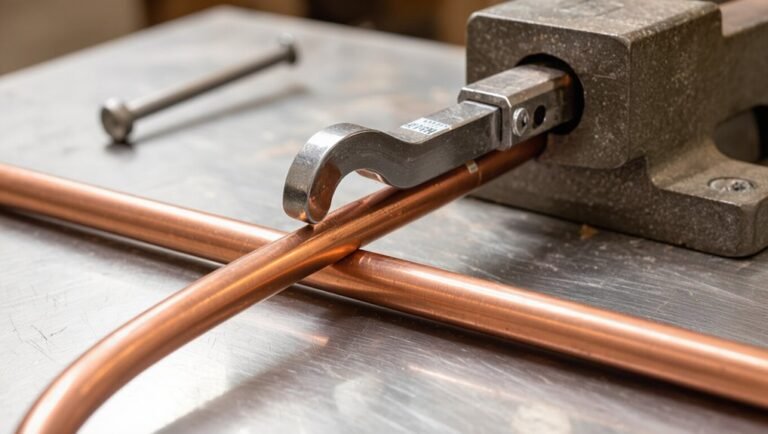
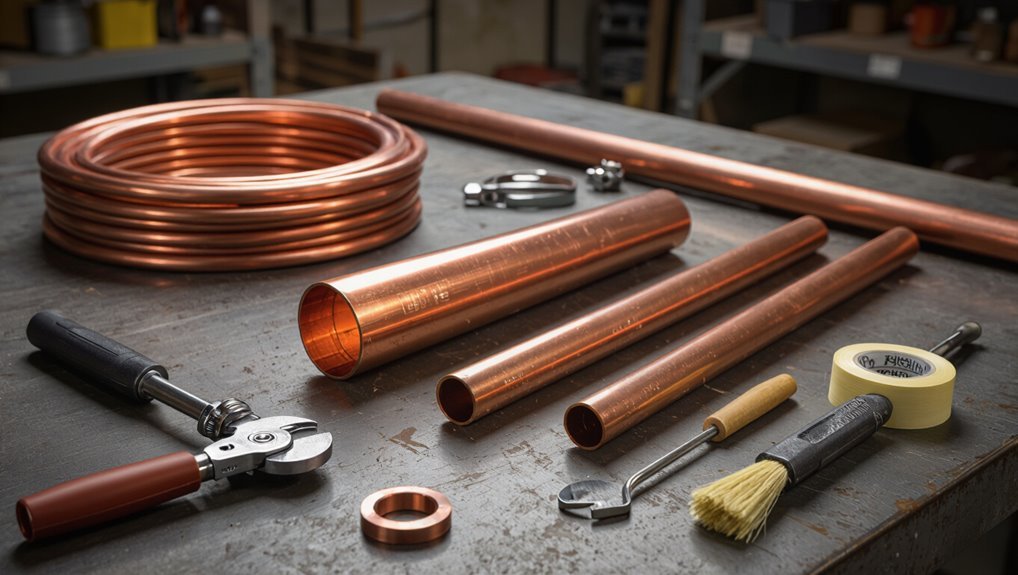
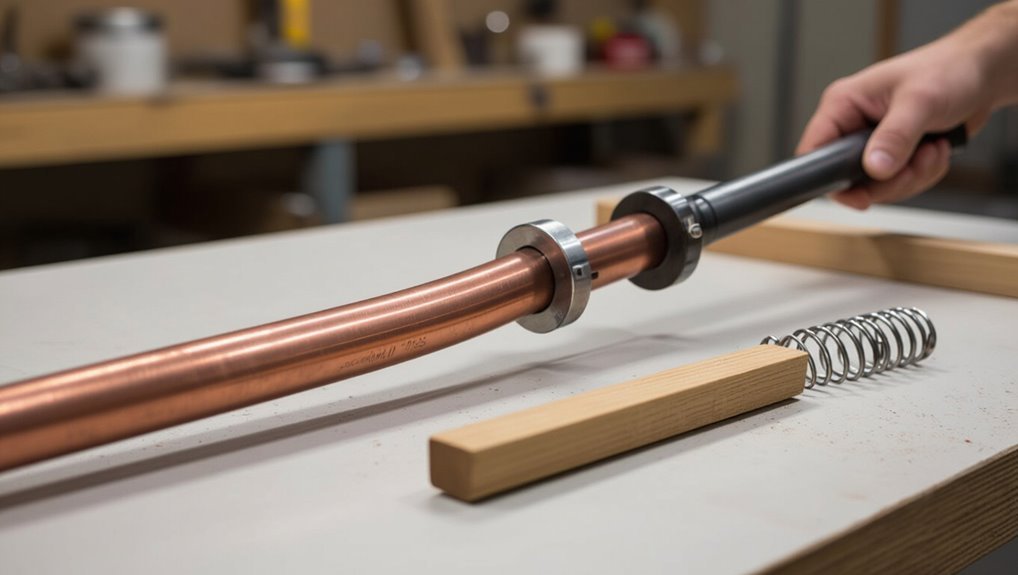
A small set of specialized tools makes accurate, kink-free bends in copper pipe possible: tube benders for controlled radii, mandrels for internal support on tight curves, and bending springs for short, handheld corrections.
- Tube bender — Provides consistent, smooth bends; chooses die size to match pipe O.D.
- Mandrel — Inserts into the pipe to prevent collapse during severe or long-radius bends.
- Bending spring — Fits inside or outside for quick, manual bends on soft copper.
- Lever or hydraulic bender — Used for larger diameters or thicker walls where human force is insufficient.
Each tool suits specific pipe sizes and bend requirements.
Prepare Copper Pipe for Bending: Measure, Support, Anneal
After selecting the appropriate bending tool, the pipe must be measured, supported, and annealed to guarantee clean, accurate curves. Measure twice, mark bend locations, and account for springback. Support the pipe with saddles or a vise padded to prevent flattening; use a form or bender to maintain radius. Anneal only when needed: heat evenly with a torch until a dull red, then quench or cool per alloy guidance to restore ductility. Inspect for scale, clean joints, and re-measure after annealing. Proper preparation reduces kinks, cracks, and fitment errors.
| Task | Tool | Tip |
|---|---|---|
| Measure | Tape | Mark both ends |
| Support | Saddle | Pad contact |
| Anneal | Torch | Even heating |
Bending Copper Pipe Step-by-Step With a Hand Tube Bender
When ready to bend, the operator positions the pipe in the hand tube bender so the mark aligns with the bender’s pivot and secures the stock in the clamp. Then, the operator applies steady pressure on the handle while watching the degree scale to reach the target angle; smooth, continuous motion and occasional small readjustments prevent kinks and guarantee the pipe follows the die radius.
The process continues with measured steps:
- Verify alignment and secure the pipe.
- Bend slowly to the halfway angle, pause to check fit.
- Resume to final angle, using the scale.
- Release and inspect for springback and finish.
Bend Copper Without a Tube Bender: Spring, Sand, and Heat Methods
Several practical alternatives exist for bending copper without a tube bender, each relying on simple tools or heat to prevent kinking and maintain an even radius. Techniques include using a spring insertion for gentle curves, filling with sand and sealing ends for firmer bends, and applying localized heat (annealing) to soften the metal before shaping. Each method suits different diameters and bend radii; safety and cleanup differ. Proper support and gradual force reduce deformation. Below is a compact comparison to guide selection.
| Method | Best for | Notes |
|---|---|---|
| Spring | Soft, small curves | Reusable, quick |
| Sand fill | Sharper bends | Messy, requires sealing |
| Heat (anneal) | Tight radii | Requires fire safety |
| Combined | Difficult bends | Use progressively |
Common Bends: 90°, 45°, Offsets, and Compression Bends
The section outlines practical approaches for forming 90° and 45° bends with consistent radii and minimal kinking.
It then covers offset techniques for shifting pipe runs while maintaining flow alignment.
Finally, compression bend methods for fittings and tight spaces are summarized with attention to sealing and clearance.
90° And 45° Techniques
Many plumbing runs require accurate 45° bends to change direction smoothly without the bulk of a 90° elbow. Mastering these techniques—from mark-and-bend methods to using spring benders or fittings—keeps flow resistance low and alignment precise.
Practitioners measure and mark where the bend begins and ends, apply even pressure with a tube bender or spring, and check angle with a protractor or gauge. Heat is unnecessary for small-diameter soft copper.
When fittings are preferable, compression or slip 45° elbows guarantee repeatability.
Common best practices include:
- Clean and deburr cut ends
- Support pipe to avoid spring-back
- Bend slowly, checking incrementally
- Use correct tooling for OD
Offsets And Compression Methods
Offsets and compression bends let a plumber shift pipe runs vertically or laterally without extra fittings, maintaining flow while fitting around obstacles.
Offsets use two opposing bends and a center section to change alignment; precise measurements and consistent bend radii prevent stress and guarantee proper slope.
Compression bends employ compression fittings or specialized compression elbows to join straight sections where bending is impractical, useful near fixtures or tight spaces.
Proper annealing, backing support, and deburring maintain seal integrity.
Selection between offset bending and compression connections depends on access, aesthetic requirements, pressure ratings, and code compliance, optimizing durability and leak prevention.
Prevent Kinks, Flattening, and Work Hardening : Pro Tips
Prevent kinks, flattening, and work hardening by matching technique and tools to the copper’s diameter and temper: soft annealed tubing tolerates tighter bends and can be reshaped, while hard-drawn pipe requires gentler curves, proper support, and slower, even bending to avoid stress concentration.
- Use the correct sized bending spring or form to support the ID and maintain roundness.
- Apply steady, uniform pressure; avoid sudden jolts or over-bending at one point.
- Support long runs with backing wood or a mandrel to prevent local flattening.
- Frequently inspect bends for work hardening and minor cracks; stop if resistance increases.
When to Anneal Copper and How to Do It Safely
Know when annealing is necessary by checking the copper’s temper, bend radius, and the presence of hard spots: soft annealed tubing can be bent with less risk, while hard-drawn pipe that resists forming, produces spring-back, or shows signs of work hardening should be annealed before further shaping.
Annealing softens metal by heating to a dull red (approx. 600–700°C for copper) then cooling slowly. Use a propane torch in a well-ventilated area, clear flammable materials, and wear heat-resistant gloves and eye protection.
Mark areas to heat, avoid overheating which melts the copper, and quench only if specified by manufacturer recommendations.
Joining and Testing Bent Copper: Fittings, Soldering, Pressure Test
Several common methods are used to join bent copper—compression fittings, sweat (solder) joints, and mechanical push-fit couplings—each chosen based on access, pressure rating, and permanence.
The technician cleans and fluxes mating surfaces for solder, tightens compression nuts without over-stressing the bend, or seats push-fit connectors per manufacturer instructions.
After assembly, connections are visually inspected for gaps and proper alignment. A pressure test follows using water or air at recommended test pressure, watching gauges and joints for leaks for several minutes.
If leaks appear, repair involves tightening, re-sweating, or replacing the fitting as appropriate.
- Clean and flux
- Assemble per type
- Pressure test
- Repair or replace
When to Call a Pro (Code Limits, Large Pipe, Safety Risks)
After completing bends, fittings, and pressure testing, some jobs still exceed the scope of a typical DIYer and should be handed to a licensed plumber.
Code compliance, large-diameter piping, structural penetrations, and municipal inspection requirements often mandate professional involvement.
Complex layouts, concealed locations, or systems carrying high pressure, gas, or potable water require expertise to prevent leaks, contamination, or failure.
Safety risks include torch use near combustibles, lead solder removal, and confined-space work.
When uncertainty arises about permits, material limits, or emergency shutoff access, hiring a pro minimizes liability, guarantees adherence to codes, and protects property and occupants.
Conclusion
Whether a DIYer should bend copper depends on pipe type, tools, and technique—yet the real test waits at the bend. Skilled hands and a proper tube bender, annealing when needed, and careful support can yield flawless curves; one misstep yields kinks, leaks, or costly repairs. Before committing, consider code limits and when to call a pro. Tension tightens, breath holds—then the fitting clicks into place, and either success or a costly lesson reveals itself.